






Companies are under more pressure than ever before, with boards demanding profitability and efficiency. Gone are the days of casual spending—if your product or service doesn’t deliver clear, measurable value, it’s at risk.
As someone who has spent over two decades in customer success, navigating everything from high-growth startups to large enterprises, I’ve seen firsthand the importance of not just delivering value, but proving it.
In this article, I’ll break down the strategies I’ve used to build a powerful value cycle that drives renewals and expansions, even in challenging economic climates.
Why value matters
Right now, your customers are under immense pressure, especially from their boards.
The question they're being asked is: When are you going to become profitable, and how are you going to become more efficient? This is particularly true for those that rely heavily on external funding.
Gone are the days of frivolous spending. Now, every dollar counts.
If you’re not driving value for your customers, your organization is at risk. And it’s not just about your customers achieving value; they need to know they’re achieving value. Not only do your customers need to see the value, but the right people within their organization need to be aware of it, too.
I’ve had countless conversations with customer success leaders who are shocked when a customer churns, despite being happy with the value. My first question is always, “Did the decision maker know how much value you were providing?”
Often the answer is no. It’s no longer enough to have one strong use case or one solid relationship at an organization.
Becoming multi-threaded
Now more than ever, you need to be multi-threaded within your customers' organizations. You should ask yourself:
- Do I have the ability to land on multiple budgets?
- Are there multiple people who will go to bat for my product or service?
- How many use cases can I spin up for this customer?
It doesn’t matter whether you’re a small company or serving major clients, value and ROI are king, and being multi-threaded is a necessity.
I’ve developed a value cycle that I’ve used successfully at four different organizations with vastly different business models. Not only has it helped me drive strong ROI, but it’s also been instrumental in expanding business relationships.
I believe in it so much that I continue to implement it in every organization I work with, and I share it when mentoring startup leaders. This approach works, and I’m excited to share it with you.
The four-pronged approach to driving value
Let’s dive into the four key steps that drive value and renewals in customer success. The approach I’ve used successfully across multiple organizations is a simple yet powerful framework:
- Understand the goals and pain points
- Build a plan
- Deliver that value
- Report on that value
Let’s break each step down, starting with the first and arguably most foundational: understanding your customer’s goals and pain points.
Step 1: Understand the goals and pain points
The first and most critical step in driving value for your customers is understanding their goals and pain points. This might sound basic, but it’s the foundation of everything that follows.
If you’re not aligned on what your customer is trying to achieve and the challenges they face, you’ll never be able to deliver the value they need.
Many of you may be familiar with the sales framework MEDDIC, which focuses on metrics, economic buyers, decision criteria, and pain points. In customer success, we take a similar approach, but our job is to ensure that the pain points identified during the sales process are carried through and acted upon. This is where partnering with your sales team is crucial.
If you’re not receiving this information during the handoff, you need to fix that immediately. It’s one of the most important things you can do to start off the customer relationship on the right foot.
Whether you’re in the onboarding phase or well into the customer lifecycle, keeping the customer’s goals and pain points front and center is non-negotiable. Every conversation, every check-in, should be rooted in those goals and pain points.
Establishing a rhythm for continuous discovery
One mistake I see often is treating the discovery of goals and pain points as a one-time event. In reality, this should be an ongoing process.
Every time you interact with your customer, you should be revisiting their goals, problem statements, and the reasons they purchased your product in the first place.
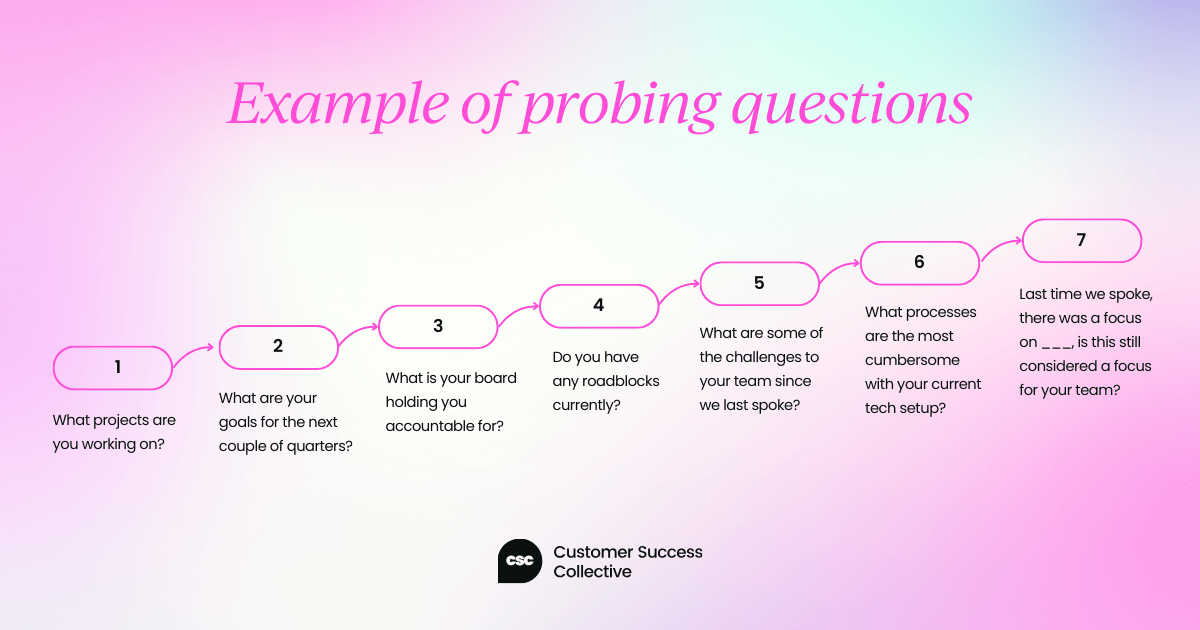
Come prepared with probing questions during each check-in to continue surfacing these pain points. I highly recommend creating a shared document—whether in Notion, Google Docs, or another tool—where your team can build a repository of these probing questions.
Customize them to the specific industries or types of customers you serve so your Customer Success Managers (CSMs) are equipped to dig deeper in every conversation.
Discovering untapped value
One of the most valuable things you can do is to uncover untapped value for your customer—ways to solve their pain points without them having to spend more money. This could be features they’re already paying for but not using, or opportunities that exist within their current contract.
For example, if your company offers an unlimited seat model, there’s often untapped value in getting more employees at the customer’s company to adopt your product.
Asking the right probing questions can reveal these hidden opportunities, increasing your product’s stickiness and deepening your relationship with the customer.
Documenting the process
In every customer engagement, it’s critical to document the goals, pain points, and any untapped value you identify. I’m a big fan of using tools like Notion for this. It’s a collaborative platform where teams can update and share what they’re learning from each customer interaction. This allows the team to stay aligned and continuously improve their understanding of the customer’s business.
The key takeaway here is simple: keep the focus on your customer. Everything you do should be about learning more about their business, their challenges, and their goals. The more you know, the more you can position yourself as a valued partner—not just another vendor.
Step 2: Building a plan
Now that you’ve understood the customer’s goals and pain points, the next critical step is building a plan.
But here’s the key: plans have to be two-sided. It’s not enough to simply document a strategy—you need your customer’s full buy-in. Without it, all you’ve got is a bunch of words on paper.
Once you’ve identified the problem statements that both you and the customer agree to work on, you need to ask:
- How are we going to achieve these goals together?
- For example, what kind of change management do they need to implement?
- Does their team need specific training to adopt your solution?
- If so, can you schedule quarterly on-site visits for use case-specific training?
Everything needs to be clearly documented and scheduled—get those dates on the calendar and make sure there’s a shared commitment to the plan.
Getting customer buy-in
Buy-in doesn’t stop with the person you’re working with directly. You need to get their team on board as well.
Ask them how you can support them in gaining internal buy-in. Can you help them create marketing materials for their team? Could you make quick, two-minute Loom videos explaining why the solution is important and how it will make their lives easier?
In some industries, especially those that are more traditional or resistant to change, this can be a big challenge. People who have been doing the same job for 30-35 years may be hesitant to adopt a new system after relying on paper processes for decades. But it’s achievable—you just need to meet them where they are.
One strategy I’ve used is to identify the person who’s been at the company the longest. If you can get them on board, the rest of the team is likely to follow. This approach has been incredibly effective in overcoming resistance to change.
Document everything
Another essential piece of the plan is documenting baseline measurements. Knowing where you’re starting from is critical for measuring success later.
However, in some industries, customers can be reluctant to share precise numbers. They might not want to admit how much value you’re bringing because they fear you’ll raise your prices. For example, if you saved them $20 million, they might worry you’ll charge them $19 million next year.
To work around this, I’ve developed ways to get baseline measurements without always tying them to exact dollar amounts. Sometimes you need to be creative in how you measure success, but having that baseline is essential.
One more important tip: Never leave a customer call without scheduling the next one. People’s calendars fill up fast, and trying to chase down your next meeting can be a huge time sink. Get the next call on the calendar while you’re still on the phone with them—this will make life easier for you and your team and keep the momentum going.
A concrete example
To illustrate this, let me share an example from a plan we built using Gainsight with one of my teams. We were working with a transit agency in the Nordics, and our goal was to increase on-time performance and decrease early departures.

On the right side of the plan, we listed the key challenges, key benefits, and milestones. For example, by December, we had planned to test a total of 60 lines out of 225. This was a joint plan with the customer, written in plain language so they knew exactly what was going to happen and when. It was clear, actionable, and kept both parties accountable.
Charts and visuals like these are invaluable for keeping everything on track, and they ensure that everyone is aligned on the next steps.
So, when building your plans, remember to not only think through the problem statements but also to document and visualize everything to create clarity and accountability for both sides.
Step 3: Delivering value
Now that you have a plan in place, the next step is delivering value—but not all value is created equal.
One of the key things to understand is that different customers will prioritize different types of value, so it's essential to identify what’s most important to them and stack rank that value from the very beginning.
At many companies, especially in the early stages of the customer relationship, the focus is often on adoption. Getting users onboarded and navigating change management successfully is a big win, and it’s a crucial first step. However, adoption alone won’t always secure an upsell or a renewal, especially in today’s economic environment.
I’ve seen tools that had widespread adoption but were ultimately ripped out because they didn’t deliver the necessary ROI. I’ve personally experienced this as a CS leader—it’s painful to see a product with 97 people logging in every day get removed because the ROI just wasn’t there. It’s a tough lesson, but it highlights a critical point: adoption is not enough.
Types of value beyond adoption
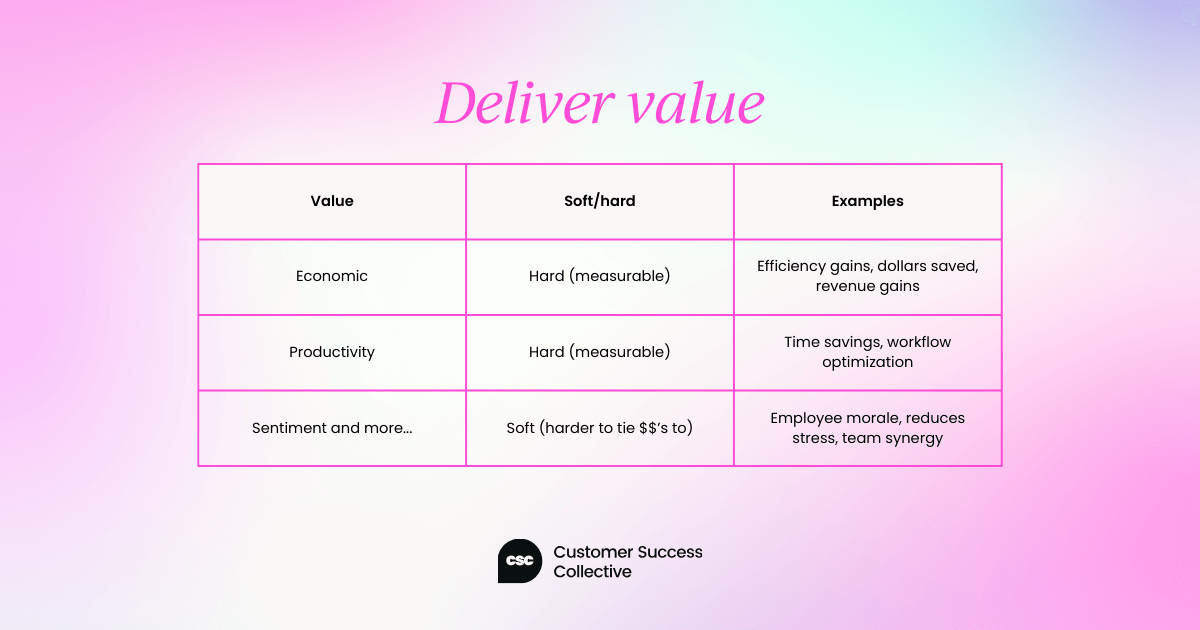
To secure renewals and expansion opportunities, you have to go beyond basic adoption and uncover other types of value that resonate with your customer. This could be cost savings, efficiency gains, risk reduction, or any number of other factors.
The key is to make sure you’re not only delivering that value but also reporting it out clearly to the customer.
Here’s the thing: your customer might not always recognize the full extent of the value your solution is providing. That’s why it’s crucial to consistently communicate and document these wins.
Whether it’s through executive business reviews, quarterly updates, or even more informal check-ins, make sure you’re showing your customers how your product is driving value in a way that directly aligns with their goals.
In this economic climate, where budgets are tighter than ever, showing ROI is essential. Adoption is a great starting point, but delivering measurable business outcomes is what will ultimately drive renewals and expansions.
Step 4: Reporting on value
Now let’s dive into the final, and arguably most critical, step: reporting on value.
It’s crucial to continuously report the value you're delivering so that the right people within your customer’s organization, especially budget holders, are aware of the impact you're making.
I’m a huge fan of executive business reviews (EBRs) because they offer a structured opportunity to showcase the wins, celebrate successes, and—most importantly—position yourself as a strategic partner.
For example, when I started doing EBRs with the city of San Antonio, only a few people attended. By the time I left, we were filling up a boardroom because of all the great things we were doing together. This is where you get in front of key decision-makers and budget holders to not only make them look like rock stars but also remind them, Hey, we're printing dollars for you.
Hard and soft ROI
When reporting on value, hard ROI—the kind that is measurable in dollars—is always the ideal.
If you can tell a customer that for every $100 they invested, they got $200 in return, that’s powerful. But sometimes, getting those hard ROI numbers can be tough.
If you struggle to quantify exact dollar values, double down on soft ROI. This could be in the form of time savings, efficiency gains, or improvements in processes that, while not directly tied to revenue, still offer significant value. For example, if your product has saved a team countless hours, even if you can’t attach a dollar figure to it, that’s still a meaningful outcome.
In industries like public transit, where we had to work carefully with unions, we couldn’t always point directly to job savings or time studies without risking backlash. Instead, we got creative by focusing on significant time savings for staff without tying it directly to personnel cuts.
The best part is when customers start questioning your metrics—How did you measure that? How do you know? It’s a sign they’re engaged, so be ready with your answers.
Tailoring the message to the audience
Here’s another example from my current company, where we were focusing on training, rollout, and adoption. During the EBR, we highlighted successes and discussed potential next steps. Importantly, we left space to fill in those next steps with the customer—it makes the process collaborative and shows that we’re evolving together.
It’s essential to customize your reporting depending on the type of value you're showcasing. Whether it's operational improvements, financial ROI, or the impact on a team’s workflow, tailor your messaging to match the priorities of your audience.
The value cycle is a flywheel
As you continue reporting value, remember that the value cycle doesn’t stop—it’s a flywheel. Once you get it moving, it keeps going. Each time you meet with the customer, you should be collecting new goals, building on the successes, and reapplying the cycle.
Here’s a quick rundown of what that looks like in practice:
- Collect new goals in live sessions.
- Map out the product areas or modules they’re using.
- Define the next steps collaboratively.
This cycle fuels ongoing growth and ensures that you’re always aligned with what matters most to your customers.
Segment for success
One final piece of advice—segment your customers thoughtfully. Don’t just segment based on revenue alone. Understanding where your customers sit and how they measure ROI will change how you position your value.
For instance, high-touch customers may require a more detailed, personalized approach, while lower-touch customers might benefit from an abbreviated version of this model. By segmenting smartly, you can drive better results and have more targeted conversations with your customers.
Tying value to growth
At one company I was at, by tying everything to value throughout the customer journey, we helped grow an account from $68,000 to $310,000. Why? Because everything was tied to measurable outcomes, and the customer could clearly see the value we were delivering at each stage.
Here’s how to really master this process:
- Catalog your use cases and break them down by persona.
- Create a map of your customers to see how many of these use cases are being addressed and where there’s room for growth.
- Start collecting goals from your top customers. This can feel overwhelming if you have a large customer base, so start small and use the goals to fuel your ROI stories.
- Finally, don’t forget to segment—there are multiple ways to do this, and each approach will affect how you position value.
This process is critical to driving renewals, expansions, and long-term success. Use it, repeat it, and refine it—and you’ll see the impact in your customer relationships and your bottom line.


Become a CSC Insider
Thank you for subscribing
Get exclusive insights, frameworks, and strategies from customer success leaders driving real business impact.
An email has been successfully sent to confirm your subscription.
 Follow us on LinkedIn