










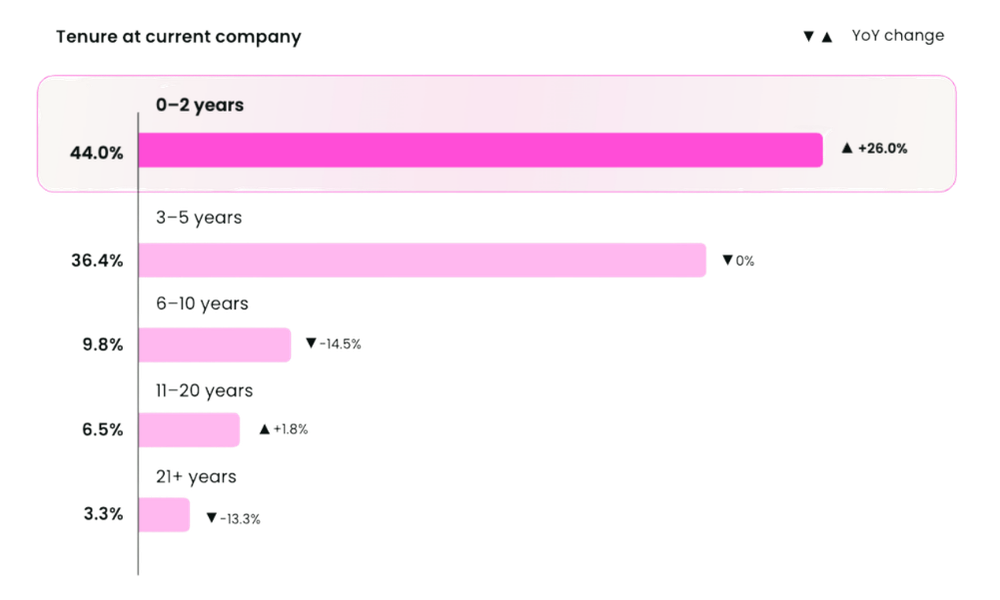
In 2026, 44% of customer success (CS) professionals have been at their current company for less than two years. That's shot up from 18% in 2025, according to the State of Customer Success 2026 Report; to be specific, we’re talking a 26-point swing in a single year.
If the average CS professional is changing employers every couple of years, then the traditional idea of a "five-year plan" – build skills here, get promoted there, grow with the organization – is harder to execute than it used to be.
Which means the age-old question isn't just, "Where do I see myself in five years' time?" It's "What kind of CS professional do I want to be – and will my current skill set travel with me?"
There are two broad career architectures in customer success: the industry expert, or the problem solver. In fact, most professionals are building one more than the other, often without realizing it.
Path 1: The “industry expert”
The industry expert's value is domain knowledge. They know fintech compliance well enough to advise customers on regulatory risk. They understand how healthcare procurement works, why implementation timelines look the way they do, and what a typical CS buyer profile looks like in their vertical. Their practice is built on "trust me, I understand your world."
At the senior end, this profile is kind of formidable. A head of customer success who’s spent 10 years in fintech brings something to a customer conversation that no methodology can replicate: credibility.
But there’s a risk involved with this level of specialism. When your career is tied to one vertical, and if that vertical consolidates, deprioritizes CS, or moves to a self-serve model, the domain knowledge that made you valuable becomes less portable than the methodological skills you may have underinvested in. (Emphasis on “may have.”)
And without being the grim reaper of recruitment, there's an even harder version of this risk. As Mike Lee, Head of Customer Success & Post Sales at PublicInput, put it in his session at Customer Success Summit Las Vegas in 2023 on hiring specialized CSMs:
"A 'generalist CSM' can learn about an industry, but they'll never be in that industry. There's a difference between working in that industry for a while and understanding the ins and outs, the problems they may have, the stresses, all the different intricacies of that role."
Mike’s shorthand for hiring customer success managers is: "I can teach CS. I can't teach industry experience." That said, he was careful to qualify it:
"I think there's a place for generalist CSMs and specialized CSMs. I think it's important to have both. Totally in one direction is going to be a problem. Both have something to add."
The flip side is that the reverse is also true – an industry specialist who hasn't built transferable CS skills can struggle to move laterally if their vertical changes underneath them.
Path 2: The “problem solver”
Now, the problem solver's value is hugely transferable. If you’re a problem solver, you’re busy solving the same core challenges in every role you land – whether it’s adoption, retention, expansion or value realization – and getting better at the commercial and operational mechanics of doing it.
The problem solver’s skill transcends industries because the underlying problem doesn't change much: help customers get value, make that value visible, turn it into revenue.
At the senior end, this profile builds leaders who can speak directly to business outcomes – NRR, churn, expansion – in any industry context.
Irina Kyselova, Customer Success Lead at EY, made this point during a panel discussion on future-proofing your career at Customer Success Summit London in 2024:
“Depending on the size of the organization, there may not necessarily be career progression within the same work stream. That's why I always say: think about where you want to branch out.
“Some CSMs can be good salespeople, and the opposite is true. Some CSMs who would like to be more technical can become implementation engineers at some point. It's important to understand what skills you need, and what level, to branch out to a particular job."
The real risk with this type of CSM is that without deep subject matter or domain knowledge, it can be harder to earn the most senior advisory relationships, where customers want someone who speaks their language, not just CS methodology.
The problem solver who also invests in understanding their customers' world – not just CS process – is the harder profile to compete with.

What the 2026 customer success trends data tells you
Our State of Customer Success 2026 research has a few signals worth sitting with if you're figuring out which path to invest in.
The commercial pressure is real, and it's growing
80.4% of CS professionals say their function is a key revenue driver. Monetization is up 9.5 percentage points year-on-year to 46.7% – the fastest shift in the six years we've tracked it.
CS is being asked to own more of the revenue equation, which means professionals who can speak fluently about commercial outcomes are the ones getting invited into the rooms where decisions get made.
AI governance is an open gap (and someone has to own it)
45.7% of CS teams are planning investment in AI-driven insights and predictive analytics. 41.3% have no formal AI governance process. If you build that fluency before your organization figures out it needs someone to own it, you've created a career opportunity nobody was advertising.
 Grace Gupta
The tenure crash makes portable skills matter more right now
If you're changing employers every two years – or if the data suggests you might – your career compounds on skills you take with you, not institutional knowledge you leave behind.
That said, domain expertise isn't disappearing. The 2026 sample is getting more senior, not less – Directors, Heads, and VPs are a growing share of the profession. At that level, understanding the customer's world deeply is often what separates a good CS leader from a great one.
The honest answer is that the strongest five-year plans build both. But most people don't have the bandwidth to develop in all directions at once, which means choosing where to put your energy intentionally.

How to figure out which fits you
A few questions worth considering:
Where have you had the most impact?
If your most impactful moments have come from knowing something the customer didn't expect you to know about their industry – regulatory context, competitive dynamics, typical procurement cycles – you're operating as an industry expert. If they've come from diagnosing a structural problem and building a process to fix it, you're a problem solver.
What does your next role actually require?
Look at the job descriptions for the roles you want in five years. Are they asking for experience in a specific vertical, or demonstrated commercial outcomes across multiple customer segments? That tells you what the market is actually paying for.
Are you tracking your skills, or just your titles?
Natalie Fraser, Director of Customer Success at Litera, put her experience plainly in a Customer Success Summit London 2024 panel on career development:
“I started in account management – in sales. When I was more junior, I started looking for senior account manager jobs because I thought: ‘Well, I'm an account manager, so my next job is senior account manager.’
“It took a while until I hit a wall and realized that the job title, and focusing on what you think you should be doing because of your role, is kind of irrelevant. It's way more about the skills you have.
“Focusing on skills rather than what your job title is, or what you think it should be, is far greater.”
It sounds obvious. It's harder to action than it looks.
 Grace Gupta
How much of your knowledge travels with you?
If a significant chunk of your knowledge is specific to your current stack, your current customers, or your current go-to-market model – and it doesn't transfer – that's a risk worth taking seriously given the mobility data.
Building your plan
The 2026 data shows 66.8% of CS teams have no dedicated enablement function. If you're waiting for your org to develop you, you may be waiting a while. The professionals building the most durable careers are largely self-directing their development.
One of the most practical approaches to this comes from Melissa McMillan, former VP of Customer Success at Screencastify, who shared her methodology at a Customer Success Summit panel on career progression:
“I have a spreadsheet. Tab one is every relevant CS role – from junior CSM all the way up to CCO and beyond – with all the skills from our org's job descriptions listed out in categories: account management, people management, strategy.
“In my first session with a new CSM, we look at: what is the next role you want? If you want to be a senior CSM, we go through that column and highlight all the skills you don't demonstrably have today.”
It's a simple system, but the discipline of naming the gap is more than most people do.
The skills worth building regardless of path
Whatever path you choose, build on the skills the function is actually demanding right now: commercial fluency (connecting CS activity to revenue outcomes, not just satisfaction scores), AI literacy (understanding where AI can support CS work and where the governance gaps are), and operational credibility (the ability to design, measure, and defend a CS program at a leadership level).
On top of that foundation, an industry expert builds vertical depth. The problem solver builds cross-functional range – into product, revenue operations, finance.
But neither path is more secure than the other. The professionals who are clearest about which skills they're building, and why, are the ones most likely to look back in five years and recognize the plan they were following.
The data says 43.9% of CS professionals want to stay at their current company and get promoted. That's a healthy aspiration. The question is whether the path forward is visible enough – and specific enough – to make it happen.
If it isn't, the same data says 39.9% are planning to move companies. The market for experienced CS professionals is active. The difference between using it strategically and using it reactively is whether you had a plan before the decision got made for you.
Either way: have a plan!
Editor's note:
Quantitative findings in this article are drawn from the State of Customer Success 2026 Report.
Speaker quotes are taken from the following Customer Success Summit sessions:
- "The power of hiring specialized CSMs who reflect your ideal customers," by Mike Lee at Customer Success Summit Las Vegas 2023
- "Future-proofing your career – essential skills for tomorrow's CSM," by Irina Kyselova and Natalie Fraser at Customer Success Summit London 2024
- "To VP, C-suite and beyond: success stories in career progression," by Melissa McMillan at Customer Success Summit San Francisco 2023.
All job titles reflect speakers' roles at the time of their respective events.


Become a CSC Insider
Thank you for subscribing
Get exclusive insights, frameworks, and strategies from customer success leaders driving real business impact.
An email has been successfully sent to confirm your subscription.
 Follow us on LinkedIn




Start the conversation
Become a member of Product Marketing Alliance to start commenting.
Sign up now