









The latest data from the State of Customer Success 2026 Report on AI governance should make CS leaders squirm, not because they're surprising per se, but because they're just so easy to recognize.
41.3% of CS functions have no formal AI governance or quality assurance (QA) process in place. Only 29.3% have formal governance. The remaining 28.6% rely on informal peer review, which, in practice, means no consistent process at all.
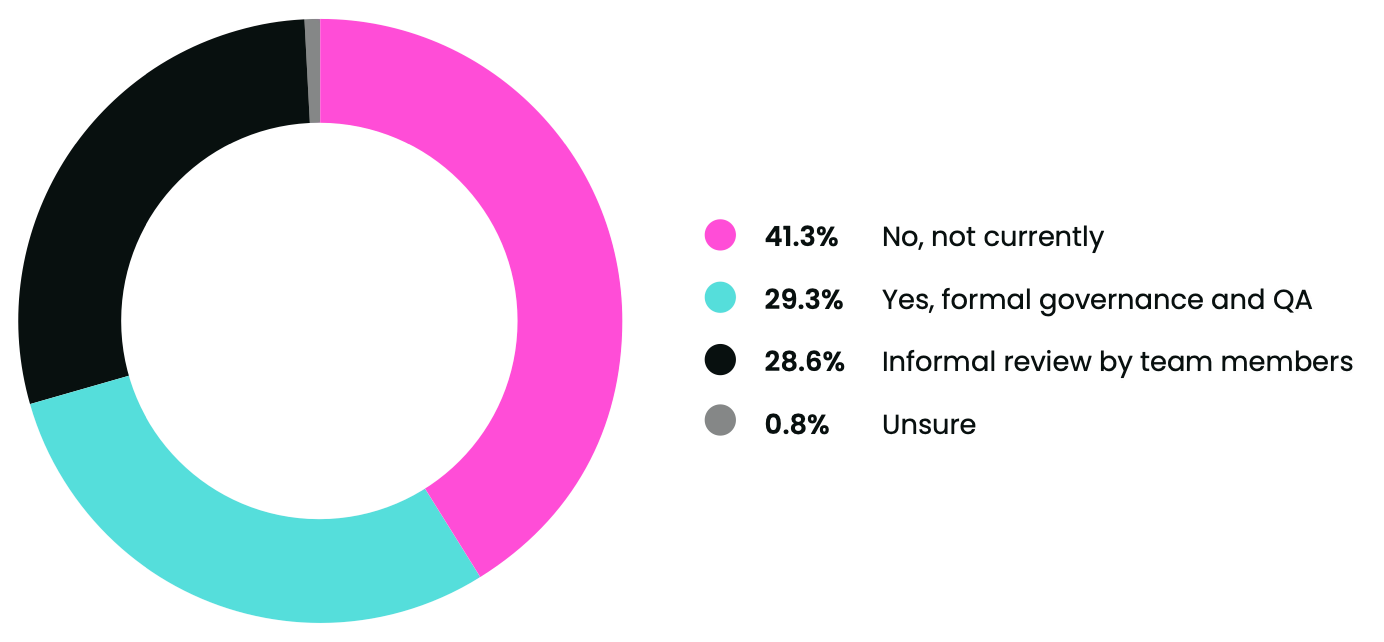
That means 69.9% have nothing formal in place. For the vast majority of CS teams, AI output quality depends on whether the right person happened to check it that day.
Considering how much customer data CSMs are responsible for safeguarding, that's a major compliance and security red flag.
That sits directly alongside this: 95% of CS teams are already using AI in some capacity, and 75% plan to invest more over the next year. Investment is accelerating. The governance infrastructure isn't keeping pace.
You see, we're interested in that uncharted space between what teams are building toward and the guardrails around those investments.
Where AI actually sits in customer success right now
The picture of current AI use in customer success is more grounded than most of the surrounding hype.
The most common pattern is individual or ad-hoc use – 30.1% of respondents. Think: ChatGPT for email drafts, Fathom for call summaries, quick research. Team-standard productivity tools account for 23.6%. Workflow automation sits at 12.2%. AI that's core to the delivery model: 11.4%.
Decision support – where AI actually informs health scoring, risk assessment, or prioritization – is used by just 8.9% of respondents. And 5.7% are already deploying customer-facing AI.
That last figure is small, but it's the one that should give leaders pause. Customer-facing AI is where ungoverned outputs stop being an internal problem and become a customer one.
The open-text responses capture the range well:
- "Not enough yet. CSMs use it for email and client research."
- "We use AI to automate internal flows. We want to use it for customer-facing tasks, but we’re not ready yet."
- "Just starting. It needs a lot of help!"
Several of our survey respondents describe their organization as "exploring" AI use. A few describe themselves as "AI-first." Most are somewhere in the early stretch.
This matters because the investment plans are considerably more ambitious than they were in 2025. Teams that currently use AI at IC level are planning to move toward predictive analytics, workflow automation, and self-service resources – a meaningful jump in operational scope. The governance infrastructure isn't keeping pace.
The scale problem
Virginia Bloom, Director of Customer Experience at Aclaimant, puts the core risk plainly:
"AI-driven insights without guardrails means being confidently wrong, at scale, and fast. One bad assumption used to cost you a single account. That same assumption in an AI workflow spreads across your whole book before anyone notices – and good luck walking it back."
This is the thing that changes when AI moves from ad hoc, individual use to workflow automation or decision support. A CSM using AI to draft an email and getting a bad output costs one email. An ungoverned health scoring model producing bad risk flags across 500 accounts costs 500 accounts – and by the time anyone notices, a lot of damage is done.
At Customer Success Summit Sydney back in 2024, Rajiv Ranjan, Customer Success Director at Oracle, described exactly this dynamic playing out with his financial services customers across the JAPAC region. When he introduces AI capabilities to customers, the questions come immediately:
"How do you handle data privacy? How do you handle data security? How do you handle training of your AI models?"
His point was direct: governance isn't just an internal exercise. Customers are already asking about it, and CS teams need credible answers ready. Ranjan's recommendation at Sydney was to start with visibility. Until you have an inventory of the AI models operating in your environment – who owns them, what data trains them, what guardrails exist around agents and prompts – you can't govern any of it.
Raymond Otero, Customer Success and Product Outcomes Executive, puts the stakes in their starkest terms:
"The risk isn’t that AI makes mistakes. The risk is that AI allows organizations to scale mistakes with unprecedented speed and confidence. Customer success ultimately runs on trust. An ungoverned model that incorrectly flags risk, misidentifies opportunity, or generates flawed recommendations doesn't just create a bad customer experience – it creates a bad customer experience at scale."
The accountability gap
The data finding that stands out most isn't the 41.3% without governance. It's what sits underneath it: nobody owns the outputs.
Chinelo Diejomaoh, Senior Customer Success Manager at HiBob, cuts straight to it:
"Who owns the quality of AI-generated outputs in your team? If the answer is nobody, that’s your starting point."
This becomes more pressing as AI moves up the stack. When it's individual use – a CSM summarizing a call – ownership is obvious. When it's a workflow automation routing accounts, or a model generating renewal risk flags, ownership gets a bit murky. Decisions get made that nobody has explicitly signed off on. When those decisions are wrong, there's no accountability structure to identify the problem, let alone fix it.
Kourtney Thomas, Head of Customer Success at TakeUp, adds the dimension most teams haven't thought through yet: legal and compliance exposure.
"There are absolutely legal and compliance risks that come into play since we're dealing with customer and product data in CS. Depending on the industry, that sensitivity and complexity can bring even greater liability. I think there's the legal and compliance risk in scaling AI investment too fast, but there's also the more practical risk of poor output that does not achieve the expected ROI. Without governance and QA in place, there's just a compounding problem of garbage in/garbage out."
Kourtney is also direct about where the pressure originates:
"There's a huge amount of pressure top-down to incorporate and invest in AI, but it's important for leaders to push back on the speed of that mandate and balance it with responsible and effective AI use."
The human problem underneath the governance gap
At Customer Support Summit San Francisco 2025, Shanta Bodhan, Associate Director of Innovation Customer Experience at Cornerstone, opened her talk with a set of statistics worth sitting with:
- An MIT study found 95% of AI pilots failed to deliver financial savings
- S&P Global reported 42% of Gen AI pilots were abandoned
- Capgemini found 40% of organizations tracking AI ROI take one to three years to see positive returns.
Shanta argued that the common thread in those failures wasn't technical. "Many failures are human factors – culture, readiness, trust, and workflow friction."
And one consequence she identifies is what she calls "shadow work": when team members don't trust an AI tool's output, they end up redoing the task themselves. And yes, it's oh-so easy to put this down solely to inefficiency, but it’s actually a bigger concern for leadership. It's a governance failure in disguise. Your organization ends up paying for AI it isn't actually using, and AI is influencing decisions nobody's checking because everyone assumes someone else did.
Virginia Bloom identifies the same pattern from the practitioner side:
"In most CS teams, AI is living at the individual or tactical level. Teams are staying small even as books and revenue grow, and the AI tools they're handed often weren't added to the stack with CS in mind in the first place. So your best guardrail is a human, stretched across that growing book, who actually understands what they're using and feels safe pulling the off-ramp when the output is wrong."
That phrase – "feels safe pulling the off-ramp" – is worth taking seriously. A governance framework on paper does nothing if team members aren't confident enough to override a bad output.

Where leaders should start
At Customer Success Summit London 2025, Sara Earnshaw, Senior Director of Customer Success at Ivanti, posed a question to the room: "Can you, hand on heart, say that your success plans are AI and agentic AI ready?" Almost nobody raised their hand.
Her team of seven manages 2,500 customers, and she's already deploying agentic AI for onboarding – using it to gather customer goals upfront and track whether those goals were met by the end of the process. She plans to extend this to success plans, where an AI agent handles routine check-ins and a CSM steps back in periodically for deeper conversations, informed by what the agent has gathered. At that scale, governed automation isn't a preference. It's the only viable model.
Her practical test for where AI belongs: success plans need to be specific enough that each element can be answered yes or no. As she put it, quoting a former mentor: "Be specific enough to be falsifiable." Plans that meet that bar can be tracked by AI. Plans that don't require human interpretation.
The starting points
The customer success leaders who provided context to our 2026 research data don't disagree on where to start. The common thread across all four is deceptively simple: before you govern AI, you have to be able to see it.
That means knowing what tools are actually in use – even informally, even the ones individual CSMs have adopted on their own – and then answering the question Chinelo puts most directly: who owns the quality of the outputs? Not the team. Not IT. A named person.
From there, the advice converges on two things: scope and checkpoints.
Raymond’s recommendation is to start with a small number of high-impact use cases – risk identification, next best actions, renewal forecasting – set success criteria upfront, and measure quality from day one.
Kourtney makes the same point from a compliance angle: tie any AI investment to a specific business objective, document your data sources, and build in human review before you scale. "Without governance and QA in place," she says, "there's just a compounding problem of garbage in, garbage out."
Virginia’s framing is the most portable:
"You can start building the muscle with a few honest questions for any AI use: What problem are we actually solving? Where is the data coming from, and is it any good? What's the risk if this goes unchecked? Where's the human checkpoint or off-ramp? That last one is the whole game right now."
Raymond puts the same instinct into a principle worth keeping:
"The most effective governance programs are not written as standalone policies. They're embedded directly into the workflows where AI influences decisions. Govern the outcomes, not just the technology."
None of this requires a formal governance program. It requires clarity about what you're deploying, why, and who's responsible when the output is wrong. The organizations closing the gap aren't the ones with the most robust frameworks. They're the ones where someone has already answered Chinelo’s question.
Editor's note: This article draws on perspectives shared by Sara Earnshaw at Customer Success Summit London 2025, Shanta Bodhan at Customer Support Summit San Francisco 2025, and Rajiv Ranjan at Customer Success Summit Sydney 2024, alongside expert commentary featured in the State of Customer Success 2026 Report.


Become a CSC Insider
Thank you for subscribing
Get exclusive insights, frameworks, and strategies from customer success leaders driving real business impact.
An email has been successfully sent to confirm your subscription.
 Follow us on LinkedIn



Start the conversation
Become a member of Product Marketing Alliance to start commenting.
Sign up now