













The numbers from this year's State of Customer Success Report tell a story that CS leaders probably already feel in their bones – but seeing it in data makes it harder to brush aside.
Customer success (CS) job tenure has collapsed. 44% of CS professionals have been at their current company for two years or less – up from 18% in 2025. At the same time, the experience level of the CS workforce has actually gone up: the share of professionals with 6-9 years in the field rose from 20.2% to 23.9%, and those with 10-14 years went from 15.2% to 19%.
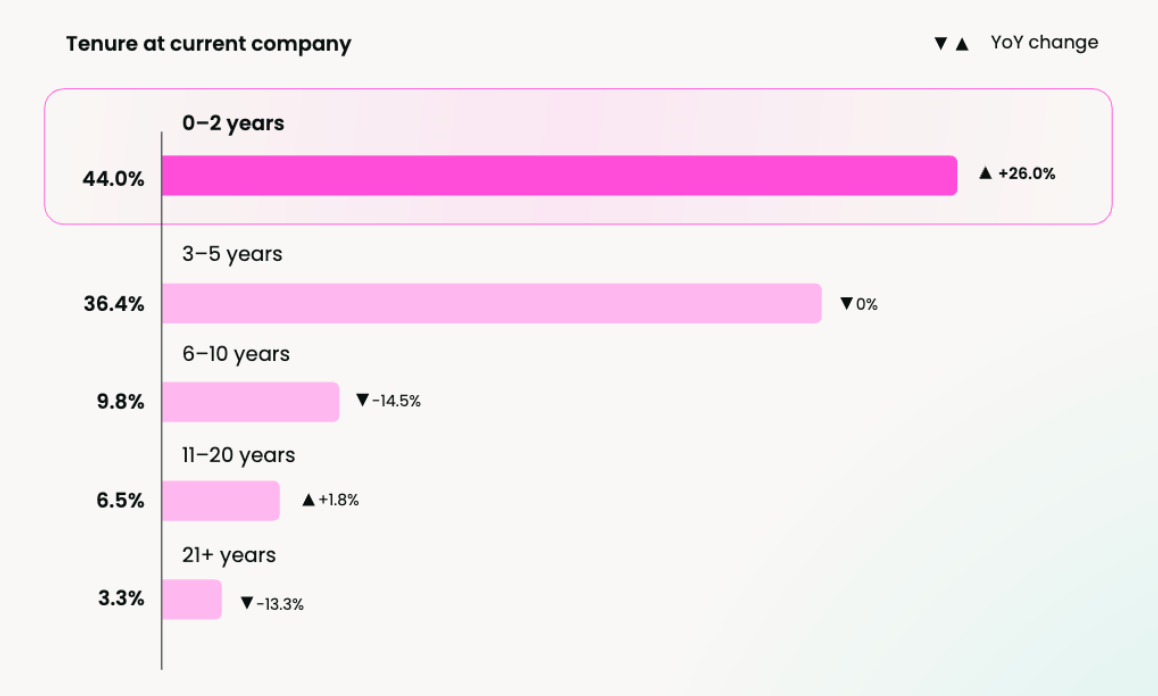
So we're not looking at a wave of new entrants cycling through. We're looking at seasoned CS professionals – people who know what good looks like – changing companies at a rate that has no real precedent in the data we've been tracking.
Why customer success tenure has collapsed
The easy answer is “restructuring.” And it's not wrong – it's just incomplete.
From 2023 onwards, a significant portion of SaaS companies dismantled or rebuilt their CS functions. Revenue ownership shifted. Roles that were built around relationship management got redrawn around commercial accountability. Some of the people hired to do one kind of CS work found themselves in a completely different job, with different expectations, under different leadership. Many left. Some were pushed. The line between the two often wasn't clear.
Raymond Otero, a Customer Success and Experience executive who lived through a version of this himself, puts it plainly:
"It's mostly restructuring and GTM resets, with a hot talent market accelerating the churn rather than causing it. Seasoned people don’t sit through that quietly. When the operating model changes underneath them, experienced CSMs move toward orgs that actually value the discipline."
That last sentence is the one worth sitting with. People leaving aren't leaving customer success, per se – they're leaving specific organizations. The experience data makes that abundantly clear. As a profession, customer success is maturing. But CS as an employer relationship is, for a lot of people, failing.

Chinelo Diejomaoh, Senior Customer Success Manager at ComplyAdvantage, adds a dimension that the restructuring narrative alone misses:
"Senior customer success professionals are becoming more aware of what strong CS looks like. When you've worked at a high level, you know what kind of support, leadership, and strategy are needed for success. If those things are missing, frustration builds up quickly."
The tenure crash, then, is at least partly a standards problem. Experienced CS professionals have a reference point. They know what a well-run CS function feels like. When it doesn't match, the threshold for leaving has dropped – particularly when the job market means leaving is a real option, not a last resort.
This is a point worth putting alongside data presented at Chief Customer Officer Summit New York 2025. Josh Crossman, CEO & Founder of Magnify, put the market picture plainly:
"Customer success job opening growth is at an all-time low. We're basically flat between 2023 and 2024. These jobs that were cut are not coming back."
What exists is a smaller, more contested pool of positions – and the people best placed to fill them are exactly the ones most likely to be discerning about where they go.
Where customer success professionals are headed
We’ll let you in on a secret – the career aspiration data from the 2026 State of Customer Success Report is arguably more useful to CS leaders than the tenure data, because it tells you what people are planning before they do it.
43.9% of respondents want to stay at their current company and get promoted. That's the largest single group, and it's the baseline for a functional workforce: most people want to build something, not leave it. The number who plan to move companies into a more senior role rose from 21% to 26%. Those planning to move companies in the same role went from 9.9% to 13.9%.
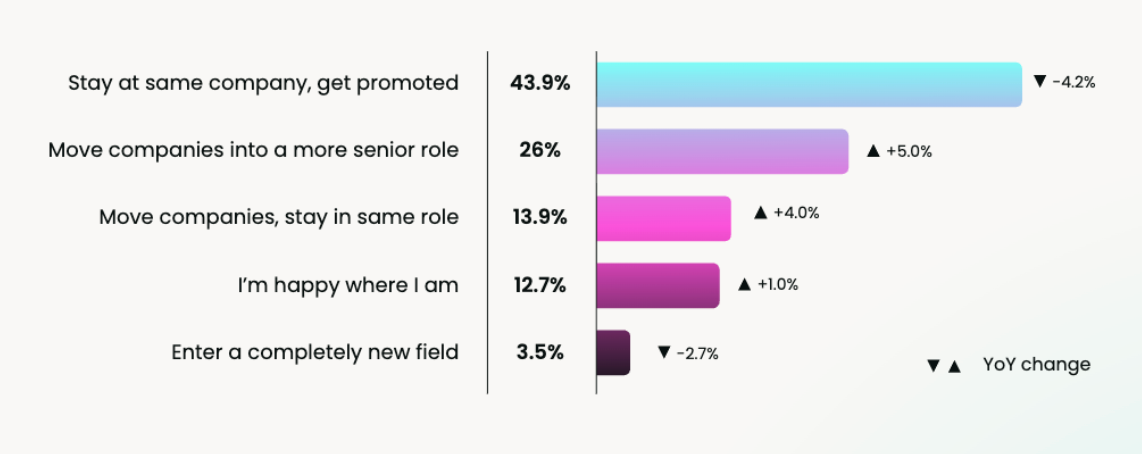
Taken together, 39.9% of respondents are planning to change employers in the next one to two years. Given that 44% of the sample has already been at their current company for two years or less, that figure carries real weight.
Among those who answered the question directly, 71% said they're actively looking for another job right now.
None of this surprised the CS leaders we spoke to. What they found more interesting – and more actionable – was the reason behind the "stay and grow" majority.
Kourtney Thomas, Head of Customer Success at TakeUp, frames it as an energy problem as much as anything else:
"I think everyone is exhausted from the pace and volatility of the industry right now, so they just want some stability. But at the same time, they want to be valued, and not every company is doing a great job of that right now."
Raymond identifies the same tension, and he's clear about what actually resolves it:
"People want to stay and grow, and they will leave the moment they conclude growth is not actually on offer. The mistake I see most is treating retention as a compensation problem when it is usually a meaning-and-mobility problem. You do not hold experienced CS talent with a counteroffer – you hold them by giving them harder, more interesting problems and a credible reason to believe the next rung exists."

What companies keep getting wrong
There's a reliable pattern in how companies lose CS talent, and it has less to do with pay than most HR teams believe.
Failure 1: Treating retention as reactive
By the time someone is talking to a recruiter, the case for staying has usually already collapsed. Chinelo is direct about this:
"The most common mistake I see is companies treating retention as just an HR issue, not a leadership one. Usually, by the time someone is talking to a recruiter, it's already too late to keep them."
Failure 2: Ambiguity during change
CS functions have been through a lot of structural upheaval in the past two years – merges into RevOps, GTM resets, shifts in ownership of renewals and expansion. Otero flags this specifically: "The second mistake is going quiet during restructuring. Ambiguity and lack of leader clarity are what actually push your best people to start looking."
This maps directly onto what's been said at our Chief Customer Officer Summits over the years.
Grant Watling, VP of Customer Success at Proofpoint, made the point plainly back in 2023:
"When people have set a career path that I know where it's trying to get to and you alter that career path, that's really uncomfortable. Change management is absolutely essential."
His broader argument was about honesty during periods of structural change – a team given context tends to problem-solve, while a team kept in the dark tends to exit.
Failure 3: Confusing loyalty with permanence
Kourtney has little patience for organizations that assume the employment contract works the way it did a decade ago:
"Companies assume people are as loyal as they were 10, 20, 30 years ago – and they're not. People are going to do what they need to do to align to their experience, their goals, and their economic needs. And if they feel like they're not being valued, they will not hesitate to make a change."
Her framing is worth quoting in full because it lands the point cleanly:
"The same customer success principles apply to both internal and external customers."
Companies that are reactive with clients, slow to demonstrate value, and inattentive to churn signals don't keep customers. The same dynamic plays out with CS talent.

Why some CSMs are leaving the field entirely
A small proportion of respondents gave reasons for leaving CS altogether. The themes are recognizable to anyone who has managed a CS team under pressure.
The word "burnout" cropped up more than once. One respondent cited lack of promotions as the reason inspiring their soon-to-be exit. One said the role had become boring – "every day is a fire I need to put out." One said it wasn't a good fit for the career they want.
The burnout signal is hardly surprising. Maranda Dziekonski, Chief Customer Officer at Fexa, spoke directly to this at Chief Customer Officer Summit London 2025, and her framing cuts through the usual wellness-program response:
"The burnout is a lagging indicator of a bigger system failure. It's unclear priorities, broken processes, or leaders who model unsustainable practices."
She also put a number on it that tends to get leadership's attention faster than any culture deck:
"Annual burnout cost for a typical 1000-person organization is about $5M. The cost isn't just turnover. It's disengagement, slower problem solving, more escalations, and customers who feel the fatigue through every interaction."
When you frame it as a financial leak rather than a wellness issue, she argued, it stops getting deprioritized.
The boredom signal is different, and worth separating. A CS role that has become purely reactive – responding to fires, processing renewals, managing escalations without any strategic dimension – isn't just unpleasant for the person in it. It's the product of poor role design. When a job offers no space for the kind of work that drew people to CS in the first place, the best candidates stop considering it. The ones who stay are the ones with fewer options.
The customer success profession doesn't have a mass exodus problem. It’s clear that the majority of people in it want to stay and grow within it. But what the data signals is a global function with a major design problem – poorly structured roles, unclear progression, and leaders who treat retention as someone else's job until it's too late.

What the data asks of customer success leaders
Kourtney’s prescription is the most concrete:
"CS leaders should be advocating for their teams, end of story. They should understand personal and professional motivators for each individual on their team, and they should prioritize ensuring there's a path toward achieving those development goals continually. That means pushing back on senior leadership and budgets and existing leveling structures when and where needed."
Her underlying logic is that leaders need to plan as if every employee is always looking – "likely to get better compensation and title" – and tell that story to senior leadership in revenue terms.
The cost of losing a strong CS team member shouldn’t be so readily attributed to the issue of salaries. There’s a very real danger of solely focusing on this, but it’s prudent to think more holistically: it's the lost customer relationships, the institutional knowledge, the momentum gap. In complex fields, that loss can take years to rebuild.
Chinelo breaks it into three actions:
- Make growth visible and real, not just in title but in scope and influence and compensation.
- Invest in development in ways that are actually felt by the team.
- Listen to what experienced CSMs say isn't working, because they usually identify the structural problems first.
Raymond adds the thing that tends to get skipped: make the internal path concrete. Not aspirational, but concrete. "Real career architecture, visible progression, and enablement that turns a job into a craft."
If this article raised questions about where your team sits – on tenure, retention, career architecture – the State of Customer Success 2026 Report has the benchmarks to answer them. The findings aren't always comfortable, but they're useful.


Become a CSC Insider
Thank you for subscribing
Get exclusive insights, frameworks, and strategies from customer success leaders driving real business impact.
An email has been successfully sent to confirm your subscription.
 Follow us on LinkedIn




Start the conversation
Become a member of Product Marketing Alliance to start commenting.
Sign up now