








We’ll cut to the chase: customer success managers (CSMs) are under more pressure than ever to drive revenue. And that pressure isn’t going away.
Customer success (CS) has evolved far beyond its support roots. Renewals, expansions, account growth – they all land on the CSM’s desk. Which is why nearly 79% of leaders now view CS as a revenue driver.
But here’s the catch: a lot of CSMs never signed up for that. In fact, some chose CS precisely because it wasn’t sales. So how do you balance the revenue expectation without becoming a quota-carrying account exec in disguise?
That’s what this article is about. So, let’s dig in.
Context: Why this pressure exists
There’s no dressing this up; senior leadership, corporate boards, your C-suite – call them what you like – they all have one priority: revenue. It’s their bottom line. It keeps the lights on and the wheels turning.
Revenue is tangible. It’s visible. And there’s no denying, it’s a massive win that CS is being recognized for driving it. It means CS is providing something the business can’t ignore, or mislabel as "support" or "service."
The distinction between sales and CS
For many, CS is a proactive beacon distinct from support and sales; one that is an escape from quotas, endless support tickets, and the constant fear of not hitting their targets. CS let them keep the people-facing part of the job they loved – helping customers realize value – without the grind of closing deals.
The pressure to drive revenue can even feel like an identity crisis.
Suddenly, CSMs are being cast as sales reps in disguise. No one may be explicitly asking you to act like an account executive (we hope), but when every conversation comes back to revenue, it can feel like customer satisfaction is being pushed to the back seat.
It’s fundamentally wrong if an organization is sidelining customer satisfaction – because that’s not what CS is about.
Company culture
Company culture plays a huge role here, too. According to the State of Customer Success Report 2025, only 35.6% of organizations describe themselves as customer-first, while nearly 38.4% say they’re sales-first. Just 9% call themselves community-first, and the rest lean toward being product- or marketing-led.
If we’re to take this data at face value, it implies that the cultural DNA of the plurality of companies prioritizes sales above all else; no wonder CSMs feel conflicted.
Unless leadership explicitly balances “customer-first” with “sales-first,” CSMs are left holding the bag – accountable for both value and revenue outcomes, but often with competing priorities.
But while it might feel like revenue and customer success are pulling in opposite directions, they’re not. In fact, the future of CS depends on proving it can do both – protect the customer experience and drive measurable growth.
Revenue isn’t the enemy
The uncomfortable truth? If you want CS to have a seat at the table, you can’t avoid revenue forever. Julien Le Terrien, Chief Customer Officer at Mobilexpense, puts it plainly:
“A significant trend is the realization that CSMs must own revenue if they want to gain credibility and legitimacy. I’ve observed many CS colleagues shift from dreading revenue-related discussions to actively embracing them, recognizing the impact revenue ownership has on their teams, careers, and influence with the C-suite.”
It’s a harsh but useful reframe: revenue isn’t the enemy of customer success; it’s the vehicle through which CS proves its strategic worth.
Mark Higginson, Chief Customer Officer at Screensteps, agrees:
"Over the past year, customer success has evolved from a support function into a strategic, revenue-driving partner. CSMs are increasingly accountable for expansion and renewals, and AI has become a game-changer in meeting those demands."
No one’s denying the significance of revenue, but it’s up to companies to carefully demarcate the boundaries of the role of CS to avoid losing what makes it unique.
The ownership puzzle
Here’s where things get tricky. Ask 10 CS leaders who owns expansion revenue and you’ll get 10 different answers. For some, CS is fully responsible – renewals, upsells, cross-sells, the lot. For others, revenue sits firmly with sales or account management.
The numbers prove just how messy it is. Nearly half of CS teams (49%) say they own all expansion revenue, while 22.6% report having no revenue responsibility at all. That’s a huge gap – and it speaks to the identity crisis the function is still working through.
Because on the one hand, ownership brings credibility. Where CS teams are tied directly to commercial outcomes, they often get more influence, bigger budgets, and a louder voice in growth strategy. On the other hand, when ownership isn’t clearly defined – or when accountability doesn’t come with proper enablement – it risks putting CSMs in an impossible position.
Rav Dhaliwal, Investor & Venture Partner at Crane Venture Partners, said it best at our London Summit three years ago:
“Customer success has to change. Right now, customer success is great at growing adoption, usage, and champions. That’s important, but it’s not enough anymore. This doesn’t mean becoming pushy salespeople burdened with an unachievable quota.”
And that’s the tension. CS can’t stay in the comfort zone of "adoption only," but it also can’t become a clone of sales. Revenue ownership has to be defined in a way that elevates CS, not erases it.
 Virginia Bloom
Leading with value
The most important principle for CSMs: revenue flows naturally from value. Not quotas. Not pressure. Value. That’s the central philosophy all CSMs should follow.
That means starting with the customer’s current investment. The first job is to ensure they’re getting every ounce of return from what they’ve already bought. A CSM’s credibility depends on it. Only once the current contract is delivering outcomes should expansion be introduced.
Frame your metrics in terms of outcomes
A really clear way to change tact and not to feel like you're hunting revenue is to show the value of your metrics. For instance, don't report on adoption as a usage metric. It’s passive and doesn’t do justice to your ability as a communicator.
Jasmine Reynolds, Director of Enterprise Customer Success at Appfire, puts this better than anyone:
“The best CS teams can easily articulate product value in financial terms, understand their customers' budget cycles and processes, and map their solutions to a pro customer's profit and loss impact. This definitely means we're adding value because we are meeting them where they are.”
It’s all well and good delivering good news to your client, such as informing them their adoption is up by 50% but you’re only doing half a job. Jasmine suggests a fresh tactic: translate that adoption into business value. Instead of saying, “Your adoption is up by 50%” try this: “Your adoption increase saved you $2 million in costs.”
When you frame success in financial outcomes, expansion conversations stop sounding like a pitch and start sounding like a logical next step.
Think of value in terms of steps, not plateaus
Another useful mindset is one coined by Mark Kosoglow, Chief Revenue Officer at Docebo. Mark has observed that in approximately 99% of companies he talks to, value creation looks like a "plateau." Let’s unpack that.
Usually, CSMs will initially witness a massive upswing of value during onboarding and user adoption, but this is followed by a plateau where value creation stops. Regrettably, this leads the customer to forget the value they initially received by the time of renewal. Mark keenly points out that this plateau "reinforces the old perpetual license model" CS is desperate for orgs to avoid, where the burden of extracting value lies with the client.

Mark suggests that instead of delivering one giant moment of value that fades, CSMs should create recurring impact through smaller, more frequent steps.
"What that does is every time that you do a new little thing for them, it builds excitement," Mark explains. This keeps the customer in a constant state of seeing value, which makes expansion less of a leap and more of a natural progression.
The trusted advisor advantage
Where do CSMs win where sales often stumble? Relationships. Now, this isn’t to say sales teams can’t cultivate relationships – they most certainly excel in this. The key difference is, once again, consistency.
A good CSM isn’t just present during renewal season. (Remember, think stairs, not plateaus.) They’re present through ups and downs – when budgets get cut, when strategies change, when things break, and when things flourish. That consistency builds trust.
With that trust comes a unique power. CSMs can spot opportunities long before anyone else. You see the workflows that are thriving, the gaps that are widening, and the processes where your product could do more.
When the time comes to discuss expansion, you’re not introducing something new; you’re simply putting words to a need the customer already feels.
Of course, that doesn’t mean CSMs should chase every upsell themselves. Complex cross-sells or entirely new product lines may be best handled in partnership with AEs. But sourcing the lead – identifying and nurturing the opportunity – is firmly within the CSM remit.
Structures that support, not suffocate
Here’s where many organizations get it wrong: they give CSMs sales targets. Hard quotas.
Suddenly, the role shifts from trusted advisor to quota-carrying rep, and morale plummets.
The better path is to align incentives with what CS already does best: retaining, expanding, and proving value.
Net revenue retention (NRR) is the “North Star” for SaaS companies because it captures the full picture – keeping customers, growing accounts, and reducing churn. Tie compensation here, and you’ve aligned revenue with customer success without corrupting the role.
Other tools help too:
- Customer success qualified leads (CSQLs): Reward CSMs for sourcing qualified expansion opportunities, even if sales close them.
- SPIFFs and MBOs: Short-term bonuses for positive behaviors (like surfacing expansion opportunities) without the burden of a quota.
- Commercial training: Teach CSMs the basics of forecasting, negotiation, and business case building – but tailor it to CS, not sales.
And here’s where the industry is showing its hand. According to the State of Customer Success 2025 report, enablement is still heavily skewed toward product knowledge:
- 40.6% of CSMs receive both sales and product training.
- 35% get product training only.
- Just 4% get sales training alone.
- And 20% get neither.
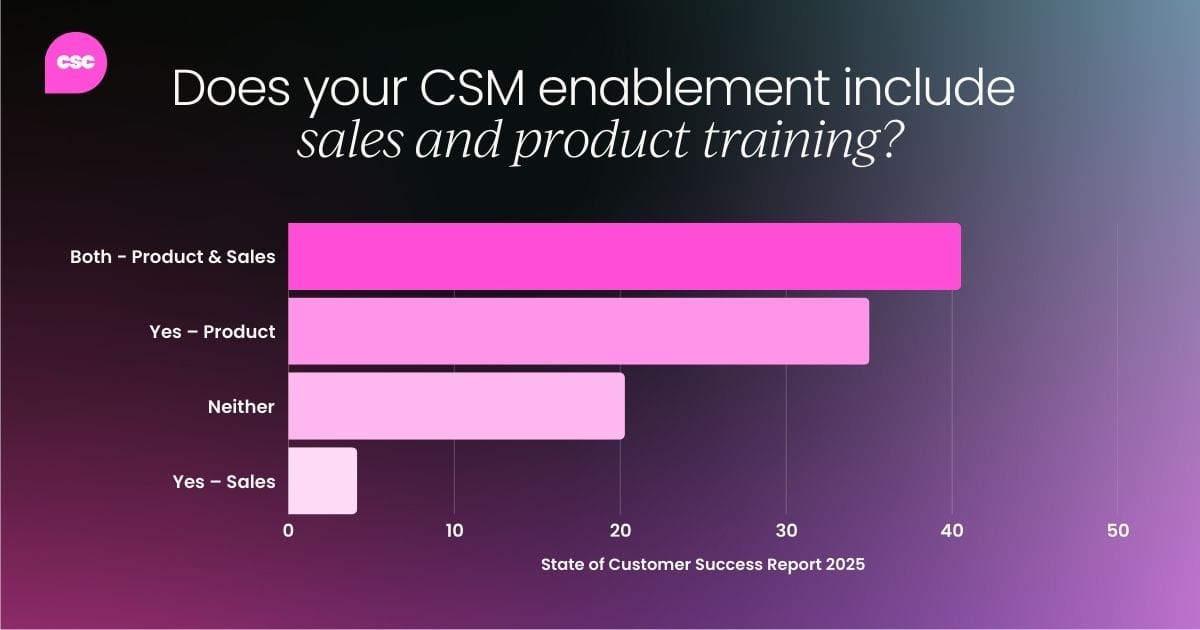
That last number should make leaders cringe.
If CS is going to own revenue outcomes, you can’t send CSMs into battle without the right armor! Product expertise is essential, but so is commercial confidence. Without both, you risk putting CSMs in the impossible position of being accountable for revenue without being properly enabled to influence it.
AI, data, and the modern CSM
Another factor reshaping the conversation is AI. Intelligent systems now surface usage patterns, health scores, and expansion signals long before a human could. Far from replacing the CSM, AI gives them sharper tools.
Just imagine walking into an EBR with data not just on adoption, but on quantified ROI, benchmarks against industry peers, and predictive insights on where expansion would deliver the most value.
Don’t for a second think that’s “salesy” – it’s consultative. And it makes the expansion conversation less about pushing and more about guiding.
The balancing act
Alright, let’s be real: the line between CS and sales will never be neat. Tension will always exist, but that’s okay! In fact, it’s productive tension.
Being mindful of Guy Nirpaz’s seminal book, the key is remembering that CSMs aren’t hunters; they’re farmers. Their job isn’t to cold-call or chase quotas; it’s to nurture the ground so that when expansion seeds are planted, they flourish.
Revenue is not separate from customer success; it’s the natural byproduct of it. When customers see ongoing, demonstrable value, they want more. When they don’t, they churn.
The challenge for CSMs is not to reject revenue, but to redefine it on their own terms.


Become a CSC Insider
Thank you for subscribing
Get exclusive insights, frameworks, and strategies from customer success leaders driving real business impact.
An email has been successfully sent to confirm your subscription.
 Follow us on LinkedIn