








Have you noticed how the role of customer success (CS) keeps expanding… but rarely sheds anything along the way?
Ask almost any Customer Success Manager (CSM) what they’re responsible for, and the answer starts to sound less like a job description and more like a system diagram: retention, onboarding, adoption, advocacy, renewals, expansion, feedback, strategy, and, increasingly, internal alignment.
On paper, this evolution makes total sense. As SaaS businesses mature, customer success has moved closer to the center of the revenue engine. But when you look at the data from the State of Customer Success 2025 Report, a more nuanced picture emerges – one that raises a sharper question: is customer success becoming more strategic, or simply overstretched?
The modern Customer Success Manager
The topline data is difficult to ignore. According to the State of Customer Success 2025 Report, customer success professionals are responsible for a wide range of activities, with the most common including:
- Customer retention (87%)
- Customer advocacy (81%)
- Strategic customer engagement (79%)
- Product adoption (78%)
- Value realization (77%)
- Churn management (71%)

Even traditionally commercial or operational responsibilities – like upselling (59%), renewals (55.5%), and data analysis (56%) – now sit firmly within scope for more than half of the teams we surveyed.
Taken together, this reinforces a broader shift: the CSM is no longer just a post-sales relationship owner. They’re expected to influence outcomes across the entire customer lifecycle. Or, put more plainly, customer success has become a multi-disciplinary function operating at the intersection of revenue, product, and operations.

How customer success priorities shifted in 2025
When you look more closely at how these responsibilities stack up, something more interesting emerges.
Retention still leads (87%), as expected. But just below it, we see customer advocacy (80%), strategic engagement (79%), and product adoption (78%) – all ranking significantly higher than renewals (56%) and upsell/cross-sell (59%).
That ordering is telling. It suggests a shift in emphasis from moments of value capture to the systems that make those moments inevitable. In other words, organizations are investing more heavily in the conditions that drive renewal, not just the renewal itself.
As Chinelo Diejomaoh, Customer Success Manager at HiBob, puts it in the report:
“Retention has moved beyond being a simple task on our list; it’s the cornerstone of the lasting relationships we want to build. By focusing on advocacy, strategic engagement, and driving product adoption, we’re not just chasing renewals, we’re truly investing in our customers' long-term success.”
This reflects a meaningful evolution in how the function is understood. Customer success is no longer there to secure renewals at the end of the lifecycle. It’s there to shape the trajectory of value across it.
Customer success challenges: Ownership vs. enablement gaps
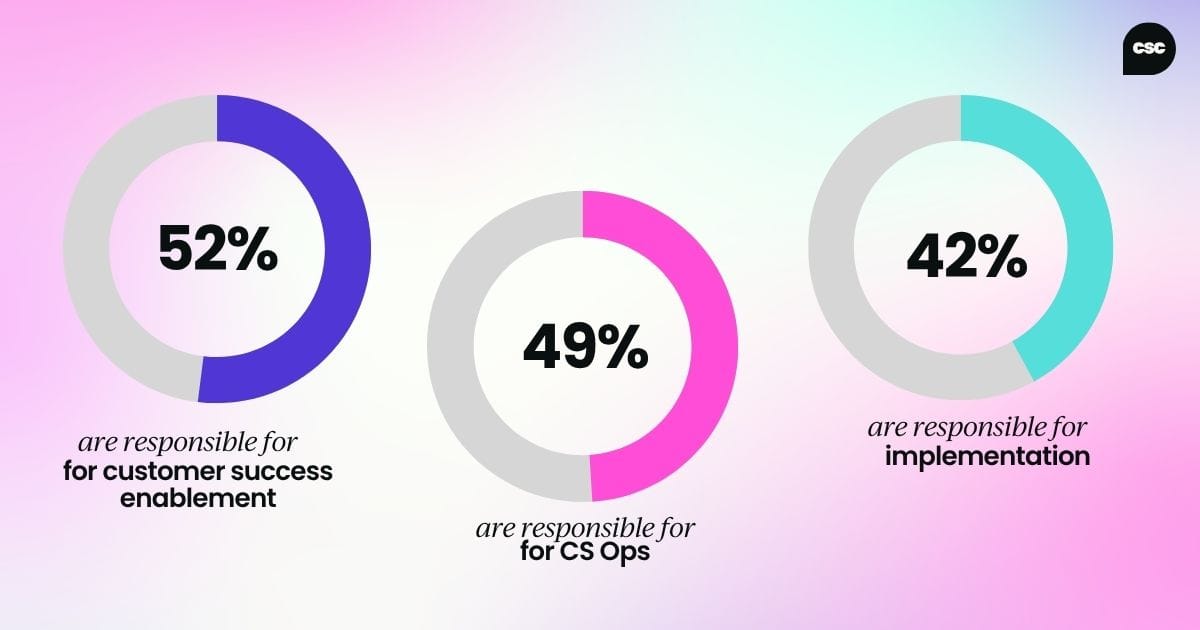
But there’s a complication. While responsibilities are expanding, ownership isn't always matched by support. Further down the list, we see areas like:
- Customer success enablement (52%)
- Customer success operations (49%)
- Implementation (42%)
These are by no means peripheral activities. They’re the infrastructure that makes scaled customer success possible. And yet, they’re among the least consistently owned responsibilities.
The tension is inherently structural.
CSMs are expected to drive outcomes – retention, adoption, expansion – but often without full control over the systems that determine those outcomes: onboarding quality, product experience, data visibility, or internal tooling.
In practice, accountability sits in one place, while many of the levers sit elsewhere. Over time, that misalignment tends to show up not in strategy decks, but in execution gaps.
Why expanding customer success responsibilities create complexity
At first glance, the expansion of responsibilities looks like progress. A more strategic role, shall we say. Greater influence? Perhaps. Closer alignment to revenue? Certainly. But there's also another way to read it. The growing scope of customer success may also reflect unresolved questions about ownership across the business.
Should onboarding sit with CS, or with implementation teams? Should expansion be led by sales, or by CS? Who owns the customer feedback loop – product, CS, or a dedicated function?
When those boundaries are unclear, responsibilities rarely get redistributed. They accumulate.
The result is not a bigger role, but a more complex one – often without a corresponding increase in authority or clarity.
How customer success responsibilities change by role and seniority
The report’s breakdown by job title adds another dimension to this analysis.
At the Customer Success Manager-level, the role remains highly customer-facing, with strong ownership of retention (90%), advocacy (88%), onboarding (76%), and churn prevention (71%).
Senior CSMs move further into strategic territory, with a stronger emphasis on value realization and engagement (both 89%), while still remaining close to the customer.
Customer Success Team Leads begin to bridge execution and leadership, with a notable focus on upselling (90%) and process management (60%).
At the Head of Customer Success level, the focus shifts inward – toward process (80%) and operations (60%) – while maintaining proximity to onboarding and adoption (both 90%).
And at the Director level, the role becomes more clearly strategic: engagement (83%) and enablement, with less involvement in hands-on work like demos (17%).
In theory, this progression is logical. In practice, the boundaries are often less defined. Senior leaders are pulled into execution. Frontline CSMs are asked to think strategically without always having the authority to act. The layers exist, but the separation between them isn't always clean.
The shift from reactive support to outcome-driven customer success
Despite the complexity, there's a clear directional trend. Customer success is moving away from reactive support – managing relationships, responding to issues, handling renewals – and toward proactive outcome ownership.
As Diejomaoh notes:
“This shift highlights the new breed of customer success professionals who don’t just respond to problems but actively influence positive outcomes.”
That shift isn't about doing more. It’s about doing different work. The question is no longer, Did the customer renew? It’s, Did the customer achieve the outcome they bought the product for?
The unit of success is clearly changing. We’re moving away from measuring based on events, and instead we’re focusing on outcomes.
But systems haven’t fully caught up
The challenge is that while expectations have evolved, the surrounding systems often lag behind. Segmentation may still be based on ARR rather than behavior. Tooling may not provide clear visibility into adoption or risk. Incentives may still prioritize renewals over long-term value creation.
This creates a gap between what customer success is expected to deliver and what it’s structurally equipped to deliver. And that gap is where much of the day-to-day friction in CS roles originates.
A simple diagnostic
If you want to understand how your organization is navigating this shift, a few questions can help:
- Are CSMs measured on outcomes (NRR, adoption, value realization) or activities (calls, QBRs, renewals)?
- Who owns the systems that enable those outcomes (onboarding, data, product feedback loops)?
- Are responsibilities clearly defined across roles, or do they accumulate within CS by default?
- Do senior CS leaders spend more time designing systems or stepping into execution gaps?
The answers tend to reveal whether customer success is operating as a designed function, rather than an absorbing one.
From role expansion to system clarity
The State of Customer Success 2025 report doesn’t just show that customer success is doing more. It shows a function in transition.
On one side, there's clear progress: a shift toward strategic engagement, value realization, and long-term customer outcomes. On the other hand, there's growing complexity: expanding responsibilities, uneven enablement, and blurred ownership boundaries.
The next phase of evolution won’t come from adding more to the role, but from clarifying how the system works:
- How responsibilities are distributed.
- How outcomes are measured.
- How teams are enabled to deliver them.
Because ultimately, customer success is defined by how consistently it turns customer potential into realized value – just at scale.

These insights come from the State of Customer Success 2025 Report, built on survey data from practitioners across the CS industry.
Take 10 minutes to contribute to the 2026 survey and help build the benchmarks leaders rely on to make better decisions.


Become a CSC Insider
Thank you for subscribing
Get exclusive insights, frameworks, and strategies from customer success leaders driving real business impact.
An email has been successfully sent to confirm your subscription.
 Follow us on LinkedIn