







Customer Success Managers (CSMs) know that winning a customer is only the beginning. The true measure of success is whether that customer adopts the product, finds value quickly, and integrates it into their daily workflow.
Without adoption, even the most promising deals risk churn, and expansion opportunities evaporate. Adoption, however, sadly, isn't that straightforward.
For leadership, success is often measured in renewals and expansion. For customers, success is measured in usage and business value delivered. Sitting in the middle are CSMs, expected to bridge both perspectives while ensuring the product becomes indispensable.
But how should adoption be driven? Should CS teams continue to rely on manual, relationship-driven efforts or shift toward automation and data-driven workflows to scale?
Recent research from the State of Customer Success 2025
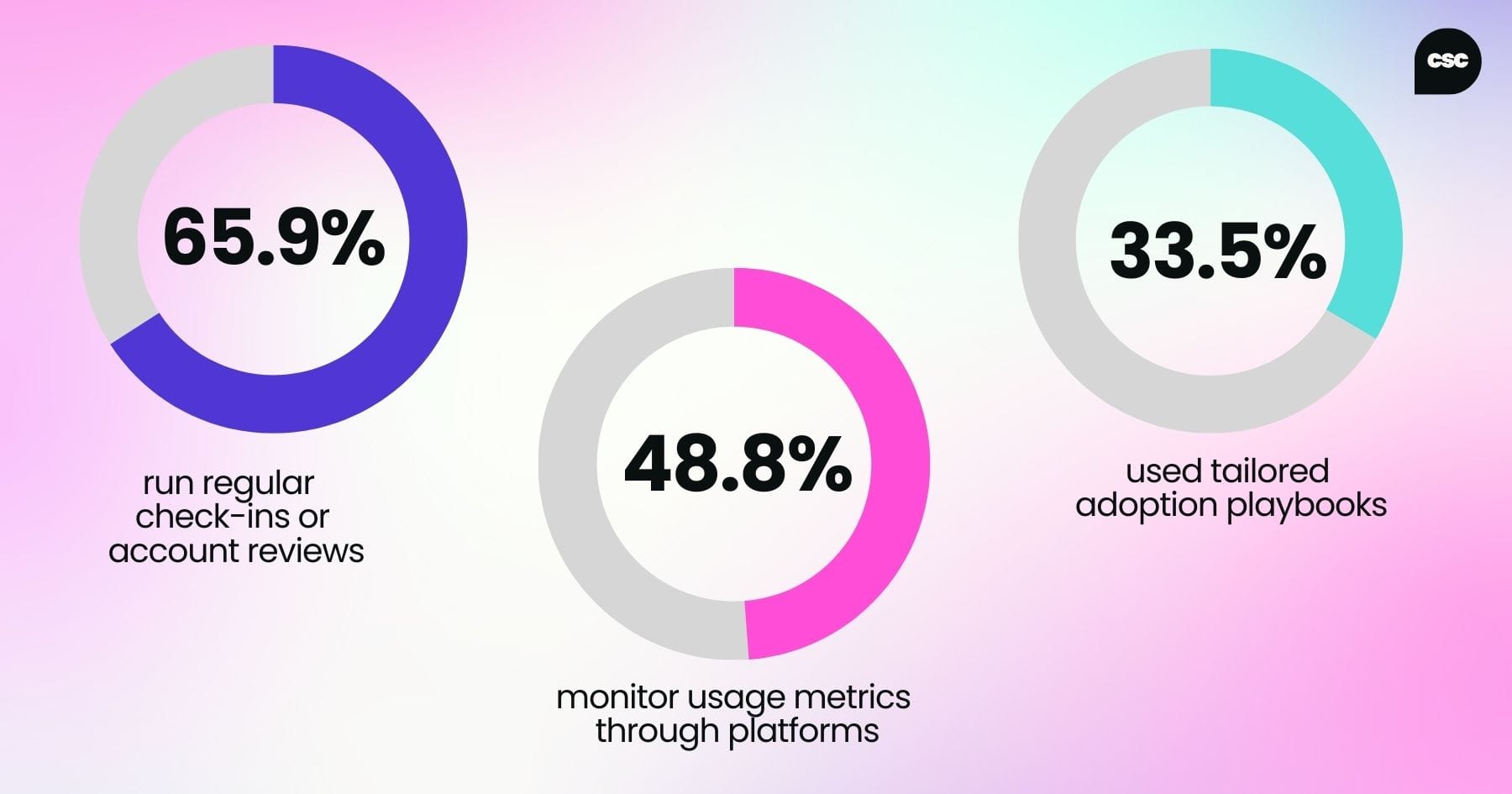
New adoption data pulled from the State of Customer Success Report 2025 reveals how teams are approaching the challenge today:
- 65.9% run regular check-ins or account reviews – all manual.
- 48.8% monitor usage metrics through platforms.
- 33.5% deploy tailored adoption playbooks.
- 36% gather customer feedback.
- Only 15.9% use automation, such as reminders or nudges.
- 14% don’t track adoption at all.
A tertiary glance at this information signifies that manual adoption dominates, automation is significantly underutilized, and the industry is still wrestling with how to define and measure success. But let’s unpack what that means for CSMs and CS leaders.

Why adoption matters
No matter how you slice it, adoption is all about value realization. The faster your customers achieve their time to value (TTV) – that first “aha!” moment – the more likely they are to renew and expand.
Just take a look at these indisputable facts:
- Strong adoption fuels NRR and creates upsell opportunities.
- Poor adoption signals churn risk – even if renewals haven’t yet reflected it.
- Onboarding is pivotal: effective onboarding accelerates adoption and reduces early attrition.
Yet, the discouraging fact remains that, quite often, the C-suite falls into an all-too common trap: Leadership often tracks renewals and expansion as success metrics, while customers measure success in terms of usage and business value delivered. As a result? CSMs are stuck in the middle, often judged by both.
This misconception can blind organizations to early adoption risks. Take a hypothetical, for example: a customer may renew only once (perhaps even due to contract inertia), but if usage lags, churn is only being delayed.
As Tanja Bloch, Director of Customer Success at Trimble, put it:
“The first thing you have to do is understand the outcomes your customer cares about. Adoption isn’t about ticking off a usage box; it’s about enabling the business value they’re aiming for. If you miss that, the whole enablement effort falls flat.”
Manual adoption
It’s hardly surprising that nearly two-thirds (65.9%) of customer success teams still rely on check-ins and account reviews to drive adoption. Human connection has always been the foundation of such critical client-facing work.
A skilled CSM can listen for nuance, draw out unstated frustrations, and adapt the product narrative to align with a customer’s goals in a way that no automated system can. These conversations build trust and, for many accounts, trust is the glue that keeps customers engaged.
But there are cracks in this model. Manual adoption is inherently difficult to scale.
Even the most dedicated CSM can only nurture so many relationships deeply. Worse still, some accounts rely too heavily on a single “power user” or internal champion. When that person leaves the business, adoption often collapses overnight, putting the renewal at risk.
Manual approaches also create qualitative blind spots. NPS or CSAT survey scores may look positive, but when you dig into usage data, the ROI story can be very different. A customer may tell you they’re satisfied while only a fraction of their team is actually using the platform. That discrepancy makes it difficult to present a coherent story to leadership about customer health.
Nicola Pellatt, Head of Customer Success at GoCardless, underscored this tension when reflecting on their scaled CS journey:
“Customers aren’t paying us for a bunch of automated emails. They’re paying for a relationship with a person. Yes, we automate some processes, but we’ll never eliminate the human element. That’s where the real value is felt.”
Manual adoption will always be critical, but on its own, it can leave CSMs in the lurch – a bit like driving on unfamiliar roads without the safety of a GPS as back-up.
Automated adoption
The pros of automated adoption
If manual adoption is trusted but fragile, automation is powerful but underused. The data presented in the State of Customer Success Report 2025 shows that only 15.9% of teams currently employ automated nudges or reminders to ensure no customer is forgotten.
For a business field under constant pressure to scale, that’s a strikingly low number.
Automation offers clear benefits. it:
- Ensures no customer is left without a touchpoint.
- Creates consistency in the customer journey, removing the variability of human execution.
And when supported by clean data, automation can even feel personal, triggering a reminder about a feature just as the customer is struggling with a relevant use case.
The cons of automated adoption
Despite the necessity to scale efficiently, don’t be hoodwinked by the allure of modern, “quick-fix” solutions; automation is certainly not a plug-and-play solution.
Poor data can lead to irrelevant or mistimed messages that frustrate customers rather than helping them.
Overreliance on automation can also feel impersonal, reducing a relationship to a series of transactional nudges. And let’s not forget adoption dashboards – the very backbone of most automation strategies – require constant refinement.
As Andreja Mrzel, ex-Director of Customer Success (EMEA) at BlackLine, puts it:
“Tracking adoption is not a one-off process. You create your adoption dashboard and revisit it after a few months. Systems change. Customers change. Our dashboard needs to keep adjusting.”
Automation shines brightest when it’s iterative, refined regularly, and used to complement – not replace – the human touch.
The hybrid model
It’s clear that adoption can’t be solved with human effort alone, but neither can it be left entirely to automation. A hybrid approach is a blend of the two, one where automation carries the weight of consistency and scale, while human interaction provides context, trust, and strategic alignment.
For enterprise or strategic accounts, personal engagement will always matter most. Executive or quarterly business reviews, workshops, and tailored adoption playbooks are critical for showing how the product ties directly to corporate objectives. But even here, automation has a role: reinforcing usage between meetings, surfacing insights in real time, and ensuring that progress doesn’t stall in the gaps between conversations.
In the mid-market, the blend is a little more balanced. Automated nudges and digital playbooks keep accounts moving forward, while CSMs step in for targeted interventions at key milestones or when risks emerge. And in SMB or long-tail segments, automation does most of the heavy lifting, with human touch reserved for the moments when customers show signs of disengagement – or opportunities for expansion.
What ties all of this together is a shift in how adoption is measured. Surveys like NPS or CSAT can offer valuable signals, but they’re not enough. Real adoption is reflected in usage data, ROI metrics, and the breadth of engagement across multiple personas.
Without that, leaders risk misreading success – thinking an account is healthy when in reality it could all come crumbling down if your main internal champion left.
 Grace Gupta
The impact on customer success teams
So, what does this mean for CS leaders? The challenge is less about choosing sides and more about orchestrating balance.
Manual adoption will always build the kind of trust and strategic value that machines can’t replicate. Automation, meanwhile, ensures that every customer – no matter how small – receives guidance and reminders that encourage product usage.
The two approaches are not competitors; they are complementary levers that, when pulled together, create a more durable adoption strategy.
This also requires a mindset shift at the leadership level. Renewals and expansions may remain the headline metrics, but they must be understood as lagging indicators.
The real leading indicator of long-term growth is adoption: how quickly customers reach their first moment of value, how deeply they integrate the product into daily operations, and how broadly usage spreads within their teams. When executives define success in those terms, they give their CSMs the mandate and the tools to focus on what truly drives retention.
 Laura Lakhwara
Our conclusion? Hybrid is the way to go
Adoption is where customer success actually happens. Relationships built through human engagement give customers confidence and clarity. Automated systems provide scale, consistency, and visibility across the broader base.
But the real danger lies in the misconceptions: believing renewals equal adoption, assuming survey scores reflect value, or trusting a single champion to hold the account together.
The companies that thrive will be those that break these habits, redefining adoption as both a human experience and a scalable process. Manual adoption builds relationships. Automated adoption scales them. But without alignment on how success is measured, both risk falling short.
Ready to go deeper?
This article only scratches the surface. The full State of Customer Success Report 2025 unpacks the latest data, strategies, and expert perspectives on adoption, renewals, retention, and beyond.


Become a CSC Insider
Thank you for subscribing
Get exclusive insights, frameworks, and strategies from customer success leaders driving real business impact.
An email has been successfully sent to confirm your subscription.
 Follow us on LinkedIn