









This article is based on a presentation given by Natalie at the Customer Success Festival London, 2023.
Catch up on this presentation, and others, using our OnDemand service. For more exclusive content, visit your membership dashboard.
When it comes to fostering seamless collaboration between customer success and sales teams, the journey involves transforming traditional boundaries into synergistic partnerships.
It's about crafting a unified approach where each team member’s strengths are leveraged to achieve collective goals.
As the Director of Customer Success at Litera, I’ve gained profound insights into the essential elements of fostering cooperation across different functions. My experiences have revealed the crucial nature of understanding, mutual respect, and a shared commitment to our customers' success.
In this article, I’ll share the practical strategies and insights that have significantly improved our CS and sales team alignment. I’m specifically going to explore:
- Why sales and customer success collaboration is so crucial
- A case study: How Litera improved its cross-functional collaboration
- Why we implemented account pods
- Breaking down misconceptions and building alignment
- Measurable outcomes of team alignment
Why is sales and CS collaboration important?
Before diving into what we've done to improve collaboration, let's first discuss why alignment between sales and CS is crucial.
Closest collaborators
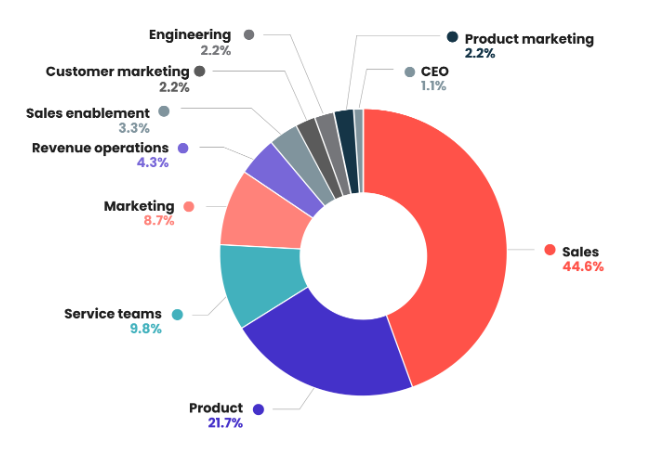
According to the Customer Success Collective's State of Customer Success 2023 Report, sales remains customer success's closest internal collaborator, even more so than product, engineering, or marketing.
For this relationship to function well, it's vital not only for the business but also for the employees.
Good working relationships between sales and CS foster higher employee engagement, contributing to better mental and physical well-being, loyalty to the company, a sense of purpose, and overall job satisfaction.
Customer experience
A seamless customer experience matters. Being siloed from other teams that interact with customers daily leads to a disjointed customer journey. Clients expect us to work together and understand the nuances of each relationship.
We've all been in situations where a customer mentions having just spoken to an Account Manager (AM), and we have no clue about the conversation. This is not conducive to a positive customer experience.
Let me share some relevant statistics from Salesforce's State of the Connected Customer report:
- 88% of respondents find the experience a company provides as important as its products or services.
- 73% expect companies to understand their unique needs and expectations.
- 62% expect companies to anticipate their needs.
These findings emphasize that delivering a seamless customer experience requires a well-aligned relationship between sales and CS.
Financial impact
Organizations with strong alignment between sales and CS see a 15% increase in customer retention rates. It's well-known that acquiring a new customer costs five times more than retaining an existing one. Furthermore, a mere 5% increase in retention rates can boost profits by up to 95%.
At Litera, we already count most of the world's largest law firms as clients. The primary growth opportunity lies in cross-selling, making the alignment between the CSMs and the sales team fundamental to our business growth.
What we did to improve collaboration
After acquiring 10 companies in just two years, it became clear that we needed to make significant changes. With many disparate roles across two primary organizations —the revenue organization and the CS organization— people didn't know each other or understand what their colleagues did.
An AM in one company would have a completely different role than an AM at Litera. Similarly, a CSM in one company handled renewals, while in Litera, renewals were managed differently. This led to confusion about who was responsible for what, and naturally, there was a degree of defensiveness, especially in the CS organization.
Customer Success Managers (CSM) were hesitant to trust their customer relationships to people they didn't know or fully understand.
To address these challenges, the CS leadership team focused on two main aspects: process and mindset.
Process improvements
Alignment from the top
The first step was ensuring alignment from the highest levels of the organization. At the end of last year, we brought in a new Chief Customer Officer (CCO), a role Litera hadn't had before.
This move was a game changer, as having a CCO advocate for the customer at the executive level fundamentally transformed our ability to align sales and CS.The relationship between the Chief Information Officer (CIO), Chief Revenue Officer (CRO), and CCO was critical. If these leaders didn't see eye to eye, changing processes and mindsets down the chain would be impossible.
Fortunately, they understood the need for alignment, which ensured that each team took responsibility for different parts of the customer journey and recognized the value of everyone's role.
Creating a RACI chart
The most impactful change we made was creating a RACI chart – a document detailing each stage of the customer journey in granular detail, from prospecting to renewal. It clarified who was responsible, accountable, consulted, and informed (RACI) at each stage.
We broke this down by every role involved in the customer journey. This document was transformative because it resolved the confusion stemming from the numerous companies, people, and processes we had brought together.
It helped everyone understand the value of each role, particularly between the AM and CSM roles, and how they benefited the customer.
Although not everyone agreed with everything on the RACI chart, having a clearly defined structure made a significant difference.
 Grace Gupta
Mindset changes
Understanding roles and responsibilities
With processes now clearly defined, people began to understand the value of different roles. The RACI chart highlighted the distinct benefits of each role in the customer journey and helped build trust between teams.
Breaking down silos
We worked hard to break down the silos between sales and CS. By fostering better relationships and understanding between the teams, we encouraged a more collaborative mindset, ultimately leading to better customer outcomes.
Getting alignment between sales and customer success right is crucial for business growth. By focusing on process improvements like alignment at the executive level and clear role definitions through a RACI chart, we could tackle the confusion and defensiveness that had arisen from our rapid growth through acquisitions.
Implementing effective solutions and processes
Account pods
One of the key initiatives we implemented was the concept of "account pods," where the same Account Director (AD), AM, and CSM were assigned to the same book of business, each fulfilling their distinct roles.
This structure proved to be hugely beneficial in the U.S., providing a cohesive customer experience. However, we learned that the model didn't work universally. For instance, it didn't fit well with our international teams due to the different number of ADs and AMs.
ADs in international regions often manage a larger customer base across wider territories. In contrast, the U.S. has a more mature market, with set groups of customers and long-standing sales teams.
The lesson learned here was to adapt processes based on what makes sense rather than forcing a one-size-fits-all approach. Although the account pods worked well in the U.S., we opted for a different structure internationally while still maintaining clear alignment and minimizing the number of collaborators on each account. Ultimately, this flexible approach provided a positive customer experience.
Customers responded positively to the pod structure where implemented, enjoying a consistent account team working for them.
Rob Zambito
Sales-to-customer success handover
Our sales-to-CS handover process was initially product-specific and inconsistent across acquired companies. We took this challenge as an opportunity to cherry-pick the best practices from each company's processes rather than imposing a single Litera approach. The resulting process became as product-agnostic as possible while ensuring consistent steps that apply to any product.
This approach significantly improved the customer experience, giving clients a consistent journey regardless of the product they were purchasing or implementing. We jointly presented the refined handover process to both the revenue and CS organizations to ensure full alignment.
Key elements of this improved handover process include:
- Sales teams complete a form detailing the buying reasons, customer problems solved by the product, and expectations.
- If the form is incomplete or doesn't clearly identify the problems the product solves, we immediately flag the subscription as "at risk." This alert is sent directly to the Executive Leadership Team (ELT). The strict governance ensures sales teams don't offer smaller products as "sweeteners" to deals where there's no genuine need for them.
- By jointly presenting the new handover process to both teams, we ensured alignment and mutual understanding of roles and responsibilities.
Internal and external joint meetings
We introduced joint meetings for better alignment between sales and CS, both internally and externally.
Internal meetings:
- Each Monday, the international sales and CS teams meet to outline their priorities for the week and any key customer meetings. This ensures everyone is aware of who is meeting with whom.
- All account team members are added as optional attendees to key meetings, allowing them to join if relevant or necessary.
External meetings:
- We aim to ensure that no internal team member is surprised by a customer mentioning a recent meeting with a colleague. Adding team members as optional attendees helps avoid such situations.
These joint meetings have significantly reduced internal confusion and improved transparency across teams.
%20(1).jpg)
Utilizing technology for collaboration
We've leveraged technology to enhance collaboration and communication between sales and CS.
- Microsoft Teams: Heavy use of Teams includes setting up customer-specific chats and channels, ensuring that all relevant team members are involved in communication.
- SharePoint: Centralized file sharing for easy collaboration.
- Highspot: To share sales and CS documentation.
- Salesforce: Sales team activities are visible in Salesforce.
- Gainsight: The CS organization uses Gainsight, and we share our data with the sales team.
The simple act of setting up a dedicated Teams chat for each customer, including all relevant team members, has proven incredibly impactful. It provides a single point of reference for any customer issues or queries and keeps everyone aligned.
Implementing these strategies has helped us create a seamless and collaborative relationship between sales and customer success at Litera. By focusing on clear processes, joint meetings, and effective use of technology, we've fostered an environment where both teams work together effectively to deliver a unified customer experience.
Breaking down misconceptions and building alignment
In the journey of aligning our CS and sales teams, one of the most challenging aspects was addressing the mindset. It's one thing to set up processes; those are within our control and can be defined and structured. However, changing the mindset is a bit more elusive.
Initially, there was a prevalent misconception within the team about the role of the sales team. Many harbored the belief that salespeople were solely focused on making a sale rather than genuinely caring about the customer's success. This is a critical misunderstanding, especially considering that our growth plan at Litera hinges on cross-selling.
For cross-selling to work, our sales team must prioritize the success of our customers —if our customers are not succeeding, they simply won't buy anything else from us. This is particularly true in the saturated U.S. market, where the opportunity to acquire new logos is incredibly limited. Ensuring customer success is not just beneficial; it's imperative.
To combat these misconceptions, we made concerted efforts to educate everyone about the different roles within the account team and the value each member brings to the customer. It was crucial to emphasize that responsibilities such as building trust and being the main point of contact do not need to fall on one person, like the account director.
Sharing these responsibilities helps in building a cohesive team dynamic.
The process and mindset connection
We've found that improvements in team alignment really start to materialize when you combine the right processes with mindset changes. The process acts as a framework that team members must engage with, and through this engagement, they begin to see its benefits, which in turn starts to shift their mindset.
As their trust in the process grows, so does their adherence to it, creating a positive feedback loop that not only enhances team performance but also helps in changing the mindset over time.
The power of personal connections
Last year, we organized an all-team meet-up in Chicago, which proved to be a significant step forward. Bringing together disparate teams in one location allowed for more than just formal meetings; it enabled team members to connect on a personal level.
Getting to know colleagues as individuals, and not just as roles within a sales process, helped in breaking down barriers and building genuine relationships. This personal connection is vital as it helps each team member understand and appreciate the motivations and personal attributes of their colleagues, fostering a more collaborative and empathetic workplace.
This combination of strategic process implementation, mindset adjustment, and personal interaction has been central to aligning our CS and sales teams effectively. It's a continuous journey, but one that is essential for our collective success.
Measurable outcomes of team alignment
As we reflect on the progress made in aligning our CS and sales teams, it's clear that while we haven't reached a perfect state —what one might call 'sales and CS Nirvana'— the improvements are undeniable and substantial.
It's an ongoing, iterative process, and although there are still individuals who are less collaborative or resistant to processes, the overall collaboration between the teams has significantly enhanced.
Significant customer wins and financial growth
One of the most tangible outcomes has been our customer wins. This quarter, the alignment of our account teams has clearly influenced our renewals and upsells.
In financial terms, our renewals this quarter have increased by $600,000 compared to the same quarter last year. While it's hard to attribute this success solely to team alignment, it's evident that this synergy has had a significant impact. The well-aligned account teams are noticeably fostering customer growth.
Improvements in employee and customer satisfaction
On the internal side, our employee net promoter score (NPS) has seen a 24-point improvement. Earlier this year, the CS team's satisfaction was notably low, plagued by disruptions and unclear processes.
The clarity and structure we've introduced have markedly improved our internal environment. Again, while not all changes are due to this process alone, it has undeniably played a critical role.
Externally, our customer NPS has improved by eight points. This rise reflects a better customer experience, driven by consistent service across our products and clear communication of each team member's role and value.
Customers now recognize and appreciate the dedicated support of their account teams, which has led to noticeable improvements in our service delivery.
Continuous improvement and new initiatives
Looking forward, we understand that our journey toward perfect alignment is not over. This isn't a 'checkmark and move on' scenario. We are exploring new initiatives, such as formalizing commission structures for CS on qualified leads, which do not necessarily need to result in a sale.
This approach aims to align compensation with team contributions better, recognizing the importance of CS in driving sales through customer satisfaction.
While the path to complete alignment is still under construction, the strides we've made are clear. We anticipate continued improvements and adaptations in our processes and strategies in the coming year, ensuring that our CS and sales teams not only grow closer but also drive our business success more effectively.


Become a CSC Insider
Thank you for subscribing
Get exclusive insights, frameworks, and strategies from customer success leaders driving real business impact.
An email has been successfully sent to confirm your subscription.
 Follow us on LinkedIn