






There comes a point for every customer success (CS) team where the quesiton of coverage becomes urgent. Yes, your customer base is growing (congrats!), but your headcount isn't (commiserations).
Up until now, the way you've been deciding which customers get a dedicated CSM, which ones share one, and which are better suited to a tech-touch model, can't be stretched any further. Most CS teams have answered that question in some form.
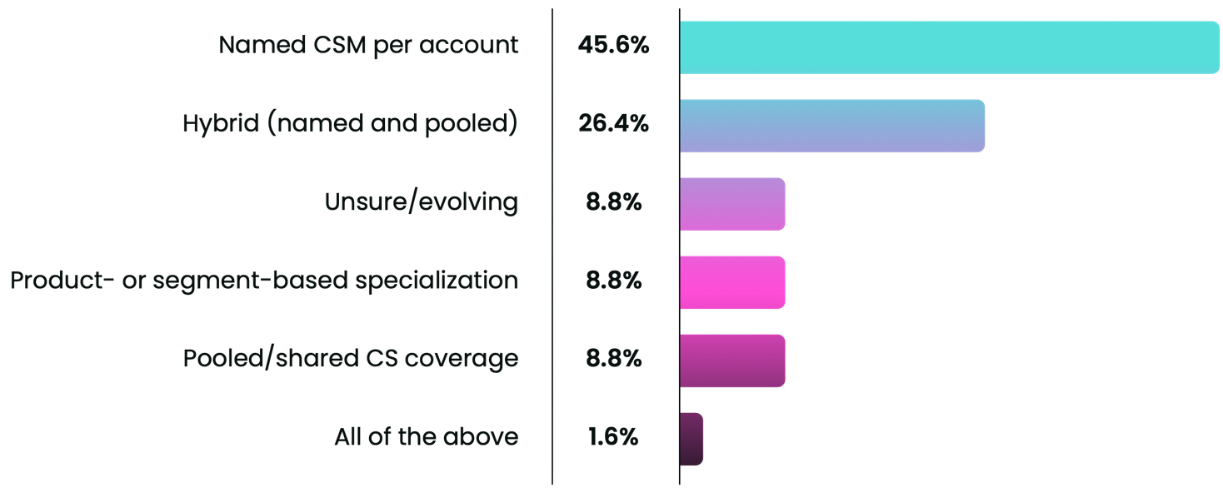
According to the State of Customer Success 2026 Report, 45.6% operate with a named CSM per account, and more than a quarter run a hybrid named-and-pooled model. The coverage structure question looks settled.
But ask how those decisions are actually made day to day – how CSM capacity and coverage are determined – and the picture changes. 37% of teams use revenue-based segmentation.
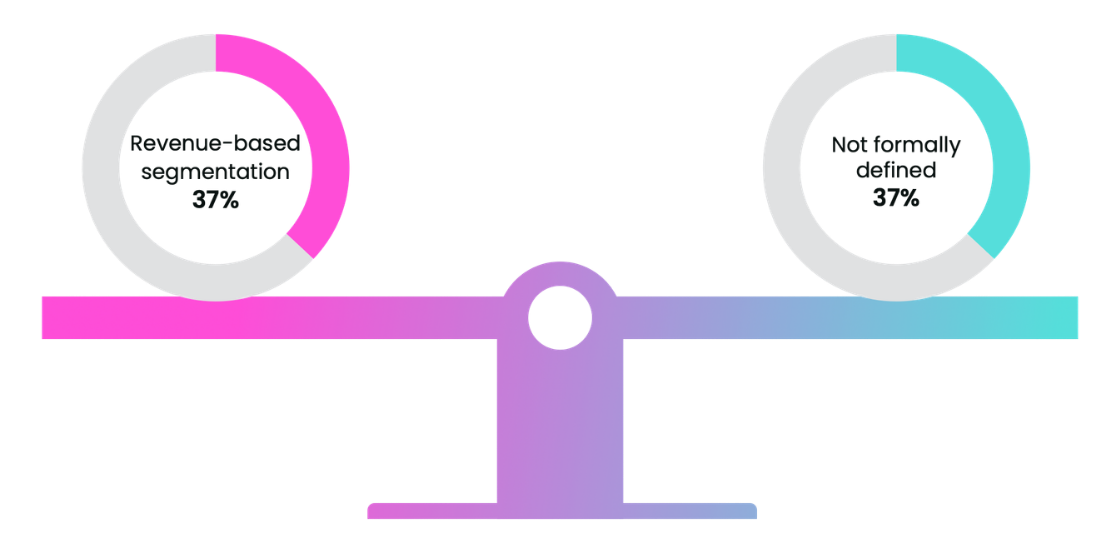
Another 37% say capacity isn't formally defined at all. Risk-based and adoption-based prioritization, the approaches most likely to predict where CS intervention would actually move the needle, account for just 5.5% combined.
The structure is there. The logic underneath it, for most teams, isn't.
The segmentation problem underneath the coverage question
For perhaps obvious reasons, most organizations tend to segment their clients based on the revenue they bring in. It’s a rational starting point, allocating CSMs’ time proportional to account value.
But there’s a well-documented blind spot that’s pretty scary: a $50K account at high-churn risk often needs more active coverage than, say, a $200K stable client who’s fully adopted and set to auto-renew.
When you segment based on revenue, you don’t offer the level of attention required by clients with a higher churn risk. Instead, you’ll find out about the $50K churn at the renewal meeting instead of two quarters before.
Chinelo Diejomaoh, Senior Customer Success Manager at ComplyAdvantage, puts the problem plainly:
"Using revenue-based segmentation is a good place to start, but not the best way to finish. ARR shows what's important for the business, but not what's at risk or where your time is needed most."
See, that’s the question CS leaders should actually be asking. Chinelo argues it isn't just where teams should focus, but where your actions will make a difference – and how soon.
At Customer Success Summit Washington D.C. 2025, Melonie Keeffe, Head of Customer Success at Language I/O, described what happens when this problem hits at scale. Post-Adobe acquisition, she told the room, her team hit an inflection point:
"$3M customers became $13M customers. We were landing $6M net new customers quarter over quarter. What got us here will not get us there."
The revenue-only segmentation model that had worked before broke. Her team's response was to rebuild from the foundation:
- Customer segmentation
- Delivery model definition
- Role definition
The segmentation piece is where she diverges most sharply from standard practice. ARR alone tells you the distribution of customers. But what you also need, she argued, is an understanding of each customer's propensity to grow and their level of maturity. According to Melonie, customers should be able to slide in and out of segments based on those criteria, rather than being permanently locked into any one tier.
This produced three distinct segments:
- Transformational customers driving top-down digital change
- A middle tier called "mature and grow" that with the right care could become the next transformational accounts
- A data-driven long tail requiring a fundamentally different engagement approach
What underpinned all three was a digital customer success strategy – not just for the long tail, but for every single segment. When Melonie’s team started measuring who was actually engaging with their digital content and events, the answer was striking: their largest, most complex transformational customers were showing up more than anyone else.
Clearly, the assumption that "big accounts only want high-touch coverage" just isn't one supported in reality.
 Emily Evans
The engagement architecture question
It’s important to stress that having a coverage model and having a prescriptive engagement model are two different things. The 2026 State of Customer Success Report data suggests most teams have the former… just not the latter. That gap shows up in inconsistent customer outcomes rather than any single visible failure.
At Customer Success Summit Denver 2025, Emily Evans, Customer Success Director at Ping Identity, described exactly this problem. Roughly two years prior to her talk, her team had no prescriptive engagement model. CSMs were given loose guidance and left to determine their own approach. Predictably, the results were uneven.
The framework she built, called “Success Connect,” broke customer engagement into five distinct interaction types:
- Pulse checks for regular strategic syncs
- Dedicated success planning sessions separated from routine check-ins
- Executive business reviews
- Innovation and roadmap sessions
- “Value unlock" sessions – a proactive play that reviewed what customers were licensed for but not using, timed to land around four months before renewal.
The separation is the key design decision. Emily drew an analogy her audience instantly recognized: most CS leaders try to do career planning inside regular one-on-ones, and it consistently gets crowded out. The same thing happens when success planning gets shoehorned into a “quick” pulse check.
When you give each interaction type its own dedicated time and attendee list, the quality of each conversation goes up. What worked so well was that each interaction type has a different cadence depending on tier:
- High-touch customers get quarterly success planning sessions
- Low-touch customers get them twice a year
To determine whether the ratios were right, Emily built a bandwidth calculator – accounting for prep time, meeting time, and follow-up time across all five engagement types – to establish the maximum number of accounts a CSM can realistically handle at each tier.
As of 2025, when she gave her talk, her team’s high-touch target was fewer than 20 accounts, with an expectation it would settle around 12 to 15. Low-touch was fewer than 30, likely to land near-ish 25.

The commercial ownership question that shapes everything
Coverage model design doesn't happen in a vacuum. The commercial ownership structure underneath it – who owns renewals, who owns expansion, where sales ends, and CS begins – determines the roles, incentives, and swim lanes that any coverage model has to accommodate.
At Chief Customer Officer Summit New York 2024, Stuti Bhargava, former Chief Customer Experience Officer at OneSpan, laid out three models and was direct about her preferences:
- In the first, all commercial activity sits with sales while CS focuses purely on adoption and usage.
- In the second – the most common today – new logos go to sales while expansions and renewals sit with CS.
- In the third, a separate account management team reporting into the CCO handles commercial activity alongside both sales and CS.
She considers the first model largely outdated, though she acknowledged it still works in specific situations: complex solutions, long selling cycles, large ACVs, and renewals as complicated as the initial sale.
The risk is that the entire CS organization becomes a support structure for sales. "You have this king," she said, "and you have the rest of the people kinda supporting it." Even within this model, she argued, CS should be generating qualified leads and receiving some compensation for deals that originated from their work.
The second model is much cleaner. Existing customers are fully owned by CS, and if executed well, renewals become a non-event rather than a milestone. Stuti’s practical fix for the risk that CSMs spend too much time on commercial activity: create a smaller renewal operations team to handle the transactional elements, so CSMs stay focused on adoption and value.
The third model – dedicated account team under the CCO – is the most expensive and most complex. Stuti recommends this approach be used selectively, only for the largest enterprise accounts where multiple relationships across the customer are genuinely necessary.
Her conclusion after working through all three: she now won't take a leadership role that doesn't include revenue ownership. Not because revenue ownership is the goal in and of itself, but because without it, the voice of customer work that CS excels at stays perpetually at the level of input rather than initiative.
Stuti’s perspective explains why revenue-based segmentation is so default – when CS doesn't own commercial outcomes, ARR is the only signal that travels up the org to the C-suite.
What the capacity data is actually telling you
The 37% of teams with no formally defined capacity model aren't necessarily failing. But the 5.5% using risk or adoption-based prioritization is the number that should concentrate minds.
The report contributors who provided context to the 2026 data don't disagree on the diagnosis. Revenue-based segmentation is a starting point, not a strategy.
Raymond Otero, Customer Experience and Product Outcomes Executive, goes furthest in reframing the question:
"The future of capacity planning is not revenue-based segmentation. It's signal-based segmentation. Revenue tells you who is important today. Signals tell you where outcomes can be influenced tomorrow. Risk, adoption, expansion potential, executive engagement, and product utilization are far more predictive of where human attention creates value than account size alone."
Kourtney Shoemaker, Lead Customer Success Manager at Billtrust, adds the dimension that tends to get lost in the modelling: the human element. Segmentation and capacity planning can look good on paper while still failing in delivery, particularly when planning is too aggressive and leaves teams overloaded.
"You don't want to be so tight with your planning that churn goes wild and your KPIs fall apart."
The real question, as Raymond frames it, isn't how many accounts a CSM can manage. It's whether scarce customer-facing resources are being deployed at the moments that actually matter. Right now, for the majority of CS teams, the signals that should be driving that allocation aren't being used.
Editor's note: This article draws on perspectives shared by Emily Evans at Customer Success Summit Denver 2025, Melonie Keeffe at Customer Success Summit Washington D.C. 2025, and Stuti Bhargava at Chief Customer Officer Summit New York 2024, alongside expert commentary from Chinelo Diejomaoh, Raymond Otero and Kourtney Shoemaker featured in the State of Customer Success 2026 Report.


Become a CSC Insider
Thank you for subscribing
Get exclusive insights, frameworks, and strategies from customer success leaders driving real business impact.
An email has been successfully sent to confirm your subscription.
 Follow us on LinkedIn



Start the conversation
Become a member of Product Marketing Alliance to start commenting.
Sign up now