








Don’t let the online noise fool you: in the world of subscription-based businesses, there have never been two more incongruous words than “surprise churn.” We’d wager that when companies “suddenly” lose a customer, it comes down to how they treat renewals.
When a renewal looms like a monolith in your calendar, it becomes a static event that must be conquered, and then, magically, all will be fine. This mindset cements the idea that a renewal is a contract to renegotiate – a scramble in the final weeks to prove the customer got what they paid for.
This simply isn’t how customer success (CS) orgs with high renewal rates handle renewals. For them, the renewal is the last step in a process that began at purchase, and the outcome is mostly decided by what happened in the 11 months before anyone opened the contract.
See, that difference matters more now that AI has entered the renewal motion. Used well, AI is able to spot risks that you might have missed, build the value case as you go, and take admin off your plates.
A word of warning, though: AI can’t function with poor data hygiene. It’ll be efficient in the short term, but give you countless headaches in the long. If your AI is trained on a fragmented base of data, it gives you faster versions of the blind spots you already have.
Here’s where AI changes the renewal equation, what it needs to work, and what practitioners are doing with it today.
Want AI that works across the whole customer journey?
Our free NRR guide shows how CS leaders connect purchase, onboarding, adoption, renewal and advocacy.
Why customer renewals still go wrong
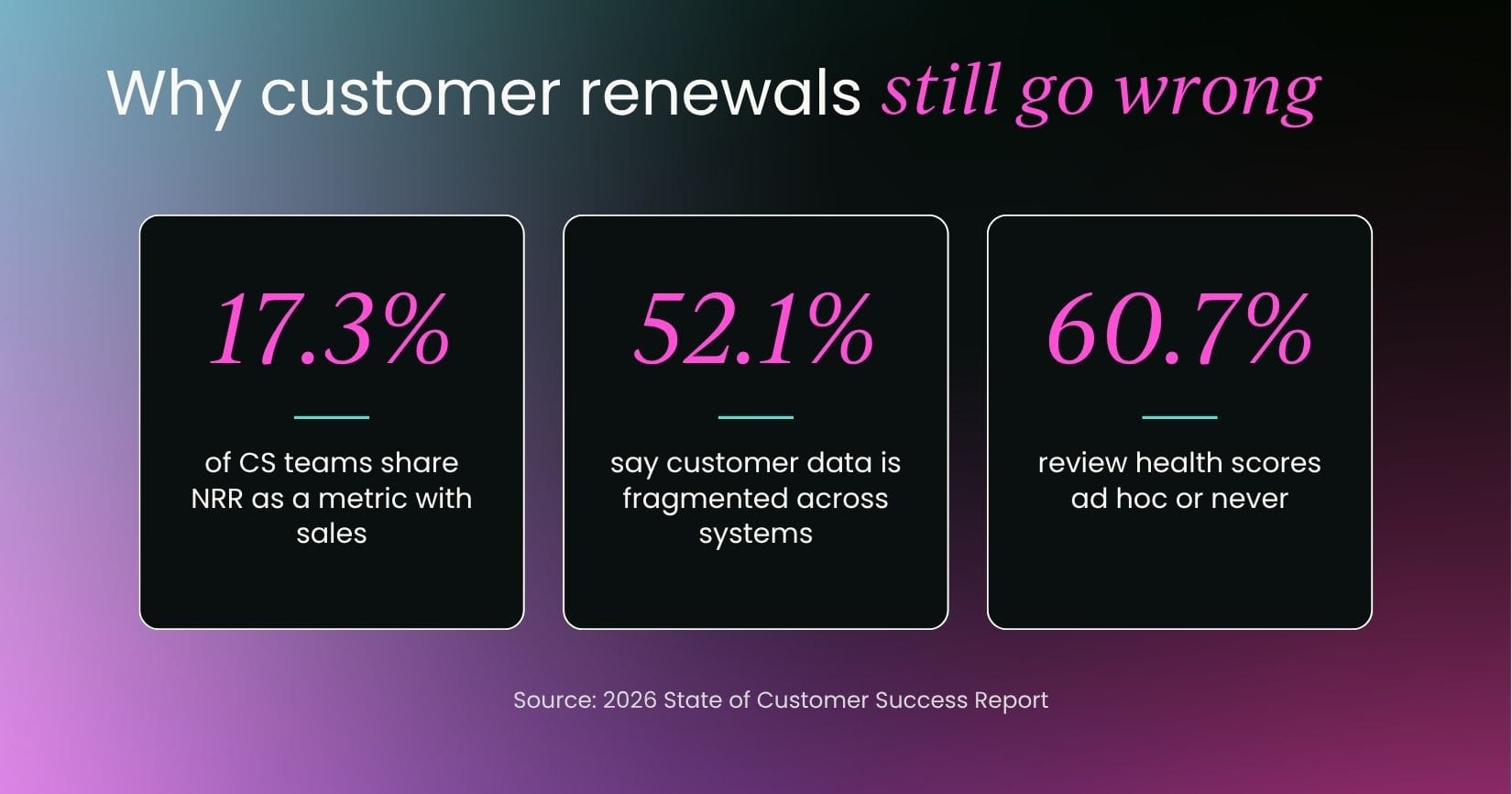
The structural problem shows up clearly in the 2026 State of Customer Success Report.
Only 17.3% of CS teams share NRR as a metric with sales. 52.1% say customer data is fragmented across systems. And 60.7% review health scores ad hoc or never.
In other words, the team responsible for retention is working from an incomplete view of the customer, with a health score that rarely informs a decision.
Dominic Constandi described the result during a talk on identifying at-risk customers, from his time as Chief Customer Officer at ZoomInfo:
“The worst thing in the world is when someone comes to you and says, ‘Got blindsided on this one – competitive threat, didn’t see it, bad utilization, bad adoption, weren’t tracking it. We’re two months out from the renewal.’ Then there’s nothing to do. They’ve made a decision. You can’t swarm it and you can’t affect an outcome. Awareness is key.”
– Dominic Constandi, former Chief Customer Officer, ZoomInfo
Every use case below comes back to awareness. AI earns its place in renewals when it tells you something early enough to act on.
The foundation AI needs before it can improve renewals
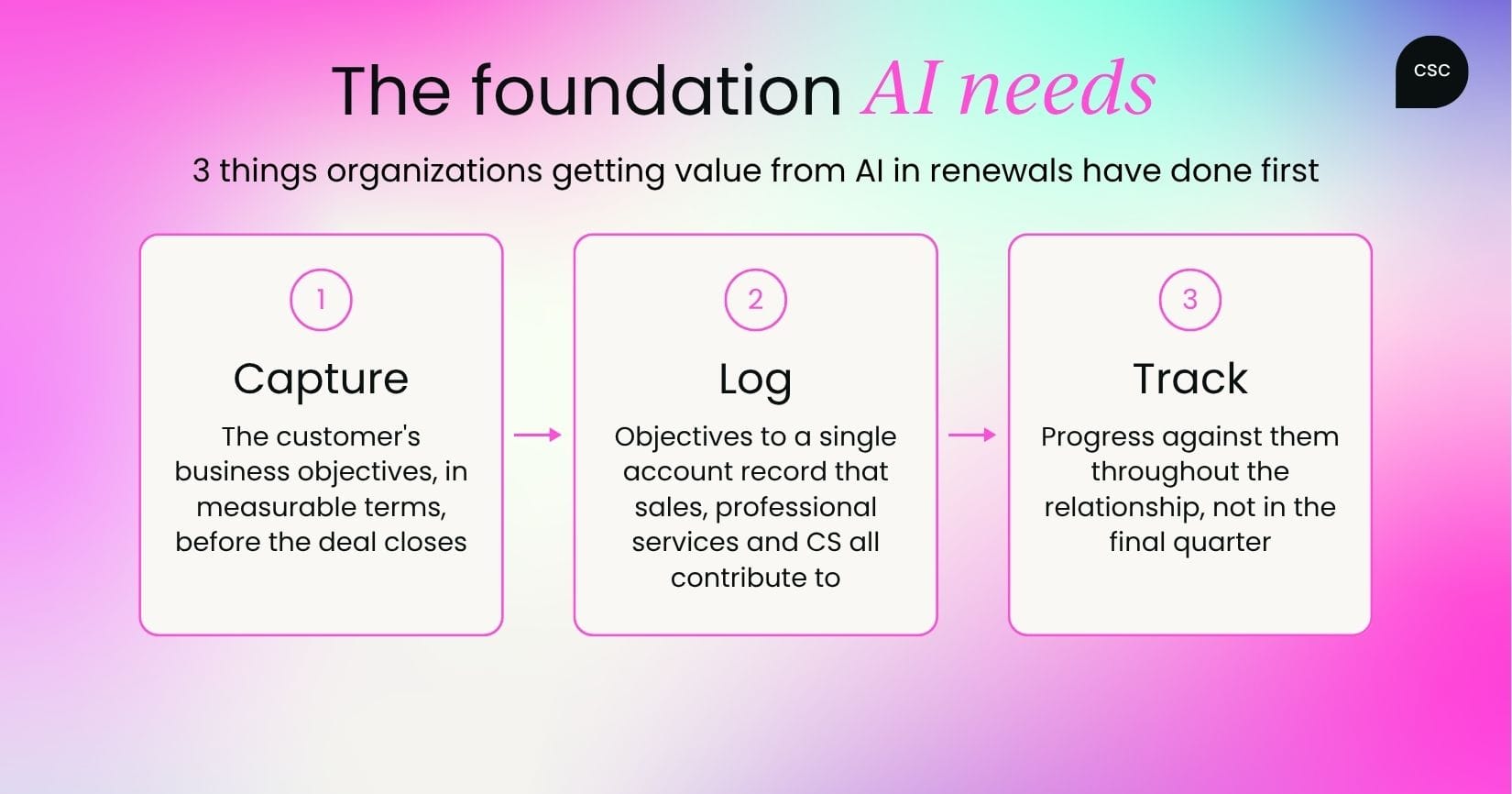
AI can only work with the context it’s given. If the customer’s definition of success was never written down at the point of sale, no model can measure progress against it at renewal.
The organizations getting value from AI in renewals have done three things first:
- Captured the customer’s business objectives before the deal closed, in measurable terms
- Logged those objectives to a single account record that sales, professional services and CS all contribute to
- Tracked progress against them throughout the relationship, rather than reconstructing it in the final quarter
Without that, AI is guessing. With it, three things become possible.
3 ways to use AI for renewals
1. Flag churn risk earlier with AI
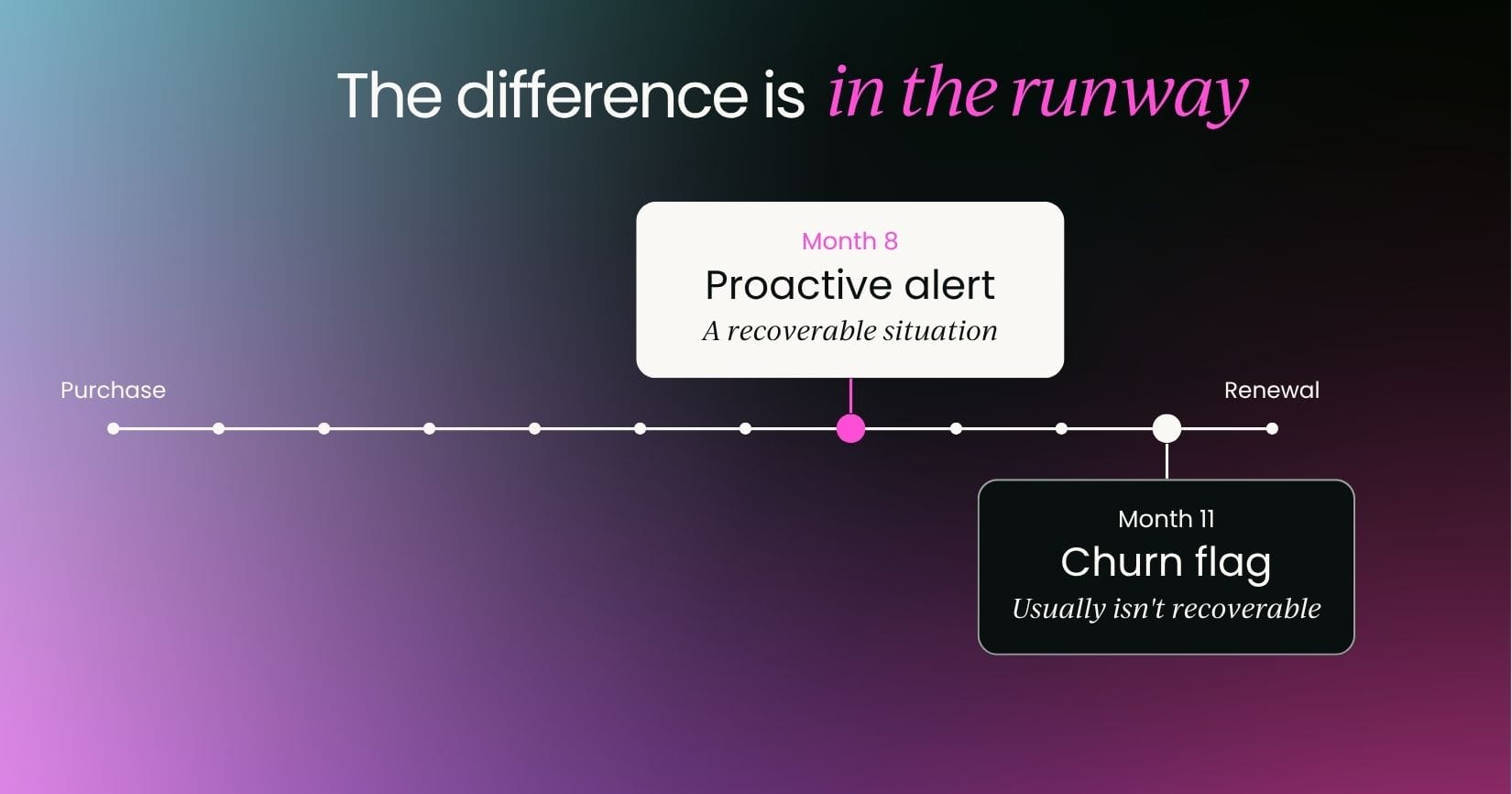
The most immediate win is time. When you continuously track health signals against the account record, product usage, support ticket volume, sentiment from call transcripts, and response rates to CS outreach, risk surfaces before it hardens into a pattern.
The difference is in the runway. A proactive alert in month eight is a recoverable situation. A churn flag in month 11 usually isn’t.
The signals that move the needle aren’t always the ones teams expect.
Mark Presto, Head of Customer Success at Workstream, shared how his team tested an AI churn prediction model against 18 months of historical data at a Customer Success Summit session.
For most of that period, the model correctly predicted around 60% of accounts that went on to churn. When the team added call transcripts from a conversation intelligence tool alongside their product usage data, that figure jumped.
He then ran his own sense check. He gave each of his CSMs 20 accounts, without showing them the model’s score, and asked them to call which would churn and which would stay. On average, the model’s prediction matched the outcome for 16 of the 20.
The testing also overturned an assumption. His CSMs believed a mention of a “credit card update” on a call signaled likely churn. Across customer journeys, the phrase turned up just as often among customers who renewed.
The takeaway is pretty compelling: a lot of churn risk lives in conversations, and your model needs measuring. If you know which accounts churned last year and what your system said about them a month before, you know how often it was right – and whether it deserves your CSMs’ trust.
That rigor helped with the business case too. To get his CEO on board, Mark kept it simple: “If we save seven customers this year because of this tool, we break even.”

2. Measure and prove customer value continuously
The renewal conversation only becomes a formality when the customer can see what they’ve achieved against the outcomes they agreed at purchase.
Without a shared data foundation, building that picture is a manual exercise that happens once a year, under pressure, in the weeks before the contract expires. When value is tracked against the account record throughout the relationship, the renewal narrative assembles itself as you go.
Maranda Dziekonski described the end state in a fireside chat on CS and sales alignment:
“When you get to that point, the renewal is just another day. It’s just another conversation. It’s not this big scary conversation for the CSM. You’ve already done all the work and now it’s just like, ‘Hey, let’s continue to work together.’”
– Maranda Dziekonski, Chief Customer Officer, Fexa
The bar for what counts as value has also gone up.
Speaking about renewals under budget pressure at a 2026 Silicon Valley event, Sherrod Patching, Chief Customer Officer at GitLab, was blunt about it:
“If those outcomes don’t have a direct dollar correlation with them, then the warm fuzzies, those days are over.”
– Sherrod Patching, Chief Customer Officer, GitLab
Her team is using AI to build a much deeper view of what good adoption looks like for each customer, then forecasting risk across a multi-year horizon. Part of the benefit is internal. When CS and sales disagree about an account, the data settles it.
“There is a way to put data in the middle of this so that it becomes a lot less emotional,” she said. “For instance, 'This customer is using half of their licenses. Walk me through why you think this is okay.'”
3. Automate business review prep and long-tail renewals
The third use case splits by segment.
For high-touch accounts, AI can draft the business review from live customer data, pulling account history, value delivered, health trends and recommended next steps into a narrative the CSM can refine. The CSM walks in prepared, rather than spending the night before pulling reports from three systems.
For long-tail accounts – the ones that don’t justify high-touch CSM time but still represent real revenue – AI can run more of the renewal motion itself: proactive outreach, renewal documentation and account summaries. That frees your team to focus on the accounts where a human relationship moves the outcome.
Dominic Constandi described how his team handles smaller customers who buy creative tools almost like a consumer product:
“We have a material long tail... That is where we do use agentic AI to literally just be like, great, look at Snowflake, look at the ATR... look at what their product is, look at when they bought and literally come up with that entire outreach.”
– Dominic Constandi, former Chief Customer Officer, ZoomInfo
On the same stage, Sherrod was candid that GitLab isn’t there yet for outreach. Her team uses AI for scoring and to route accounts back to a person, but internal systems are slowing things down. “I think one of our biggest hurdles to change is our own internal systems,” she said.
That’s where most CS teams sit. Autonomous outreach is realistic for high-volume, low-risk segments with clean data. For everyone else, the path runs through scoring and preparation first.
How to set AI guardrails for renewals
The cost of an AI mistake in a renewal is lopsided. A wrongly scored account might mean a CSM misses a risk conversation. An autonomous agent sending incorrect renewal terms to a major customer could damage a relationship for years.
Even so, the 2026 State of Customer Success Report found that 41.3% of CS teams have no formal AI governance or QA process for AI outputs.
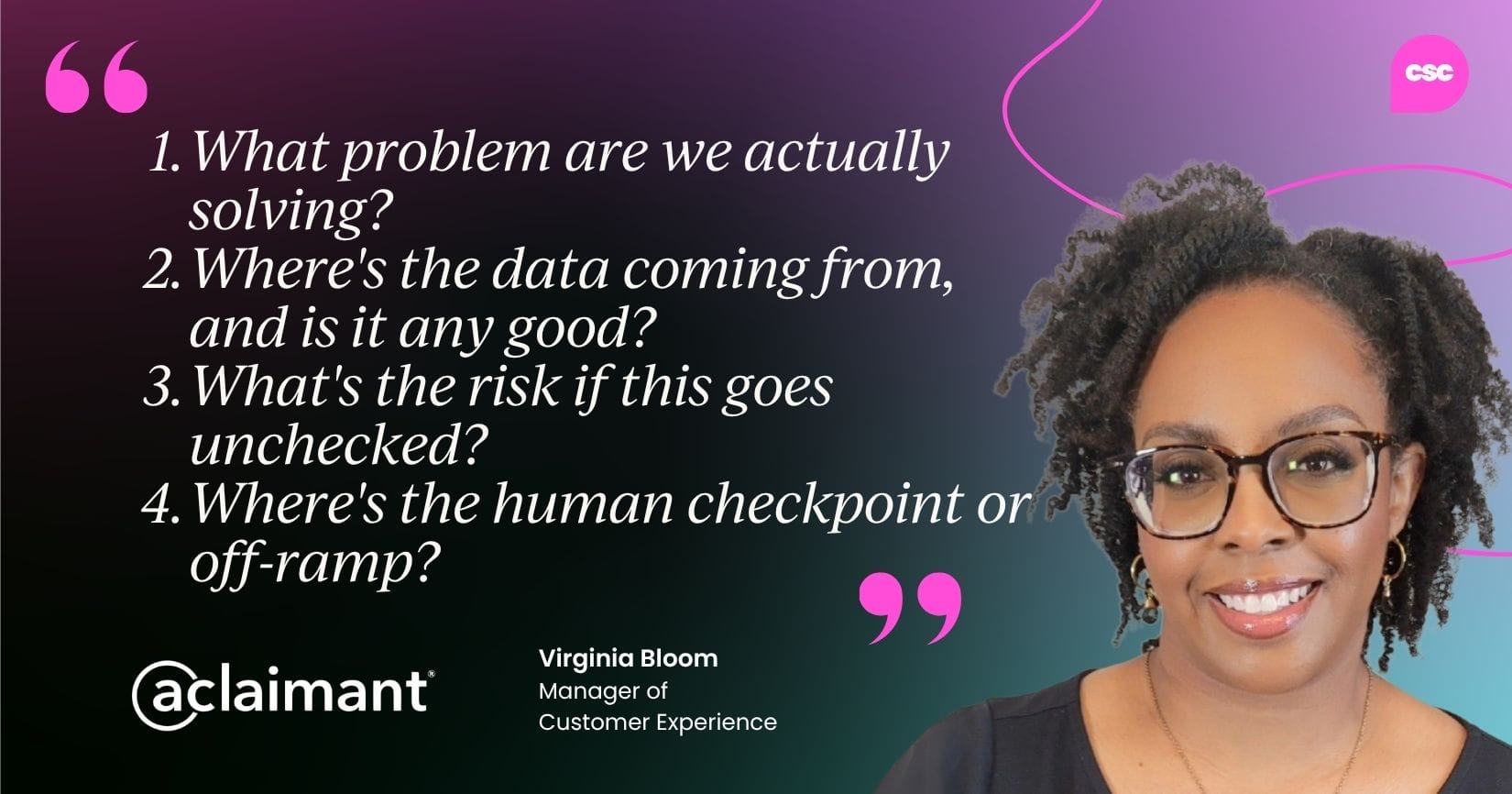
Governance doesn’t need to be a policy document. Virginia Bloom, Director of Customer Experience at Aclaimant, uses four questions before any AI use case goes live:
- What problem are we actually solving?
- Where’s the data coming from, and is it any good?
- What’s the risk if this goes unchecked?
- Where’s the human checkpoint or off-ramp?
For renewals, that last question carries the most weight. Decide which accounts AI can act on alone, what confidence level triggers a human review, and who owns the call when the output looks wrong.
Where to start with AI in your renewal process
A sensible order for bringing AI into your renewal motion:
- Start with preparation. Draft business reviews and account summaries from the data you already hold.
- Measure your risk model against last year’s churned accounts. Fix the inputs before you scale.
- Add conversation data. Transcripts catch risk that usage data misses.
- Automate the long tail last, and only where the value case is clear and there’s a defined off-ramp.
The goal is a renewal that confirms a year of documented outcomes. AI can help you get there, but only if the context it needs has been captured from the day the deal closed.

This article has been adapted from Chapter 3 of AI Across the Customer Journey: The NRR guide for CS leaders.
Download the full ebook to see how the same thinking applies at purchase, onboarding, adoption and advocacy.


Become a CSC Insider
Thank you for subscribing
Get exclusive insights, frameworks, and strategies from customer success leaders driving real business impact.
An email has been successfully sent to confirm your subscription.
 Follow us on LinkedIn



Start the conversation
Become a member of Product Marketing Alliance to start commenting.
Sign up now