








Customer Success Managers (CSMs) and Account Managers (AMs). They're both two job titles that float around a lot of businesses. You might be more familiar with Account Managers thanks to Mad Men and long lunches, but CSMs are cropping up more and more. Are they the same; what's the difference? They both seem related, right?
But it’s not just a case of rebranding; Customer Success Managers (CSMs) are not Account Managers re-packaged for tech industries that offer Software as a Service (SaaS).
Upon a closer look at their respective skill sets, goals, approaches, and interactions with customers, Customer Success Managers and Account Managers couldn’t be more distinguished. They both operate on entirely different scales and have different objectives when it comes to the customer.
We aim to demystify any confusion surrounding these two distinct professions by examining the similarities and differences between these two complex roles.
TL;DR: Customer success vs. account management
In case you're in a rush, here's the topline info, the main differences between a Customer Success Manager and an Account Manager.
| Customer Success Manager | Account Manager |
|---|---|
| Focuses on the entire customer base | Focuses on select high-value clients |
| Driven by customer lifetime value | Driven by account revenue |
| Proactively delivers value | Reactively responds to client requests |
| Scales across many customers | High-touch, personalized service |
| Seeks customer retention | Seeks contract renewals and upsells |
What does a Customer Success Manager do?
A Customer Success Manager is a person who looks after the employer-customer relationship after the sales process. Their role is to ensure loyalty and a lengthy relationship, with the overarching aim for the customer to receive the most out of the product and/or service.
Roles and responsibilities
In an organization, the Customer Success Manager is responsible for developing and nurturing the customer’s value, using metrics like net promoter score (NPS), to monitor the state of their customer base and to lengthen the customer lifetime value (CLV).
The CSM's overall ambition is to demonstrate value to the customer and vastly elevate their experience with the product, ultimately driving long-term sustained revenue by retaining the customer and avoiding unnecessary churn.
 Grace Gupta
What is an Account Manager?
An Account Manager is a role within an organization dedicated to managing strong relationships with clients.
After a customer’s onboarding with sales, the Account Manager will take over customer liaison until the end of the client’s professional partnership with the organization.
Roles and responsibilities
An Account Manager generates revenue and builds a lasting, fruitful relationship with company clients. Normally, an Account Manager will only have a few accounts, perhaps just two or three, and works with a small pool of customers.
In a nutshell, an Account Manager is the personified link between the employer and the customer. But don’t let an episode of the TV show, Mad Men, fool you – it’s not all long lunches filled with boozing and schmoozing in smoke-filled Manhattan hotel bars! There’s a genuine, cultivated strategy for liaising and listening to a client’s needs.
Just like customer success, you need to have phenomenal people skills to be an Account Manager. In fact, it's the beating heart of account management. It’s a profession that demands an ability to problem solve and to work with a variety of different people, so being able to clearly communicate is critical to success in this role; you need to be able to relay information elegantly between both employer and client.
The similarities between Customer Success Managers and Account Managers
While Customer Success Managers and Account Managers have distinct differences in their day-to-day responsibilities (more on that shortly), there are noteworthy parallels in the core talents and objectives they share.
At their foundation, both roles center around developing positive, productive relationships with customers. They leverage a robust set of "people skills" –exceptional communication, service-focused mindsets and analytical abilities – to drive retention and revenue growth.
Though their approaches differ, CSMs and AMs are united by their passion for customers and desire to be trusted partners that enable mutual success. The following bullet points expand on the key similarities that unite these two, customer-centric functions.
- Build strong relationships with customers: You'll find both CSMs and AMs are relationship builders at heart. They're focused on earning trust and creating real rapport with customers through honest communication and rock-solid partnerships you can count on.
- Require excellent communication and interpersonal skills: Here's the thing - both roles demand top-notch people skills. CSMs and AMs need to connect with every type of customer personality while showing genuine empathy, patience, and the flexibility to adapt on the fly.
- Provide a positive customer experience: Your CSMs and AMs are all about delivering those consistently awesome interactions that wow customers. They're laser-focused on creating a smooth, valuable journey that keeps you coming back for more.
- Be the main point of contact: Think of CSMs and AMs as your go-to people. They're often your primary contact, making sure you get seamless support while managing your relationship day in and day out.
- Track and analyze customer metrics and data: Data's their secret weapon! Both CSMs and AMs dive deep into insights to understand your account health. They're constantly analyzing usage patterns to shape winning strategies.
- Involve some elements of upselling or expanding accounts: While it's not their main gig, CSMs and AMs have a knack for spotting growth opportunities. They'll strategically match your evolving needs with solutions that actually make sense.
- Focus on retaining and growing revenue: Bottom line? They're invested in keeping you happy and helping you grow. CSMs and AMs drive retention and revenue through smart account optimization and building genuine loyalty.
- Collaborate cross-functionally within their company: These folks don't work in silos. CSMs and AMs team up with sales, marketing, and product teams to connect all the dots throughout your entire customer experience.
- Contribute insights to improve products/services: Your feedback matters, and CSMs and AMs make sure it's heard. They're constantly feeding customer insights back to drive improvements that actually solve your problems.
- Align customers' goals with company objectives: It's all about creating that perfect sync between what you want to achieve and where the company's headed. CSMs and AMs are masters at finding that sweet spot.
 Kimberly Ayala
What are the key differences between customer success and account management?
It boils down to both teams' different overarching goals.
Customer success is concerned with cultivating customer loyalty via demonstrating value. While making money is part of every department's long game, customer success teams go about it in a more subtle and less mercenary way.
Account management is not only preoccupied with consolidating revenue and keeping the client happy but often is in charge of upselling, cross-selling and renewals.
Every organization operates under varying business models with different demands to answer and objectives to reach.
Acknowledging this fact plays a massive part in the function of customer relationship management between Customer Success Managers and Account Managers.
Let's go into this in slightly more detail. 👇
1. Scale of customers
The way a multinational enterprise corporation operates will not be the same as a small, independent business. Factoring size into the equation is imperative, as the size of the client base varies dramatically between a Customer Success Manager and an Account Manager.
An Account Manager will focus their attention on very few clients – maybe two or three, depending on the value of each account.
For example, larger companies might have one single client who brings in $1m in revenue, or more. The prestige of this account (client) demands a close relationship with a specific contact person to ensure their needs are met. For complex, high-value clients like this, account management takes a high-touch engagement approach with them.
CSMs, on the other hand, can deal with hundreds, if not thousands, of customers at any given time.
The size of your employee-to-customer ratio will drastically affect the level of personalization afforded. Customer success teams use tools like Intercom to imitate a close, personal relationship with the customer, but it’s quite literally en-masse. In no way does that observation aim to discredit the ethos behind customer success, far from it.
CSMs operate on a significantly larger scale than account management does.
2. Customization
A lot of why these two fields operate so differently is how they operate under vastly different business models. As customer success originated within the SaaS industry, their customers can be loosely described as “buy-off-the-shelf.”
Take the subscription model as an example: customers might pay to watch their favorite cable TV channels, or to read articles in the New York Times behind its online paywall.
They all pay a fixed small sum per month or annum, and while there may be different plans or subscriptions to choose from, there is actually little room for radical customization or changes to the product.
The underwritten golden rule for customer success is to allow every customer to reach their goals with your product and/or service – we certainly aren’t negating that. Large or small, SaaS organizations will operate under very similar models – and this model doesn’t necessarily bend over backward to accommodate each individual customer. Frankly, it’s impossible to do so for everyone.
At surface level, one difference between an Account Manager and a Customer Success Manager is their ability to say “no” to customers. (Don’t worry, we promise you it’s not just an excuse to be rude, far from it!) Saying “no” to a customer can be a positive move and one that will help CSMs and the company in the long run.
The weight of customers’ investment in account management can cause a great deal of compromising and changing goalposts between different departments. If you’re on commission or billing a client by the hour, of course, they will want to ensure their ambition comes to fruition.
But what we’re really talking about is learning the skill to handle a customer’s expectations.
3. Managing (great) expectations
Dickens wrote about them; CSMs live them.
If you really think about it, all it boils down to is common sense. When making promises to everyone, you’re not going to be able to fulfill these commitments to all of them. (You’d have to be super-human to pull that level of customer attention off.)
With this customer model, you’re inevitably going to have to let some people down. And the result? You could negatively impact your customer relationships and you don’t want to get on their nerves!
Without a doubt, Customer Success Managers are constantly working towards an overarching objective: for customers to meet their goals. Consequently, CSMs can find themselves overstretching their prescribed job role.
It’s important to draw lines and politely redirect querying customers to the relevant department, such as sales.
During our Customer Success Festival in June 2021, Corinne Goldberg, former Head of Customer Success at Slack, explained that one of the defining characteristics of a CSM is their commitment to ensuring realistic expectations between customer and business.
The last thing CSMs want to do is disappoint their customers. After all, when customers are disengaged and neglected, you’ll become susceptible to increased churn rates, and while it is possible, re-engaging a churned customer isn’t easy.
Of course, everyone wants to be able to have their customers leave fully satisfied. But realistically, in a SaaS business model that isn’t feasible. In turn, by letting people down you compromise the quality of your service. If customers feel neglected this can spark a high churn rate — something you definitely want to avoid like the plague. Essentially, providing genuinely helpful feedback works both ways.
Due to account management's focus on revenue, there are certain stereotypes of Account Managers being “yes” people. The line goes, if you’re paid by the hour by a high-value client, there can be an obligation to agree to every request made. This can often not only be disappointing for the client but incredibly time-consuming.
Looking to tie customer success closer to revenue?
The different approaches of Customer Success Managers vs. Account Managers
A key difference between Account Managers and CSMs can be measured by their skill sets, and the way both industries feed into each other is highly contested.
Account management is very much a subset of a strategic CSM’s skills. Both fields function in similar ways, but this overlap in skill set comprising both roles isn’t equally shared. In fact, the reverse situation isn’t applicable; customer success management isn’t a mirror of account management.
A Customer Success Manager is consistently trying to add value to their product and to the customer’s experience; a CSM might ask the customer how they can make improvements. Depending on the type of product or service, a Customer Success Manager may be able to monitor the customer’s user engagement and reach out to understand why something might not be working out.
On the other hand, an Account Manager is driven by an expansive regime, focused on renewals and sales. This lens of revenue is a major difference between a CSM and an Account Manager’s prerogatives.
We interviewed Jyo Shukla, Senior Customer Success Manager at BitSight, who gave her insight into the DNA behind a CSM:
Jyo’s insight lends itself to a much bigger point: Customer Success Managers have a nurturing mentality. Jyo says CSMs are able to derive the best outcomes for their customers and help them have a more holistic experience.
In contrast, account management aims to secure revenue commitment from clients.
The day-to-day responsibilities of a Customer Success Manager vs. an Account Manager
The day-to-day responsibilities of an AM and CSM depend on the type of AM role you're working in. The day-to-day responsibilities of an Account Manager (AM) and Customer Success Manager (CSM) depend on the type of AM role and organization.
Jess Crow, a Customer Success Manager at Titus Learning, leads a team of recently transitioned CSMs from AMs, offering an interesting perspective.
For Jess, a CSM's daily responsibilities tend to involve:
- Strategic review meetings (discussing success plans)
- Supporting blockers/challenges with service desk tickets
- Helping clients meet their outcomes/ROI
- Providing product recommendations and advising on the roadmap
On the other hand, an AM's responsibilities at Titus Learning include:
- Securing renewals with the CSM providing insight (proposals, negotiations, etc. – classed as transactions)
- Leading sales opportunities (upselling/growth) passed as customer-qualified leads (CQLs) by the CSM to provide value and solve problems
- Leading gathering of requirements/scope, generating proposals and commercials
A key overlap stems from the need to understand client requirements and commercial aspects.
For Jess, this happens because insight and relationships sit with the CSM team. CSMs end up doing much of the work to secure upsells with existing clients, given their trusted advisor status, not sales focus.
Client Success Account Managers
Not all account management roles are the same. Client Success Account Managers (CSAMs) have way more in common with CSMs than your traditional, sales-focused Account Managers who are laser-focused on renewals and upsells.
Natasha Beresford, Client Success Account Manager at Product Marketing Alliance, breaks it down: both roles are all about proactively helping clients see value. The difference? How they get there.
The CSAM approach
CSAMs build deep relationships with a smaller book of accounts. They're the primary point of contact after sales hands things over, running frequent check-ins tailored to each client.
These aren't just courtesy calls—they're opportunities to share updates, track shifting goals, and spot cross-sell or upsell opportunities along the way.
How CSMs differ
CSMs typically juggle a higher volume of customers. Their focus is on nailing the onboarding experience and making sure clients have what they need to get maximum value from the product.
With that kind of scale, they lean on persona-based communications and respond to queries as they come in, rather than maintaining that high-touch approach CSAMs can offer.
As Natasha puts it: "A CSAM has a slightly narrower scope of tasks, but they're usually more in-depth. The recommendations made by the CSAM are often tailored to the client specifically."
Both roles advocate for customers internally and champion the organization externally – gathering testimonials, collecting feedback, and pushing for improvements.
But here's the reality: CSAM work is time-intensive. Client reporting, engagement monitoring, issue resolution, regular calls—it all requires hands-on, account-specific effort. Even with templates to streamline things, there's always going to be manual work involved.
The flexibility between Customer Success Manager roles and Account Managers
How much freedom do you actually have in each role? It's a key question when you're weighing up the two paths.
Natasha Beresford, Client Success Account Manager at Product Marketing Alliance, says it varies by organization—but there are some clear patterns.
Both CS and AM roles need flexibility
Account Managers often work across time zones, so schedule flexibility matters. CSAMs might take calls outside normal hours to accommodate clients, because those conversations are essential for building strong relationships.
And when client needs shift – or there's been a miscommunication during the sales handover – CSAMs need the flexibility to navigate tricky situations, adjust deliverables, and reset expectations on the fly.
CSMs typically have less autonomy
Here's the thing: a lot of what CSMs work on – emails, banners, group posts – goes out to a wider audience. That means more processes, more review stages, and tighter alignment with company standards and launch timelines.
It's about maintaining consistency and maximizing impact across a large customer base.
CSAMs have more room to make calls
CSAMs operate with more discretion. While there are guidelines (tone of voice, check-in processes), the day-to-day management of each account is largely up to the individual CSAM and their client.
For example, a CSAM might have authority to offer refunds or product exchanges up to a certain value – no need to loop in sales or management.
They'll also make judgment calls on service levels. If an account has strong growth potential, or if the lead booker is willing to provide a testimonial or client interview, a CSAM might decide to go above and beyond.
It's a more tailored, relationship-driven approach, and that requires trust and autonomy.
 Ashvin Vaidyanathan
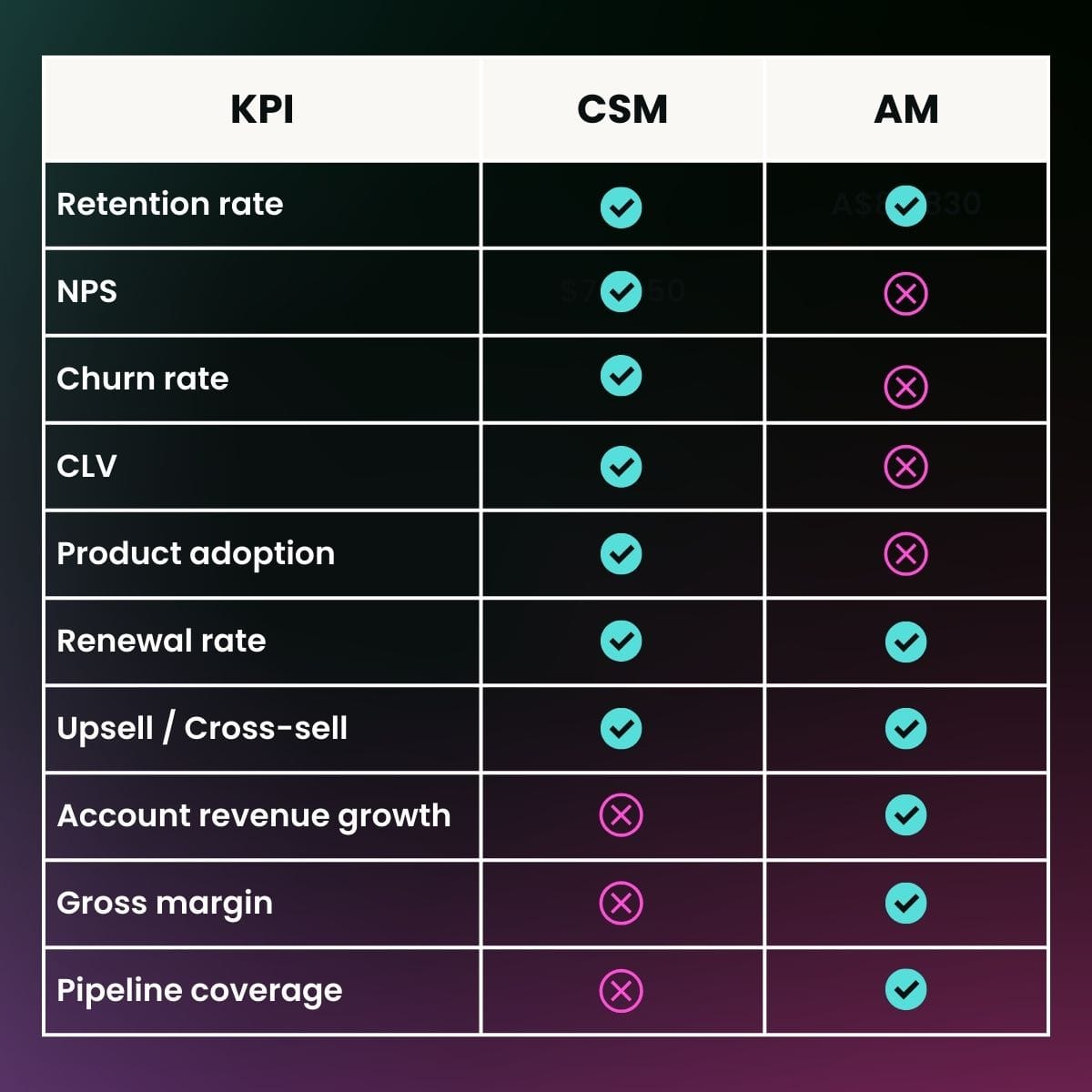
Primary KPIs for Customer Success Manager vs. Account Manager
Understanding the key performance indicators (KPIs) for CSMs and Account Managers is crucial for setting clear expectations and measuring impact. While both roles aim to drive customer value and revenue, their KPIs reflect distinct priorities and workflows.
CSMs are typically measured on:
- Customer retention rate: The percentage of customers who renew or stay active over a set period.
- Net promoter score (NPS): Gauges customer satisfaction and loyalty.
- Churn rate: Tracks the percentage of customers lost.
- Customer lifetime value (CLV): The projected revenue from a customer over their relationship.
- Product adoption/usage metrics: Measures how deeply customers are using the product.
AMs, on the other hand, are evaluated by:
- Renewal rate: The percentage of contracts/accounts renewed.
- Upsell/cross-sell revenue: Additional revenue generated from existing accounts.
- Account revenue growth: Increases in the value of managed accounts.
- Gross margin/profitability: Financial performance of managed accounts.
- Pipeline coverage: Value of opportunities in the account pipeline.
Here’s a quick reference table:
According to Emily Fetherston, Enterprise Customer Success Manager at Veeam Software, at Customer Success Summit Boston 2023:
“I personally, as a CSM, have very different success metrics than my sales counterparts. This distinction ensures each role is laser-focused on the outcomes that matter most for both the customer and the business."
 Customer Success Collective
How Account Managers can make a career transfer into a customer success role
Transitioning into a different professional field is a keen way to utilize the power of transferrable skills. In fact, since customer success is a relatively non-traditional role, many people find themselves segueing into this booming function.
We asked members of the Customer Success Collective Slack community for advice for any Account Manager or Account Executive looking to move into customer success.
Josh Horsman, Head of Customer Success (UK) at Askable, said:
"As an Account Manager, you'll already be well-equipped for the role, but there are some important distinctions to consider between the roles.
"Learn to think in terms of how you can deliver maximum value for the customer. Seek to gain a deep understanding of their goals and how your product can help them to achieve those ends.
"Then, make it your mission to help the customer realize that value and hit their goals through building a great relationship, awesome onboarding, first-class customer support, being proactive about seeking their feedback, and finding new ways to help them reach those goals as both your product and their goals evolve."
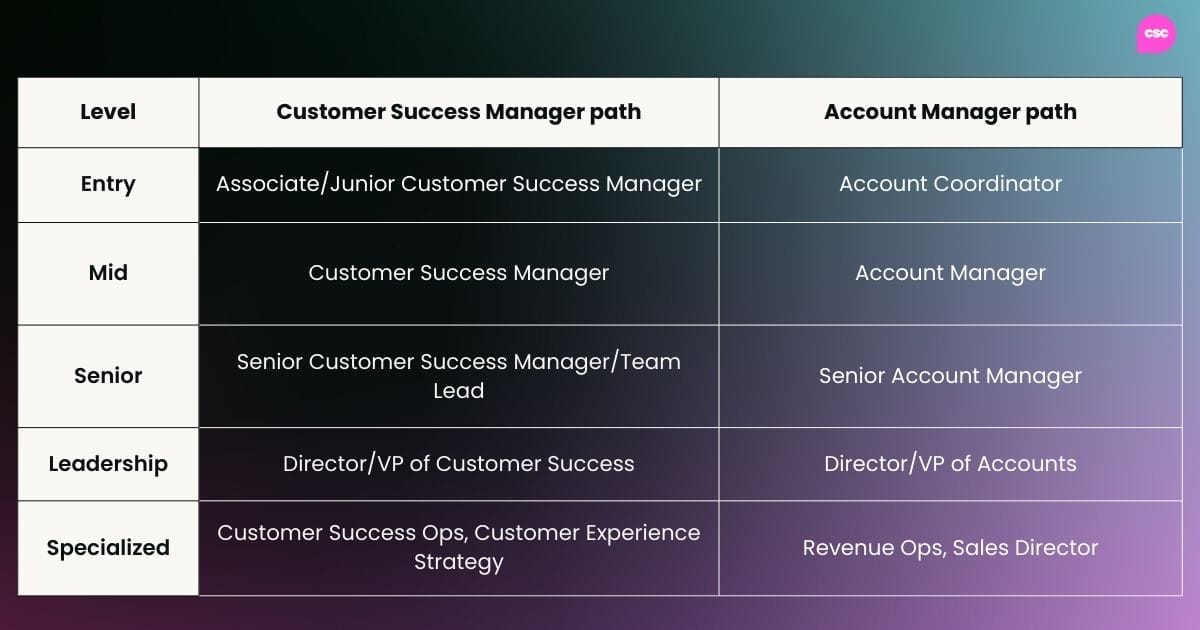
Typical career path and next steps for a CSM vs an AM
When you look at career progression for Customer Success Managers and Account Managers, you’ll notice both roles offer clear, but distinct, advancement tracks—and there’s meaningful crossover for those who want to pivot. Let’s break it down side by side for clarity.
CSMs typically start as Associate or Junior CSMs, moving into mid-level CSM roles and then advancing to Senior CSM, Team Lead, or Customer Success Lead. From there, many step into management as Customer Success Managers (of teams), Directors of Customer Success, or even VP/Head of Customer Success. Some CSMs branch into specialized roles like Customer Success Operations or Customer Experience Strategy, especially in larger organizations.
AMs often begin as Account Coordinators or Junior Account Managers, progressing to Account Manager, then Senior Account Manager. The next steps include roles like Account Director, Head of Account Management, or even VP of Accounts. In some organizations, AMs transition into broader commercial leadership, such as Sales Director or Revenue Operations.
Here’s a quick comparison table for reference:
For startups and scale-ups building customer success functions from scratch, finding candidates with direct CS experience isn't always realistic, or even necessary.
Speaking on a panel at Customer Success Summit London 2023, Melissa Foster, Chief Experience Officer at WorkBuzz, shared her pragmatic approach to building a CS team from the ground up:
"When we started our journey, we had to recruit from outside of customer success – that was the reality of what we had. So a couple of my CSMs who have developed with us came from account manager backgrounds, people with strong sales incentives or experience in sales roles."
What mattered more than a traditional CS pedigree? "Finding the right people because of their behaviours, their value set – things that you can't teach."
But hiring for potential comes with a responsibility: radical transparency about what the role actually involves. In resource-constrained environments where CSMs inevitably wear many hats, Foster emphasises the importance of setting expectations from day one.
"Complete honesty. I think this is really, really important when you're hiring a new team. If it is a CSM role where they are wearing many hats, tell them that upfront."
It's a reminder that building a successful CS team isn't just about finding the right skills; rather, it's about finding the right people and being honest about the journey ahead.
 Grace Gupta
Evolving CSMs beyond relationship-building
With the impact of an unpredictable economy, budgets often tighten. Customer success teams are likely to be tasked with directly generating revenue through account expansion. This signals an evolution beyond the traditional relationship-building focus of customer success.
According to Santosh Sahoo, Regional VP of Customer Success at MuleSoft, to drive this evolution, customer engagements need to become more purposeful:
"Every engagement should intentionally progress the customer to the next step in their journey. If an engagement doesn't strategically move the customer forward, it runs the risk of being non-valuable, amounting to mere relationship-building, which, while significant, is already being covered by an account team.
"It's not solely the purview of the CSM to maintain relationships. Instead, CSMs need to focus on driving outcomes."
This intentional, outcome-based approach is the future of customer success. CSMs have a prime opportunity to expand their impact beyond just maintaining customer relationships. With the right vision and strategy, they can transform into drivers of adoption, expansion, and retention.
Traditionally, account management is commercially driven rather than outcomes driven. Many AMs prioritize sales due to targets, which can, unfortunately, lead to mis-selling if they do not fully understand client requirements and pain points. These insights usually sit with the Customer Success Manager.
The future is digital
The future of account management is headed towards a digital transformation, but that doesn't mean losing the personal touch. As McKinsey research shows, key Account Managers will need to adopt a hybrid model that blends high-tech capabilities with high-touch service.
On the one hand, data and digital tools will drive unprecedented efficiency and insights. According to the study, Account Managers can leverage automation, AI-enabled analytics, and account planning software to get an integrated view of customer needs and strategy. This allows them to scale personalization in a way not possible before.
But even as Account Managers embrace these digital capabilities, the human element remains critical. Key accounts still value a trusted advisor who understands their business and goals at a deep level. Someone who can be their advocate across the organization. This is where Account Managers will continue providing white-glove service and strategic guidance.
The most successful Account Managers will integrate the two approaches seamlessly. They'll tap data to inform where high-touch services are most valuable and personalize digital touchpoints. Blending automation with human interactions will allow Account Managers to drive growth for their most strategic customers like never before.
The future is not digital or personal. It's digital and personal. Account management will thrive by leveraging both.
 Carlos Quezada
All in all...
CSMs are concerned with demonstrating value by enhancing the customer experience for sustained loyalty and long-term revenue generation.
Account Managers are revenue-led, with the end goal of keeping high-value clients happy and dealing with renewals, up-selling and cross-selling.
Where CSMs are preoccupied with dealing with bigger scale, Account Managers ultimately deal with bigger clients. Account management can be categorized as reactive in supporting its client-business relationship with a focus on contract renewals and upselling.
Customer success, on the other hand, is preoccupied with making sure the customer’s goals are their own goals. While both can happily co-exist, a CSM wouldn’t try and do an Account Manager’s job and up-sell; it would ruin the foundation of their relationship with the customer: trust.
A CSM takes a more proactive approach with day-to-day mutual engagement plans, with the aim of adding value to the customer. Customer success teams can operate on a variety of high-touch or low-touch relationships, depending on the customer base. On the other hand, account management will ordinarily have a high-touch strategy due to their smaller clientele.
Both branches of customer relationship management (CRM) are very similar, but the glaring difference between them is intent and scale. While CSMs are more common in SaaS, and Account Managers are more traditional fixtures in business, the success of both of these roles is dependent on the style of your business and the individual demands of your customers.
Ready to become a customer success maestro?
If you want to master the essential competencies for customer success and accelerate your career, Customer Success Certified: Core is the most comprehensive training out there.
Get ready for a deep dive into every crucial aspect of the CS role.
You’ll uncover cutting-edge strategies for customer onboarding, activation, advocacy, and beyond.
Learn how to:
✅ Tackle churn
✅ Optimize expansion
✅ Ace CS metrics.
This is your chance to equip yourself with the confidence, practical skills, and competitive edge you need to excel. The actionable tools and unparalleled expertise will take your strategies to the next level so you can deliver results.
What are you waiting for? Enroll in Customer Success Certified: Core today and start your journey to CS mastery!


Become a CSC Insider
Thank you for subscribing
Get exclusive insights, frameworks, and strategies from customer success leaders driving real business impact.
An email has been successfully sent to confirm your subscription.
 Follow us on LinkedIn