








We hate to break it to you, but there's no single right answer to how much annual recurring revenue (ARR) one customer success manager (CSM) should manage. Ask a room of customer success leaders and you'll hear anything from $8M+ per CSM to "we don't use a ratio at all." The gap usually tells you more about the company than about the method.
Across Customer Success Summit talks from 2023 to 2026, a clear pattern shows up. The most specific ARR figures came from the largest companies, while the earlier-stage leaders didn't give a ratio at all.
Our State of Customer Success 2026 Report backs this up from the other side. 37% of CS teams decide how many accounts each CSM looks after based on account revenue. Another 37% haven't formally defined CSM capacity at all. So before you borrow someone else's number, it's worth knowing what kind of company it came from.
How much ARR do CSMs manage at enterprise companies?
The highest ARR-per-CSM figure we’ve heard from our events came from MuleSoft, which Santosh Kumar Sahoo, RVP Customer Success, described as "close to a $2 billion company." Speaking at New York’s Customer Success Summit back in March 2023, he was asked what the ideal CSM-to-customer ratio is for strategic customers. He said:
"We generally have measured based on revenue [rather] than the number of customers. So for us, when we started, it was about $5M+, and now about $8M+ plus. So if we have a $20M+ customer, we just have one CSM... It's not necessarily the number. It's the size of business."
So each strategic CSM looks after about $8M+ in ARR, however many accounts that takes. That figure applies to MuleSoft's top accounts only. Its long-tail customers sit on a digital model, so the number describes one tier of a very large business.
Santosh was also clear that the model has limits. He said MuleSoft's high-touch approach "scaled us till we reached almost $1.75B. It doesn't scale anymore." And when asked what smaller companies should do, he didn't tell them to copy it:
"If your leadership cares about growth and margins can wait, you don't have to go to this model."

How many accounts should a CSM have?
ButterflyMX is a mature, late-stage company, with a CS team that runs lean. At Chief Customer Officer Summit in New York, in March 2026, its Chief Customer Officer, Temy Mancusi-Ungaro, said 15 CSMs typically support around 20,000 customers.
Temy’s team segments by ARR, with dedicated coverage for the top accounts. For the tier below, Temy gave one of the few account ranges we heard:
"The next tier, I actually find that's a great place for CSMs to have books around, in the SaaS world, 40–60 accounts. So it's not a little, but it's not a lot."
The bottom of the base gets automation and AI, and low-price small-to-medium-business (SMB) customers don't get a CSM at all. "I move most of my SMBs to more of a support motion," Temy said. Temy has scaled other companies from $0 to $300M, $10M to $40M and $5M to $20M, so this view comes from several stages of growth.
 Grace Gupta
Why CSM-to-account ratios change by tier
A single company can run ratios that look like they belong to different industries. Jess Osborn, former VP of Customer Success at GoCardless, shared how they structured their monetized CS packages during her talk at Customer Success Summit in Austin back in February 2025.
Jess joined GoCardless back in 2021 and described it as "a pretty decent sized business" during her time there. "The size of GoCardless when I joined was... $90M in ARR," she recounts. "It grew to close to $200M ARR by the time I left."
GoCardless monetized its customer success services, selling them as tiered packages, and each tier came with its own ratio. For the enhanced package, which served mid-market customers, Jess explained:
"The number of accounts that would sit in the enhanced package, for example, would be based on a ratio of one CSM having approximately 30 accounts in their portfolio."
The digitally-led scale tier looked very different. "We did have CSMs, but they were about 400-500 accounts apiece," she said.
What’s perhaps the most interesting part here, this is the same company and the exact same CS org. We have two ratios more than 10 times apart. And what this demonstrates, quite plainly, is the central problem with the conversation around ARR and CSM coverage: when you ask for a specific dollar value per CSM, the answer depends on which tier you're asking about.

Why startups and scale-ups avoid fixed CSM ratios
When an audience member asked a panel at Customer Success Summit Sydney 2023, "Is there an optimum ratio of number of accounts?", none of the three speakers gave a number. As panelist and moderator Chris Jones, Global Director of Customer Success at Enboarder, put it earlier in the session:
"I don't think we can say it's X number of accounts or Y number of ARR per CSM... not saying we need to have $2M ARR each CSM because that can just be so varied product to product."
Mel Foster, Chief Experience Officer at WorkBuzz, was leading a team of about seven CSMs at a company that had "just raised Series A." She pointed out during this 2023 panel discussion that the ratio isn't always the CS leader's to set:
"Sometimes the ratios come from somewhere else. So we are quite often given in terms of our forecasting and budget planning the ratios that we're expected to work towards."
She added that account type isn't always what drives workload: "Sometimes it's just a particular stakeholder."
At the point of this panel, Krista Hoffman, VP Customer Experience at ManyChat, was building a CS team from scratch, with two CSMs alongside a 30-person support team. For a team at that stage, she said any ratio has a short shelf life: "Even if you do figure out the ratio that's good for your business, what's good right now may not be good in three to six months."
How to calculate CSM capacity
Two Sydney speakers both gave the perspective of what a CSM can realistically do, rather than from a set number of accounts or ARR. The panel worked out how much time a CSM has and what the work takes, then calculated how many accounts that covers.
Chris Jones described Enboarder’s approach on the same Customer Success Summit Sydney 2023 panel. They started with "the core activities that lead to success," using Gong data to understand "where people are spending their time" and "which CSMs have the higher net retention rates."
"Based on that, starting to understand what the activities are, then saying how many hours each activity takes, how many hours are in the year, and really doing some calculations... looking at your different segments, how many customers in each segment can a CSM take?"
A fixed figure "may pan out that way when you look into it," Chris said, but the activities come first.
Jeff Beaumont, Senior Director of Worldwide CS Operations at GitLab, described a similar model for pooled CSM coverage on a panel at Customer Success Summit San Francisco 2023. His version accounted for the time people forget to plan for, "baking in things like vacation time, meetings and all these other things like lunch." He then took the model to finance to agree on what the business could afford.
Jeff also gave finance a reason to fund it. His team compared net ARR on accounts with a CSM against accounts without one, and the difference was “a freaking lot."
How customer success teams set CSM capacity today
Our State of Customer Success 2026 Report asked CS professionals how CSM capacity is decided at their company. Revenue-based segmentation, the approach MuleSoft uses, tied with "not formally defined" as the most common answer.
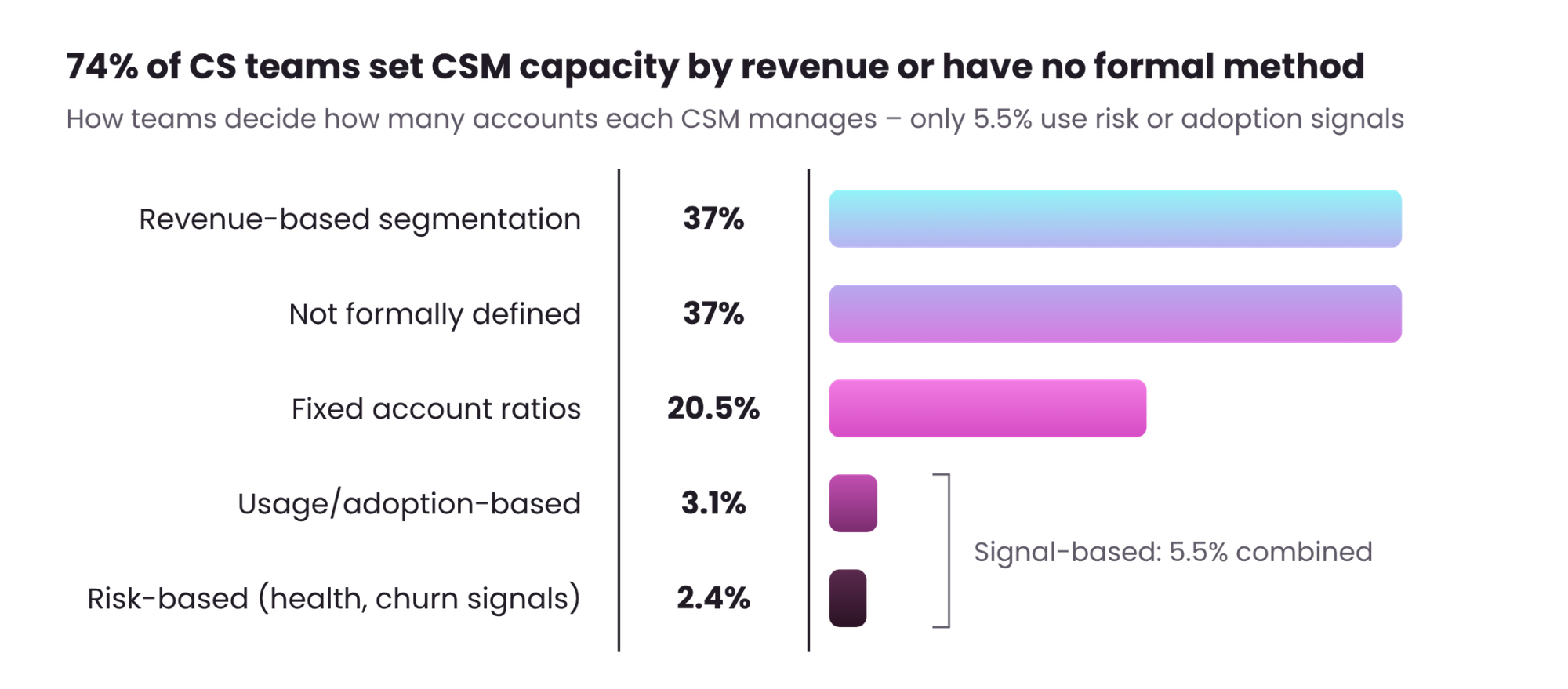
The report argues that revenue alone can point CSMs at the wrong accounts:
"A $50K account at high churn risk often needs more active coverage than a $200K account that's stable, fully adopted, and auto-renewing."
Only 5.5% of teams use risk or adoption signals to set capacity.
CSMs feel it when capacity planning goes wrong. About 14% of respondents named capacity and workload as their biggest challenge, with answers like "Too many accounts for my segment" and "Workload to CSM ratio."
We must offer a caveat – our report's sample leans toward later-stage companies. 29.3% of respondents work at late-growth or scale-up companies, 24.5% at established market leaders and 9.8% at enterprises, while 9.8% are at early-stage companies. The report doesn't break capacity models down by company stage, so it can't show whether startups and larger companies approach this differently.
 Kimberly Ayala
How to set the right ARR-per-CSM target for your team
If you need a figure for next year's plan, borrow the method rather than the number. Based on what these leaders described, here's where to start:
- Benchmark against the right company: An $8M+ book at a $2B company tells a Series A team very little. Compare yourself with businesses at your stage, and with the same tier.
- Set ratios per tier. GoCardless ran about 30 accounts per CSM in one tier and 400–500 in another. A single company-wide ratio will be wrong for most of your book.
- Build a capacity model. List the activities that drive retention, time them, and count the hours a CSM really has.
- Layer in signals as your data allows. Revenue tells you which accounts matter most. Risk and adoption data tell you where a CSM's time will change the outcome.
- Review it every few months. Your customer mix, product and headcount will change, and your ratio should change with them.
- Show finance the return. Compare accounts with and without CSM coverage, as GitLab did, so the headcount conversation starts from results.
Raymond Otero, a Customer & Product Outcomes Executive who contributed to the State of Customer Success 2026 Report, put the shift this way:
"Too many organizations optimize for coverage ratios rather than impact. The real question is not how many accounts a CSM can manage. The real question is whether scarce customer-facing resources are being deployed at the moments that matter most."
Kourtney Thomas, former Head of Customer Success at TakeUp, added a warning for anyone tempted to plan too tightly:
"Segmentation and capacity planning can look stellar on paper, but there can be a lot of nuance involved in actual delivery," she said. Plan too aggressively and "your whole team [gets] overloaded and burned out while churn goes wild and your KPIs fall apart."


Become a CSC Insider
Thank you for subscribing
Get exclusive insights, frameworks, and strategies from customer success leaders driving real business impact.
An email has been successfully sent to confirm your subscription.
 Follow us on LinkedIn




Start the conversation
Become a member of Product Marketing Alliance to start commenting.
Sign up now