












Customer success is one of the hottest departments to work in right now, but despite this, we're seeing a serious lack of C-suite representation.
Too often, customer success struggles to be part of the conversations that propel businesses forward. I can’t definitively say why that is, but here’s what I’d guess: we’re helpful people — so focused on what we need to do for customers that we sometimes forget to advocate for ourselves.
Having a seat at the table means being part of the discussions that drive the business forward. In this article, I’ll explore why that’s not yet happening — and how we can change it by repositioning CS from a cost center to a strategic growth driver.
The lack of customer success representation in the C-suite
A quick LinkedIn search reveals more than 100,000 open Customer Success Manager (CSM) roles in the U.S. – an impressive figure. Yet there are fewer than 2,000 VP of Customer Success positions, and only 21 Chief Customer Officer (CCO) titles, many misclassified as sales roles
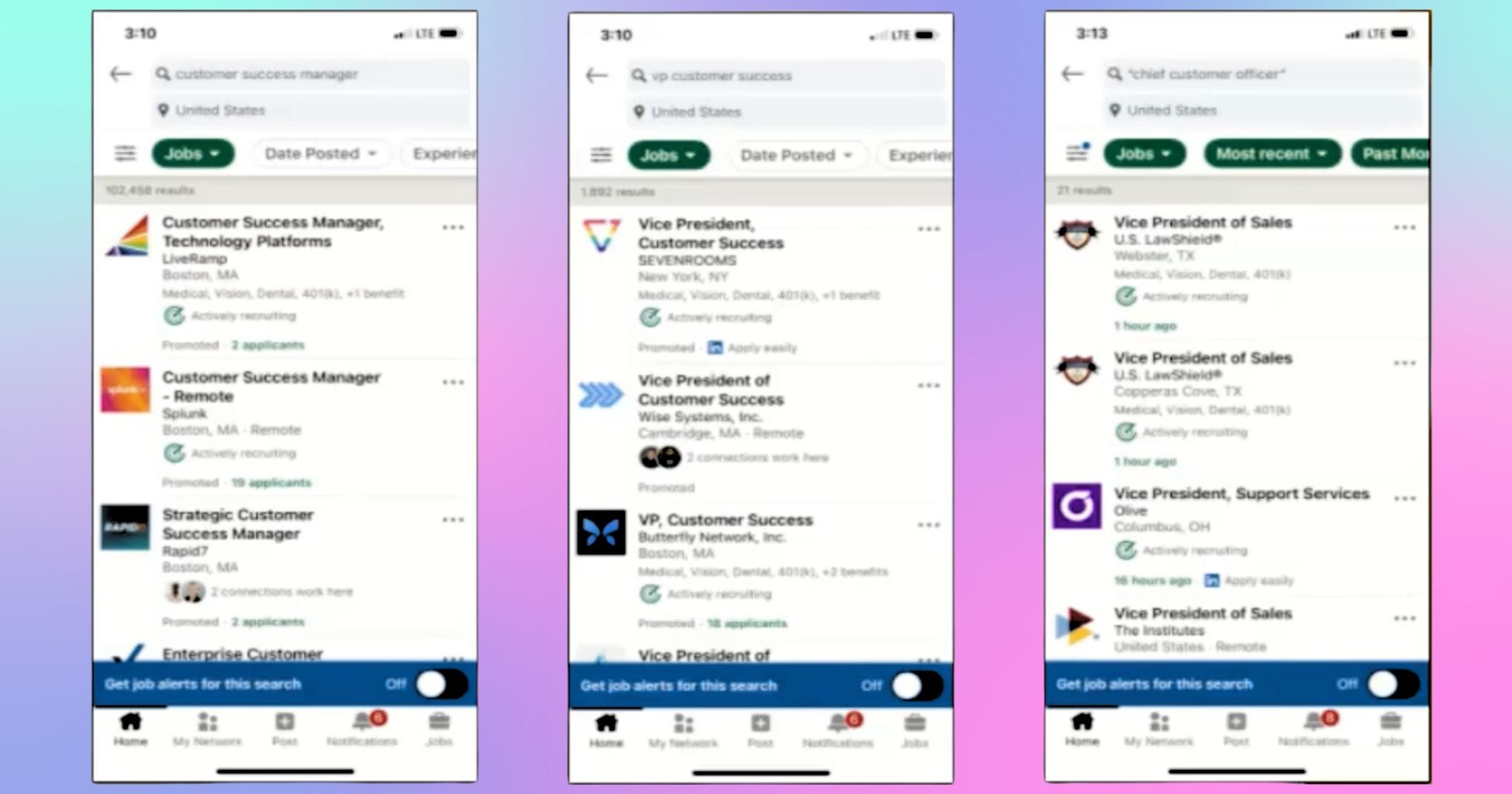
This proves we're a growing industry, but we don’t yet hold the same level of influence as other departments. It just doesn't really add up. Here's one of the reasons why it doesn't add up.
Customer success is still relatively new
It sounds obvious, but we can’t forget how young this discipline is. Think about the shift from buying CDs to streaming on Spotify – in historical terms, it’s brand new. Best Buy only stopped selling CDs in 2018.
Around the same time, Adobe and Microsoft transitioned from traditional software models to subscriptions, introducing customer success as a core function. In a subscription world, customers can switch easily, so value delivery and retention became essential.
Because we’re still new, there are some truths we need to acknowledge — and some actions we need to take — to earn that strategic seat.
8 tips on how to advocate for customer success
It's unlikely that, as a child, you said, "I want to be in customer success," and dedicated your education and initial experience to doing so. That's okay, that's totally normal, as, like I said, customer success didn't exist more than 15 years ago
If you're part of a customer success team at the moment and you don't have a growth plan in front of you, work with whoever's leading the team to build that plan, to understand what the skills and competencies are to progress in the profession.
Here are some tips I've found incredibly useful in making sure customer success has a voice that's listened to.
1. Report to the CEO and set priorities and make them happen
If you can, find an organization where customer success reports directly to the CEO – although I'll admit, this is easier said than done.
According to the State of Customer Success 2025 Report, only 4.9% of CS professionals report directly to a Chief Customer Officer, and just 19.5% report to the CEO — figures that reflect the function’s ongoing struggle for true executive visibility.
But even if you're not reporting directly to the #1, you can set priorities, make them happen, and share them back with the CEO. That's really our job as the closest people to the customer: to share knowledge with the highest executive in the business.
Example priority: Customer onboarding
An example of a priority you can set and focus on would be customer onboarding. How long is it taking you to onboard customers?
As CCO at Chili Piper, we decided to double down on the number of days it takes to onboard customers and we have made that priority happen. We focus all our resources on improving that. That's been extremely well received by the board and the executive team.
2. Get experience out of the customer success function or find ways to collaborate
You should try to get experience outside of the CS function or find ways to collaborate with other teams. Why? Because customer success doesn't happen in isolation; it's a way of doing business.
Understanding how other parts of the business work is incredibly valuable. If you can't afford to have a stint in product, marketing, sales, or engineering, perhaps you can find different projects to collaborate on with those teams.
The reality is, people don't fully understand customer success yet. I've already talked about it being quite a new thing and acknowledging that truth, but it's new and therefore it's not fully understood.
3. Set a mission to avoid becoming “the everything department”
CS teams are often pulled in a million directions and, regrettably, can often become "the everything" department.
We're absolutely pulled in a million different directions by our customers and by the different demands we have from the rest of the business. Setting a mission is powerful because when the going gets tough, you can always come back to that mission and use it to prioritize the things you're really going to focus on.
Once you have that mission, getting the rest of the company to understand it is equally important. When I was CCO at Chili Piper, we set a very clear mission for the customer success and support team, which was to grow and retain happy, active users.
It clearly defines what we're here to do, and everything that we do supports that mission.
4. Continuously educate others, internally and externally, on the role and importance of customer success
Internally, it's essential to ensure that all departments understand the role and value of CS. This may involve conducting workshops or informal knowledge-sharing sessions where the CS team could illustrate the work they do, their targets, and their overall contribution to the business.
It could also involve demonstrating how the CS team uses client feedback to influence product improvements or how they contribute to client retention and upselling. Continual internal education ensures that everyone in the organization understands and supports the CS function, recognizing its strategic importance.
Externally, educating other stakeholders about customer success is also critical. This includes current and potential clients, as well as colleagues in the industry. Clients need to understand the role of the CS team so they can best utilize their services for their benefit. A transparent and open line of communication can help build trust and further cement the client-CS relationship, which in turn drives client retention and growth.
Reaching out to colleagues in the industry is crucial, particularly because customer success is a relatively new field. This can be done through various channels such as collaborative blog posts, podcasts, webinars, or participating in industry-specific events such as CSC's Customer Success Summits. At such events, best practices and new insights can be shared, and a dialogue about the evolving role and importance of CS in different industries can be fostered.
Further, participating in such industry discussions helps to establish your company as a thought leader in the space, demonstrating your commitment to not only providing excellent customer service but also advancing the industry as a whole.
Continuous education isn’t just good PR; it’s how CS earns recognition as a strategic function.
5. Make time for strategic thinking
Look at the entire business and focus customer success on solving the most important problems preventing growth.
Making time for strategic thinking sounds like something pretty obvious, but it's extremely important. If you're working in customer success and a customer demand comes in, you're going to prioritize working on that no matter what.
But you have to find a way to create time to stop, pause, reflect, and understand how you're achieving the expected outcomes you wanted to achieve since the last time you took a pause for strategic thinking.
This part is really important – identify the most critical problems for the business, not just your customer. Here's an example: There's this nuance in the product that's really frustrating some customers, but you have to be able to prioritize working on bigger problems if they exist outside of that nuance.
For instance, if your sales team is not selling to a particular industry or a particular market, maybe you're going to have to pause and go help sales with that go-to-market plan. I always like to think the biggest customer you can have in your portfolio is your sales team.
Strategic thinking is more than just about you and your function. It's about what the business needs to grow and how you can help the business.
6. Customer success ROI is hard to prove: work closely with sales leaders to design revenue
Another truth that comes up often in conversations about why customer success doesn't have a seat at the table is that customer success ROI is actually quite difficult to prove.
This "money please" concept stems from the fact that many customer success teams have spun out of traditional customer support or client services teams. Those teams have traditionally been viewed as cost centers rather than revenue-generating departments. The perception is shifting, though: 78.7% of CS professionals now see their function as a key revenue driver, and 49% fully own expansion revenue (upsell, cross-sell, and renewals), according to the State of Customer Success 2025 Report.
This evolution in ownership marks a major step toward proving the tangible ROI of customer success.

To work around that ROI hurdle, work really closely with sales. If you can work with sales closely, you can find a way to design revenue that is going to be better for the growth of the business.
An example would be taking all of the knowledge you have about your customers – the wins, the anecdotes, the things that aren't working for them – and continuously feeding that back to sales leadership. Most salespeople don't want to sell the wrong things to the wrong people.
They care about their reputation, and they want to do what's best for the customer. Our job is to allow them to do that.
7. Measure the impact of customer advocacy
This next tip is an easy, quick win that's often overlooked. Measuring the impact of customer advocacy can really go a long way in getting a seat at the table.
Customer advocacy can mean many different things but it's basically all of the good stuff you do with your customers. We spend a lot of time talking about the bad stuff – what are the churn reasons? What can we do to avoid them? But we need to spend just as much time talking about the good stuff.
That could come from case studies, references, testimonials, reviews on G2. It could come from creating a user conference and getting a certain number of customers to speak at that conference, or to speak at other conferences for you.
Measure the amount of things your team is doing, and set some targets, set some incentives behind it. Because you can tie back these things to revenue, particularly where there's a direct correlation between a new customer being won based on a case study or reference.
But you can also tie it back to the metric of lifetime value, which is a very important lagging outcome that all boards care about. Measuring the impact of customer advocacy is extremely powerful.
8. Share revenue-based targets for gross and net retention
Finally, sharing revenue-based targets is going to allow you to enter that conversation that helps drive the business forward. This can be difficult for many, particularly if you're not responsible for what I like to call the paperwork side of things.
If you're not the customer success team who is selling the renewal, who is creating the upsell or cross-sell paperwork, or doing any kind of account management function, then how do you say you're willing to share this net retention target?
The answer is: you still need to own it. Ultimately, customers don't renew and don't buy more if they're not achieving the outcome. So you have to have a great relationship with whoever's responsible for the paperwork if you're not, and you have to work with them to design revenue, but also have some skin in the game.
Be behind that net retention number. If you're in customer success and you can't speak to the gross retention or net retention numbers of your business, then you definitely will have a problem getting a seat at the table.
Want to level up as a customer success leader?
If you enjoyed reading what one of the world’s brightest CS leaders had to say, you might want to enroll in our Customer Success Leadership Accelerator program and become one of tomorrow's champions of customer success.
What to expect in this nail-biter of a course
🧠 Non-stop, actionable insights
🔧 Practical applications every week
🤫 Total privacy with your closed CS leadership group
👥 Tons of networking opportunities
📚 Hands-on coursework activities
💡 Endless ideas from your peers and presenters
🔥 Fuel to shape your gold-standard CS strategy
This article is based on a presentation given by Gemma at the virtual Customer Success Festival, in June 2021. All job titles and credentials were up to date at the time of recording.
Catch up on Gemma's presentation, and others, using our OnDemand service. For more exclusive content, visit the Customer Success Collective membership dashboard.


Become a CSC Insider
Thank you for subscribing
Get exclusive insights, frameworks, and strategies from customer success leaders driving real business impact.
An email has been successfully sent to confirm your subscription.
 Follow us on LinkedIn