









Have you ever called a company’s customer support phone number and felt like you were talking to someone who just… didn't get it? Or maybe you've actually been that support agent, drowning in product manuals, trying to help a frustrated customer at 3 AM?
Well, I've been there, and I'm here to tell you that generative AI is changing everything about how we think about customer support.
Over the past few years, I've watched AI transform our support operations in ways I never imagined possible. And no, I'm not talking about those annoying chatbots that make you want to launch your phone across the room. I'm talking about something actually revolutionary.
The evolution of support, from Star Trek to reality
Remember Captain Kirk's communicator in Star Trek? That little device seemed like pure science fiction back then. Now, we're all carrying smartphones that make Kirk's gadget look primitive. The same thing is happening with AI in customer support right now – what seemed impossible just a few years ago is becoming our everyday reality.
Think about how customer support has evolved.
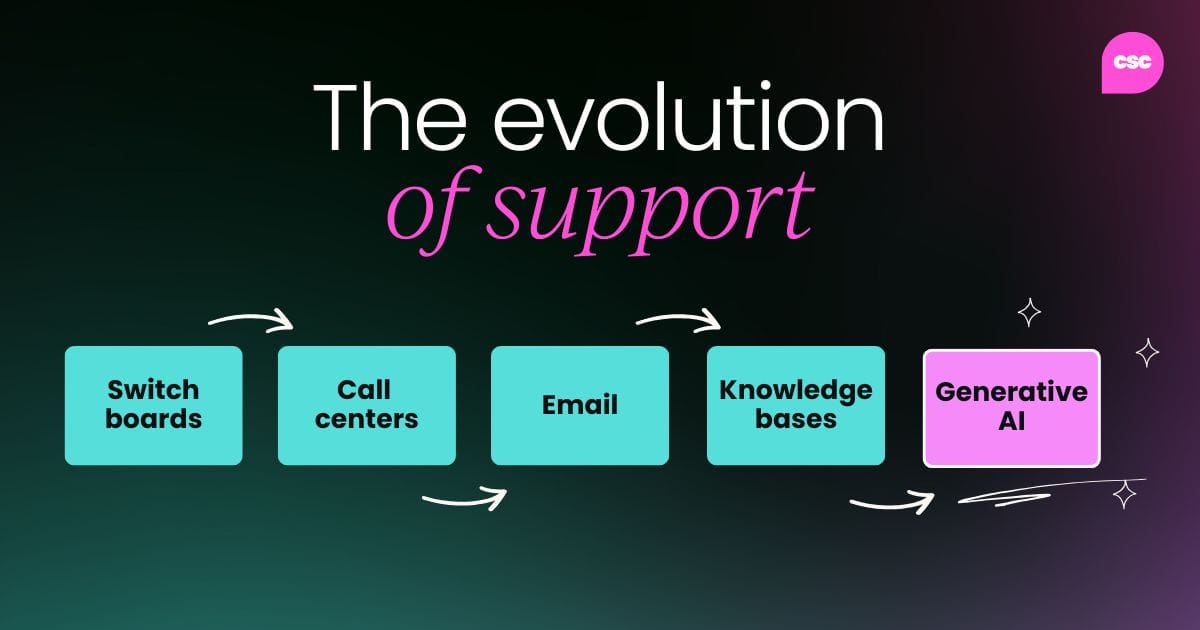
We went from switchboard operators manually connecting calls to massive call centers underpinned by IVR.
Then came email support (remember how revolutionary that felt?), followed by knowledge databases where customers could search for answers themselves. Social media support brought instant, public interactions. Each step in this evolution made support more accessible and efficient.
But here's the thing: even with all these advances, we were still hitting walls. At Crestron, we have over 3,000 different products. Each one has instruction manuals, specification sheets, how-to guides – you name it. Expecting any human support agent to know everything about every product? That's like asking someone to memorize an entire library. It's simply not possible..
Why raising an AI is more like parenting than programming
When we started implementing AI, I realized something fascinating: bringing AI into your organization is surprisingly similar to raising a child. Stay with me here.
At birth, a child has basic capabilities – breathing, crying, sleeping. Similarly, when you first "turn on" an AI system, it starts with fundamental functions like pattern recognition and basic data analysis. Just as a baby learns to crawl, then walk, then run, AI systems develop over time. And just like parenting, it's our responsibility to guide this development properly.
We can't just let AI run wild any more than we'd let a toddler climb all over the furniture unsupervised. We need to set boundaries, provide proper training, and constantly monitor its growth. The potential is enormous, but only if we nurture it correctly.
The journey from chatbots to intelligent agents
Remember those early chatbots? The ones that would respond to "My system is on fire!" with "I'm sorry, I don't understand your question. Would you like to see our FAQ?" Yeah, those were the dark days. They were logic-based, limited, and about as helpful as a chocolate teapot when dealing with complex issues!
But then came natural language processing, and in what felt like the space of over night, everything changed. Suddenly, our AI could understand context, grasp subtle meanings, and – this was huge for us as a global company – translate between languages seamlessly. No more copying and pasting customer messages into Google Translate and hoping for the best.
Now we're in the era of GPT models, bidirectional encoders, and Lambda. These aren't just fancy tech terms – they represent AI that can actually hold complex conversations. We're talking about AI phone agents that can troubleshoot issues without making customers want to scream "REPRESENTATIVE!" into their phones over the painfully tinny tones of an IVR.
AI as a necessity, not a luxury
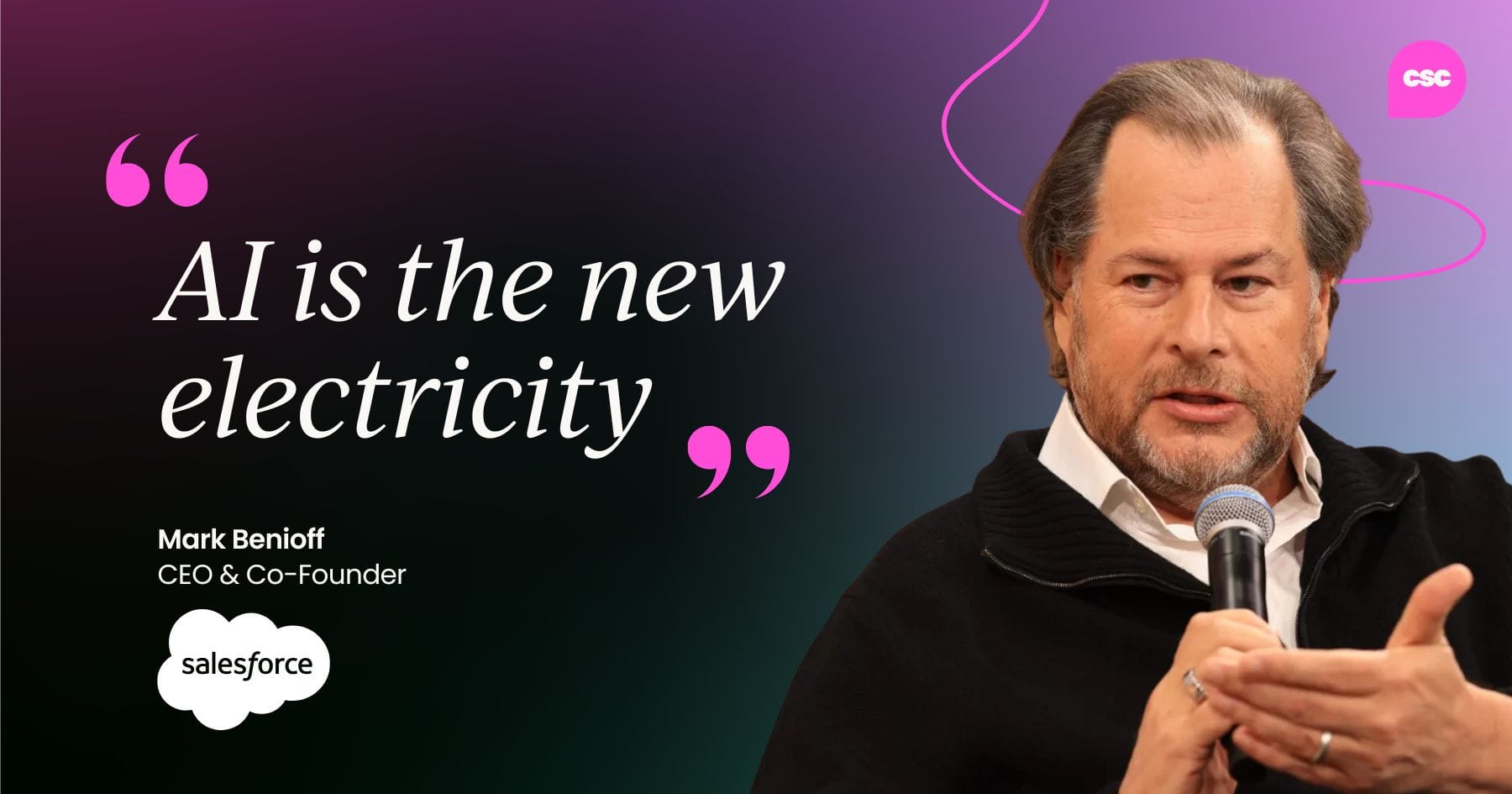
Marc Benioff, Salesforce's CEO, called AI "the new electricity," and he's absolutely right. Just like we can't imagine going a day without email now, AI in customer support is becoming essential, not optional.
Here's what this looks like in practice:
24/7 availability
Picture this – it's 3 AM, and the lights go out in a major hotel using our automation systems. In the old days, they'd have to wait for our offices to open. Now? Our AI agents can help them troubleshoot immediately, getting basic systems back online until human experts can dive deeper if needed.
Multilingual support without borders
We used to need native speakers for every language we supported. That created bottlenecks and coverage gaps. Now, customers can communicate in their preferred language, and our agents see everything in theirs. It's like having a universal translator from Star Trek (see, I told you sci-fi becomes reality).
Emotional intelligence
This one blew my mind. This is something we launched at Crestron, with our AI now including sentiment analysis.
Just to give you an idea of what I’m talking about, we have a phone system that constantly transcribes all of the phone calls we receive. In the backend, we have included a sentiment analysis engine, which tells us if a customer is getting upset. If they are, it sends a trigger, which then flags a manager down to help assist that conversation.
Essentially, giving our support supervisors superhuman hearing, so they can sense trouble before it explodes.
The human-AI partnership
Let me address the elephant in the room. "Will AI take my job?"
Here's my honest answer: No, AI won't take your job. But someone who knows how to use AI will.
Think of it this way: AI handles the repetitive stuff – order status checks, password resets, basic troubleshooting. This frees up human agents to tackle the complex, creative problems that require real human insight and empathy. Our agents are now solving interesting challenges instead of answering "Where's my order?" for the thousandth time.
On the agent side, we also run a co-pilot that live-scans the case (transcripts, prior chats, similar fixes) and drafts the next best steps the agent can ship in mere seconds.
Real results, not just hype
Let me share some actual numbers, because I know you're probably thinking, "This all sounds great, Matt, but does it actually work?"
- Customer satisfaction improved by 25-30%
- First-call resolution times dropped by 40%
- We haven't had to increase headcount despite launching 150-200 new products annually
But here's the kicker – our employee satisfaction scores went up, too. Why? Because they're doing more meaningful work. They're solving real problems, not just reading from scripts.
Data showed most contacts were technical or billing. We built richer training for the former and a single-pane customer dashboard for the latter. Fewer tickets. Faster answers.
 Grace Gupta
The ethics of AI
We can't talk about AI without addressing the ethical considerations (“With great power…” and all that). Here's our approach:
- Transparency first: Customers always know when they're talking to AI. No deception, no pretending. Trust is everything in support.
- No bias allowed: We killed an idea early on about giving better AI support to high-revenue customers. Good support shouldn't depend on how much money you spend.
- Privacy and security: With regulations changing daily (GDPR, HIPAA, state-level requirements), staying compliant is like playing whack-a-mole. But it's non-negotiable. Customer data must be protected, period.
Looking ahead: The next five years
Here's what's coming, and it's going to blow your mind:
Predictive support
Imagine your garage door alerting you that it's been left open as you leave for vacation, not when you return to an empty garage. We're building systems that identify and solve problems before customers even know they exist.
When patterns emerge (hardware, firmware, or usage), we don’t just alert the customer. We loop findings back to engineering so fixes, docs, and design decisions reflect real field data. And it’s global: if an issue hits Singapore overnight, US agents see it at login, already primed with what worked.
Hyper-personalization
When you contact support, the AI will know your skill level, your training history, and your communication preferences. It's like having a support agent who's worked with you for years, even on your first call.
The adaptation
At Crestron, we don’t treat every user the same. If someone finished training recently, or perhaps they just earned a certification, we adapt the flow. Maybe they’re a certified pro, in which case we skip the basics. New hire? We slow it way down and add a lot more context.
We use recent training and certification data to get to a resolution faster, knowing the fundamentals are covered.
Platform-aware guidance
Don’t be fooled into thinking context is only about people – it’s actually about stack, too. The same wall keypad can live in multiple ecosystems. In a sandbox app, we’ll say something along the lines of: “Press this, then this, then you’re done.”
In a full code environment, we surface the right snippets and steps. Under the hood, an algorithm picks the right model and flow so guidance stays fresh as products evolve.
Autonomous agents
These aren't just chatbots. Chatbots react; autonomous agents plan, adapt, and act – all the while drawing on multiple data sources and past solutions to resolve problems end to end.
How to make it work
If you're thinking about implementing AI in your support organization, here's my hard-earned advice:
Start small
Don't flip a switch and go company-wide. We started with 40 people, found every pothole, and then gradually expanded. Rome wasn't built in a day, and neither is a good AI implementation.
Clean up your data
Garbage in, garbage out. We did a complete overhaul of our knowledge base before implementing AI. Twenty years of accumulated documentation with different standards and outdated information? That's a recipe for AI hallucinations.
Invest in training
Your team needs to understand they're getting a powerful assistant, not a replacement. Show them how AI makes their jobs easier and more interesting.
Stay informed
The AI landscape changes daily. Just recently, one LLM provider released a feature that violated our security policies. We had to act fast to block it. You can't set it and forget it.
 Grace Gupta
The bottom line
The best way to predict the future is to create it. That's what we're doing at Crestron, and that's what the entire support industry needs to embrace. AI isn't just another tool in vogue, but a fundamental shift in how we think about customer service.
We're moving from reactive to proactive, from one-size-fits-all to hyper-personalized, from language barriers to universal communication. And most importantly, we're freeing human agents to do what they do best – solve complex problems with creativity, empathy, and genuine human connection.
The future of customer support isn't about choosing between humans or AI. This is what the scare tactics want you to believe. In fact, it's about combining the best of both to create experiences that would have seemed like pure science fiction just a few years ago. And unlike Star Trek, we don't have to wait centuries for this future – it's happening right now.
So, are you ready to join the revolution? Because whether you're ready or not, it's already here. The only question is whether you'll lead the charge or get left behind.
This article is based on a session Matthew presented at our AI for Customer Support Summit in February 2025.

Future-proof your support org in a single day
Join us in New York for the Customer Support Summit on March 10 & 11, 2026. See what’s working, what’s next, and how to upskill your team for AI-first operations.


Become a CSC Insider
Thank you for subscribing
Get exclusive insights, frameworks, and strategies from customer success leaders driving real business impact.
An email has been successfully sent to confirm your subscription.
 Follow us on LinkedIn




Start the conversation
Become a member of Product Marketing Alliance to start commenting.
Sign up now