










As we look ahead to the future of customer support, one thing is clear: AI is no longer a distant concept – it’s very much here, and it’s reshaping everything.
Over the past few years, we’ve seen AI move from simple automation tools to more intelligent, context-aware systems that enhance how we support customers.
But we’re now at the edge of something even bigger.
The next wave of transformation is being driven by AI agents – autonomous systems that don’t just assist support teams but actively reason, act, and collaborate to solve problems at scale.
In this article, I’ll walk through how AI agents are redefining support, what businesses need to prepare for, and how you can move from experimentation to real capability.
 Jatin Sharma
What are AI agents?
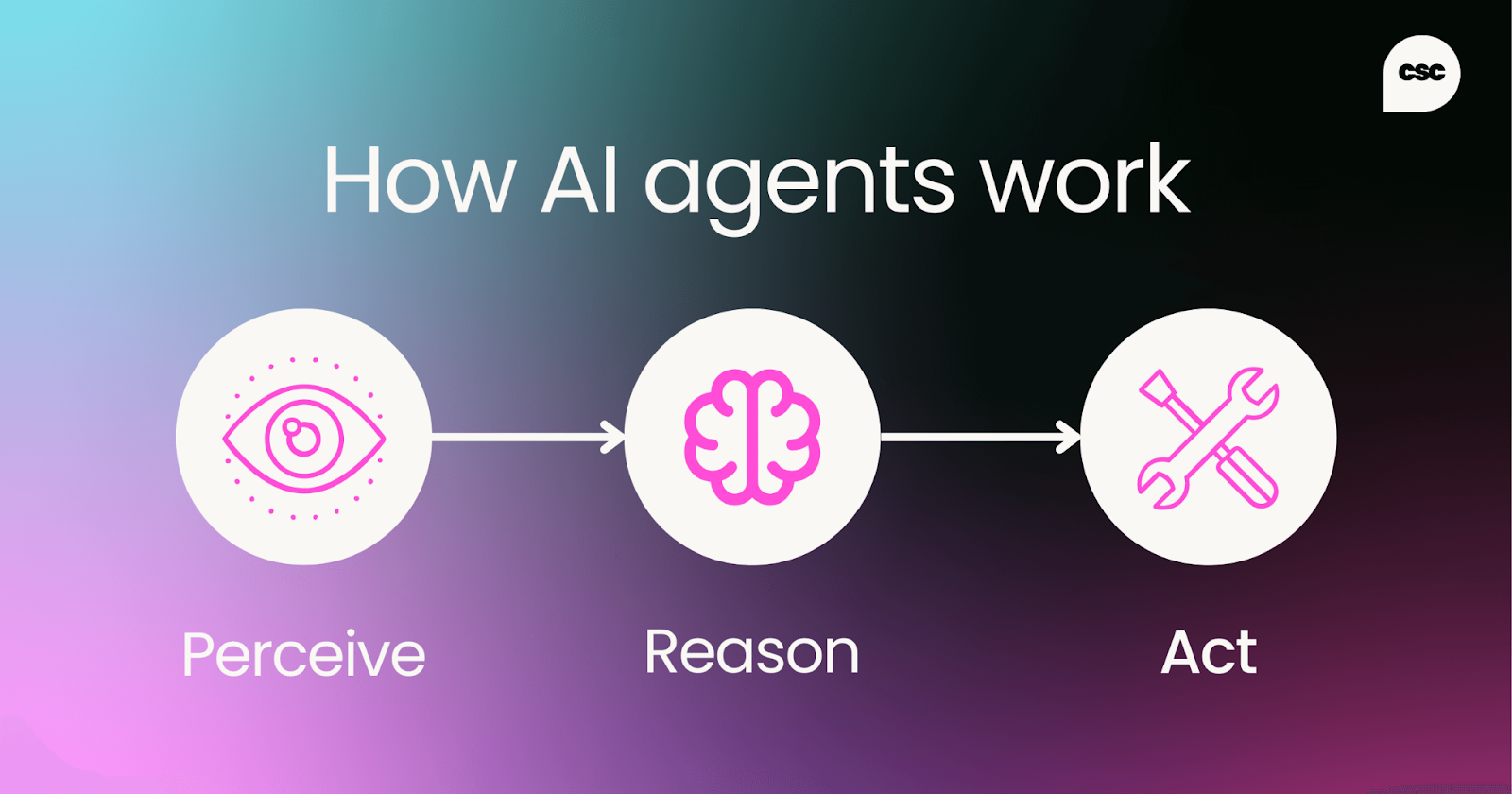
AI agents are autonomous systems that can perceive, reason, and act. This triad is essential to how they function.
These agents don’t operate in isolation; they interact with tools to take action in the environment. Perception and reasoning on their own are not enough.
For an AI agent to be effective, it must be able to do something: call an API, trigger a workflow, extract data from a source, or update a system. That’s where the action component comes in.
Today’s agents are built by leveraging the reasoning capabilities of modern large language models. Some of the models powering this space include OpenAI’s GPT-4o, Google’s Gemini Flash, DeepSeek’s recent advancements, and Meta’s LLaMA 3 series.
A mental model for AI agents
To help visualize how AI agents work, I often explain them with this simple structure:
- The agent is essentially an LLM.
- Instructions are the prompts or rules that guide its behavior.
- Tools are the APIs or functions the agent can call to perform tasks.
When a task is handed to an AI agent, it reasons through the instructions, decides which tool(s) to use, and takes action by making the appropriate calls. Think of it as a decision-making system equipped with both logic and utility.
And just as humans collaborate to solve problems, AI agents can collaborate too. If one agent reaches a point where it needs input from another, it can hand off the task. This is called multi-agent collaboration, and it’s becoming increasingly common.
In fact, we’re now seeing architectures where swarms of agents – dozens or even hundreds – each handle a small piece of a larger process, working in sync to achieve complex outcomes.
From traditional to agentic customer support
Let’s bring this to life with a familiar scenario in customer support.
Traditionally, when a customer reaches out via email, chat, or a helpdesk portal, a support engineer picks up the ticket. They triage the issue, analyze logs, collect necessary data, loop in other team members if needed, and eventually respond to the customer.
The engineer wears many hats – handling documentation, follow-ups, prioritization, troubleshooting, and more.
But what if we reimagine that workflow with AI agents?
In an agentic support scenario, the front end still looks the same: customers contact support through the usual channels. But instead of the support engineer immediately stepping in, we deploy a set of AI agents to handle the first pass.
You might have:
- A triage agent to assess the request.
- A data collection agent to gather key information.
- A follow-up agent to manage communication.
- An analysis agent to examine logs or patterns.
- A prioritization agent to flag urgency.
These agents work together to process and enrich the ticket before it ever reaches a human. By the time a support engineer steps in, they have a much more complete and actionable picture. They can still collaborate, use advanced tools, and bring in team expertise – but they’re doing so from a more informed starting point.
The agents themselves have access to the same toolkits – logs, APIs, even internal systems – so they’re not just middlemen. They’re active participants in solving the issue.
This is what an agentic support model looks like in practice – and it’s just the beginning.
 Grace Gupta
Why AI agents matter
I genuinely believe that 2025 will be the year of AI agents. We're already seeing a wave of experimentation in this space, along with a growing ecosystem of vendors offering frameworks and platforms to help businesses get started.
The momentum is real, and it’s only accelerating.
At the core of this shift is a fundamental truth: AI is redefining business processes. Wherever there are repetitive tasks or routine decision-making, AI agents are stepping in to take over – and doing so with far greater intelligence than traditional automation systems.
We're no longer talking about automation in its conventional sense – systems that simply execute pre-set instructions. Instead, we’re talking about intelligent agents that decide what needs to be done and how to do it. That’s the game-changing element.
AI agents aren’t just following steps, they’re choosing the right steps to take.

Start experimenting early
Why does this matter for your business? Because if you're not experimenting with AI agents now, you're going to fall behind. The competitive edge will belong to those who start early, who explore, tinker, test, and build a foundational understanding of these systems today.
The good news is that it's easier than ever to get started. Many AI agent frameworks and libraries are now available in the open-source ecosystem. There’s no need to wait for an enterprise-scale rollout. Small experiments can begin right away, and those early learnings will compound when you're ready to scale.
Think of this as a strategic investment. Start identifying areas in your organization where AI agents could make the biggest impact, particularly those that involve repetitive workflows, frequent handoffs, or high-volume decision-making. These are your ideal candidates for automation with intelligence.
Benefits, opportunities, and risks
If I were to sum up the core benefits of AI agents in a single line, it would be this: faster resolution times, lower operational costs, and a consistently improved customer experience.
With AI agents, you can finally deliver around-the-clock support without needing to scale your team linearly. And when they’re designed well, these systems give your customers a predictable, high-quality experience – one that reflects your commitment to innovation and service excellence.
The biggest opportunity? You can scale global support operations without dramatically increasing headcount. That also means your current support team can focus on higher-value, more complex work, while AI agents handle the repetitive, mundane, or procedural tasks.
But it’s not without risks.
AI hallucinations are real and well-documented. That’s why setting the right guardrails is critical – from decision boundaries to escalation triggers. You also need to account for ethical concerns, data privacy, and ensure that AI is applied where it makes sense.
Not every problem needs an agent. Some tasks may be better handled through simpler, well-defined processes.
Over-reliance on automation can become a liability. Use AI agents where they enhance clarity, speed, or experience, not just because you can. Strategic thinking must guide every implementation.

How to prepare your business for AI agents
So how do you get ready for this shift? Implementing AI agents isn’t just a matter of playing with the latest tools. It requires a clear plan, strategic thinking, and an understanding of your business goals.
The first and most important step is identifying your objectives. Don’t dive into AI agents without a purpose. Define what you want to achieve:
- Are you looking to reduce manual effort?
- Improve response time?
- Lower costs?
- Augment your existing teams?
These questions need to be front and center as you evaluate the role AI agents could play in your operations.
You should also distinguish between automation and augmentation. Are you looking to fully automate a task or simply make it easier and faster for support engineers to complete? AI agents are particularly powerful in decision-making scenarios, so look for areas where agents can not only execute steps but also decide which steps to take.
Long-term thinking is key. Avoid small, isolated wins that don’t scale. Instead, build for sustainability. Think about how this fits into your organizational roadmap – and where AI agents can deliver real transformation.
Use a maturity model to guide your rollout
A helpful framework I’ve used is a simple three-phase maturity model:
- Pilot: Start small. Identify one or two high-impact areas and test an agent in a contained environment.
- Integration: Once you’ve proven value, focus on connecting agents to real tools, processes, and data systems.
- Transformation: Move toward broader adoption, restructuring workflows and teams to take full advantage of AI.
Where to deploy agents and how to find opportunities
There are three key themes I consider when identifying use cases:
- Bottlenecks and inefficiencies: Where is your team losing time? Are there repetitive decisions being made daily? Could agents assist in those areas?
- Support for human engineers: Can AI agents augment the work of your team, making their lives easier and their output more effective?
- Cost-benefit: What’s the expected ROI? Consider time saved, revenue protected, or headcount optimized as you weigh the potential.
Ideal use cases often involve:
- High-volume, repetitive tasks
- Decision-heavy workflows that can be guided by data
- Scenarios where reliable tools (with APIs) are already in place for the agent to interact with
Start with quick wins. Solve smaller, well-contained problems where success can be measured. Once you’ve built confidence and gained some traction, apply those learnings to more complex workflows and broader implementations.
Tools, frameworks, and whether to build or buy
There’s no shortage of options out there. A quick search will turn up plenty of vendors and open-source frameworks focused on AI agents.
Some popular tools I’ve seen include:
If your team has the technical depth, you can even consider building your own lightweight AI agent framework tailored to your internal needs.
Whether you choose to build or buy, just make sure you’re evaluating based on scalability, security, and integration capabilities. It’s easy to get caught up in the excitement, but long-term reliability and fit with your existing systems should guide your decision-making.
Sometimes, an off-the-shelf solution is the right answer. Other times, especially if your requirements are highly specific, you may want to roll your own. Know when to build and when to buy.
Start small, stay focused, and scale thoughtfully
One piece of advice that’s worked really well in my experience: dedicate one person to this.
Just one resource who is fully focused on experimentation, testing APIs, evaluating new models, and prototyping use cases relevant to your business.
Give them the freedom to fail fast, test aggressively, and build solutions around your actual needs. This approach has proven more effective than starting with a large team or overanalyzing every decision.
Over time, as your confidence and maturity grow, you can scale this into a broader program with more contributors. But start focused.
Bring your team along for the journey
When AI agents begin to play a significant role in your organization, it’s essential to involve your engineers and support staff. Let them see AI as a partner, not a replacement.
This is about augmentation, not elimination. Train your teams to work alongside these systems. Provide FAQs, run onboarding sessions, and make sure they understand how these tools support, not threaten, their work.
Encourage engineers to become drivers of this change. Gradual adoption, feedback loops, and clear documentation go a long way toward successful change management. Transparency about what’s working, what’s not, and what’s next builds trust.
Finally, when you’re ready to roll out a solution, start with a pilot group. Get early buy-in, demonstrate results, and then expand. Scaling in stages ensures smoother adoption and fewer surprises.
Building an AI agent implementation roadmap
When thinking about implementation, it’s important to break your roadmap into clear, actionable phases. At a high level, I like to structure it into three key stages: proof of concept, integration, and optimization.
1. Proof of concept
Start small. Identify a use case that’s meaningful but manageable – something you can test and measure.
Bring in a few key stakeholders who will be responsible for evaluating your early AI agent implementations. Run focused, small-scale pilot projects, and most importantly, collect feedback continuously.
This phase is all about learning. You’ll need to iterate often, respond to issues quickly, and start building the guardrails that will support future success. The stronger your feedback loop, the faster your agents will improve.
2. Integration
Once your proof of concept is validated and there’s a clear appetite for continued use, it’s time to expand. Start encouraging a wider group of team members to use the agents.
Look for opportunities to integrate AI agents with your production systems – this is where you start unlocking real value.
At this stage, AI agents should become part of your day-to-day operations. Whether that’s embedded in internal tooling, customer-facing systems, or behind-the-scenes workflows, integration is where AI begins to scale its impact.
3. Continuous optimization
Even after deployment, your job isn’t done. AI is a fast-evolving field, and what works well today might be outdated six months from now. You need to actively optimize your agents and the workflows they support.
Monitor performance. Stay on top of new models entering the space, especially open models that might bring better performance, faster inference, or new capabilities. Test these against your existing system to see where improvements can be made.
Continuous evaluation should become part of your AI operations. It’s not just about building once – it’s about building smart, then improving relentlessly.
Addressing the risks and challenges
Of course, no implementation journey is without its challenges. Without a clear AI strategy, adoption can stall. It’s critical to align stakeholders, use cases, and technical goals from the start.
You’ll also need to pay attention to data privacy and compliance. As AI agents interact with sensitive systems or customer data, your guardrails must be robust. This is especially important during the evaluation phase, where vulnerabilities can be identified and addressed before they scale.
Model bias is another area to watch. AI agents can sometimes make assumptions or exhibit unintended behavior. To mitigate this, build proper evaluation sets into your testing framework and stay vigilant in spotting patterns that might skew results or impact fairness.
One space I believe will play a much bigger role in the coming months is AI governance. While it didn’t get much attention in the early days of large language models, 2025 is shaping up to be the year when organizations start to prioritize governance in earnest.
Being able to monitor and manage AI agents at scale, with transparency, accountability, and auditability, is becoming non-negotiable.
Start small, think big, and act now
AI is not a one-time implementation. It’s a journey. One that requires sustained investment, a clear vision, and a mindset oriented toward continuous learning and improvement.
If you want to gain a true competitive advantage, the time to begin is now. Start small, but start strategically. Identify one process in your business – something repetitive, decision-heavy, or time-consuming – and ask yourself, could an AI agent help here?
Run that first experiment. Measure the outcomes. Learn from the process. Then build on it. One successful use case should lead to another. Over time, these small wins add up and begin to shape a scalable, intelligent system that supports your broader business goals.
Evaluate the tools and vendors already in your stack. Do they support AI agents? Are they equipped to handle your workflows? Where there are gaps, explore new options or consider building internally if your needs are unique.
And I’ll emphasize once more: investing in a single, dedicated resource to focus on experimentation can pay enormous dividends. Someone who can test new models, compare architectures, and stay aligned with your specific business use cases will drive more progress than a large team with scattered focus.
So that’s my challenge to you: begin your AI journey today. Don’t wait for the perfect moment or the perfect tool. Choose one use case, build something small, and get it in motion. You’ll learn more by doing than by planning endlessly.
This article is based on a presentation given by Rohit at our Chief Customer Officer Summit in Silicon Valley 2025.
Catch up on this presentation, and others, using our OnDemand service. For more exclusive content, visit your membership dashboard.


Become a CSC Insider
Thank you for subscribing
Get exclusive insights, frameworks, and strategies from customer success leaders driving real business impact.
An email has been successfully sent to confirm your subscription.
 Follow us on LinkedIn



Start the conversation
Become a member of Product Marketing Alliance to start commenting.
Sign up now