






Artificial intelligence (AI) is everywhere – you don’t need me to tell you that; it’s reshaping how we think, write, and work.
Yet in customer success (CS), AI’s adoption seems slower than you might expect. There's a paradox where this transformative technology is all around us, but many Customer Success Managers (CSMs) aren't sure where to start, or they feel overwhelmed by the constant developments.
My own journey into AI started out of pure curiosity.
Soon after ChatGPT became mainstream in 2022, I began exploring what it could do. It quickly became clear that this was a major development that would impact every modern job, including my own as a Client Success Director at Degreed.
I realized that if I could figure out how to use AI and embed it into my work, I could future-proof my career.
This isn't about preservation in a negative sense, holding onto a role that’s dying. It’s about understanding how AI will change the nature of CS. It will shift the role from being task-based to one that is insight-based, relationship-based, and human-skills-based. It frees up your time to focus on the more interesting parts of the job.
Why are CSMs hesitant to adopt AI?
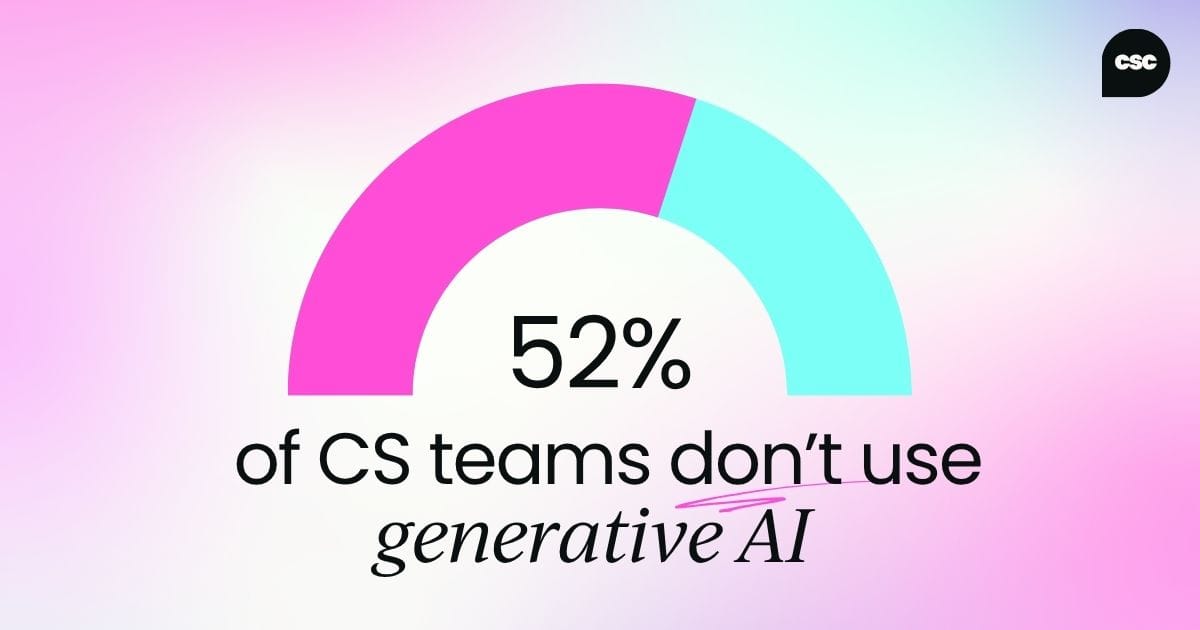
Recent data suggests that less than half of CSMs are actively using AI tools (State of Customer Success 2025 Report). While some may be using AI without realizing it through their email clients or CRMs, that number should be closer to 100%. This isn't about using AI for the sake of it, but because it genuinely delivers value to every CSM.
So, what's holding people back?
Acknowledging AI overwhelm
One of the biggest hurdles is AI overwhelm. I subscribe to daily AI newsletters, and every single day brings seven or eight major news stories. It’s a lot to keep track of, and if you’re not directly responsible for AI solutions, it’s easy to feel like you’re falling behind after just a week.
This feeling can lead to paralysis, making you think, "I can't start anything because I don't know enough," or "I'll just carry on doing things the way I've always done them."
You don’t need to stay across every new development. One of the easiest ways to stay relevant is to use AI to track AI. You can literally paste your job description into ChatGPT and ask it to create a daily digest of AI updates that matter for your role. That way, you stay current without drowning in noise.

Addressing fears about job replacement
There's also a genuine concern about job security. People don’t want to think their job can be replaced by a machine, and that’s a perfectly valid fear. This raises ethical questions about whether organizations should be pursuing the replacement of staff with AI.
For those of us in customer success, the focus should be on future-proofing ourselves. Instead of worrying that your job will be replaced, ask yourself: How can I continue to add value, and what will "value" even mean in a future where AI is everywhere?
The answer lies in shifting your focus and skills.
 Grace Gupta
How to leverage AI for immediate efficiency gains today
You don’t need to revolutionize your entire workflow overnight. The key is to start small by picking one problem you want to solve. What do you find annoying in your role? What task takes longer than it should? That’s your starting point.
Move beyond basic content generation
The simplest use case for AI is content generation. Almost all email clients now have an AI element to speed up writing emails. However, you should never just click "generate email" and hit “send.” We can all spot AI-generated content a mile off, and it completely undermines the authentic, human nature of the CSM role.
There are use cases for it, of course. But if you're writing to a client you know well, AI won't help because it doesn't know your relationship. Just write the email yourself; it will be quicker and more authentic.
Amplify your client research with the right tools
A more powerful application of AI for customer success is research. If you’re a CSM dealing with more than 10–15 clients, you can’t possibly retain all the knowledge about what’s happening in their businesses day to day.
Tools like Perplexity or Google's NotebookLM can collate information from across the web so you don't have to spend hours on research.
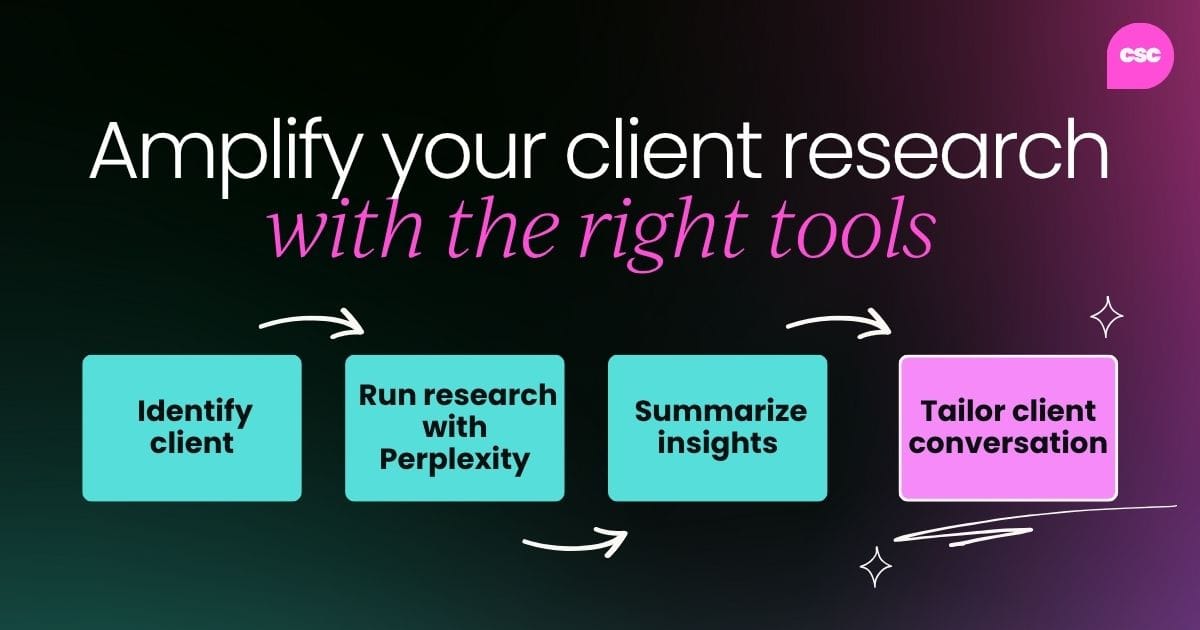
Before a call with a new stakeholder, you can run a deep research project to get a landscape review of their industry. In 10 minutes, you can have a report detailing:
- Key trends in your client's industry.
- How these trends might impact the service or software you provide.
- Potential talking points for your call.
This preparation allows you to add value from day one. You can walk into a meeting and say, "I know this new regulation is going to impact your supply chain, which means your teams need upskilling." You immediately position yourself as a valuable, proactive partner.
Many CSM portfolios are organized by industry, which means one well-executed research project can benefit multiple clients in your book. AI tools make that scalable.
Use AI for deep analysis of company documents
I deal with large, publicly listed companies that produce annual reports, ESG statements, and earnings reports that are hundreds of pages long. I download these PDFs and stick them into NotebookLM.
From there, I can use the voice mode to have a conversation with the tool. I can ask questions like, "How can I connect this point in the ESG report to a conversation about workforce transformation?"
It’s a back-and-forth conversation, not just typing queries, which I find particularly useful for uncovering relevant insights. The tool can also pull in open web sources, like a company's Forbes page, to enrich its analysis.
Building a culture of AI enablement in your organization
While individual adoption is powerful, things move to another level when companies build AI into the fabric of their organization. At Degreed, we're fortunate to have developed internal tools that showcase this potential.
The power of custom internal tools
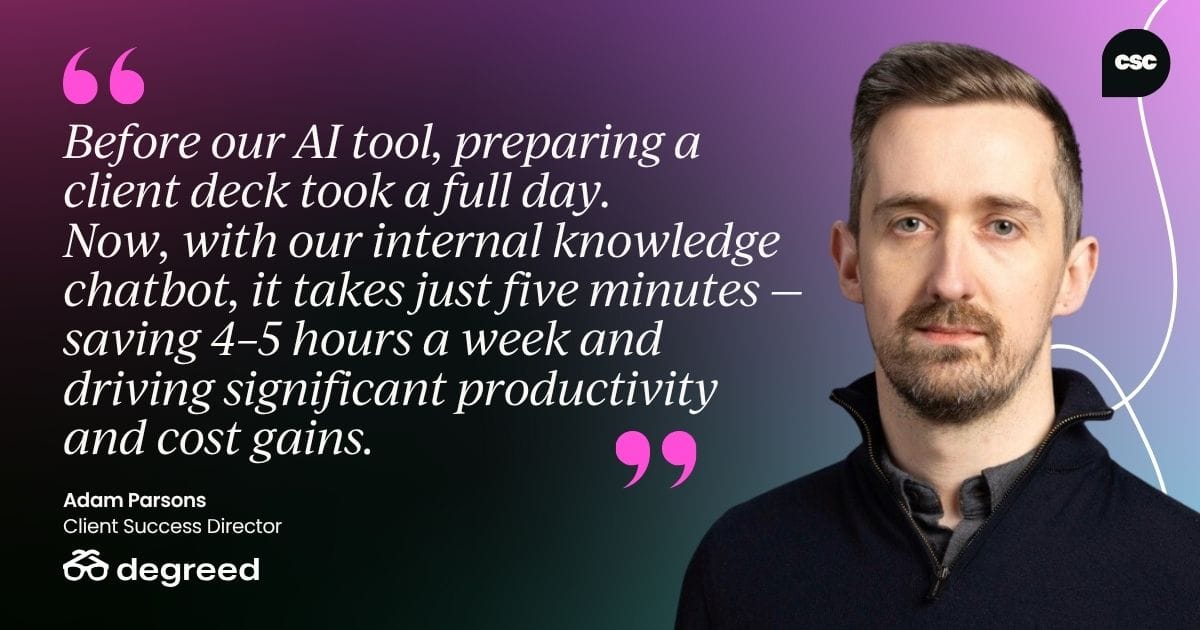
Our team built an internal tool on ChatGPT that has access to all our knowledge center documentation and understands our product and services. I can use it to prepare for meetings by asking, "I'm meeting with Client X, and this is their business objective. Can you give me a feature map of everything in our product that supports this?"
It generates a handy table that I can use as a talk track for the meeting. This process, which would have manually taken me a full day, now takes five minutes. It saves me four or five hours a week, and when you scale that across the entire CS team, the financial impact is significant.
You don’t need a dedicated Ops team to start
Interestingly, this tool wasn't built by a CS Ops person. It was built by someone in sales who saw an opportunity and had the curiosity to pursue it in their spare time. It took a couple of weeks to get the framework together, and now it’s rolled out to the team.
This shows that if you don’t have a dedicated CS Ops role yet, it doesn’t mean you can’t look at these tools. It’s about spotting an opportunity to automate a process or save time and having the initiative to find a way to do it.
 Renee Rooney
The future of the CSM role: From task-based to strategic partner
In the short term, AI will replace tasks with quicker, automated alternatives. This is the first step in customer success automation. But the end state of AI within CS is not just about getting more stuff done. It’s about fundamentally changing the role.
Automating the administrative burden
We will get to a point where you can create a QBR deck by clicking "generate deck." The system will pull all the data from your CRM and analytics software. Standard lifecycle emails, like renewal reminders, can already be fully automated. No one needs to be doing that manually.
Becoming a strategic, consultative partner
With administrative tasks handled, the CS role will become more consultative and strategic. It will focus on demonstrating to a client how they can meet their business objectives using your solution. The core questions become:
- Why did you buy from us?
- What are you trying to achieve?
- How will we demonstrate in a year’s time that you are closer to that goal?
This is how you secure renewals and reduce churn. It’s about fully understanding the gap between where your client is now and where they want to be, and then identifying the data that proves that gap is closing.
Demonstrating tangible business value
For example, a client might want to upskill their employees for the future. By digging deeper, you might find their ultimate goal is to reduce external hiring and increase internal career mobility. This, in turn, reduces hiring costs.
If you can help them link your solution to a 10% reduction in external hiring, you can put a dollar amount on that saving. Now, you can go to stakeholders and say, "By implementing this solution, we are saving X million euros per year." That is where the CS role starts to deliver incredible value.
Your first steps into customer success AI
So, how do you get started without feeling overwhelmed? It comes down to a simple, intentional approach.
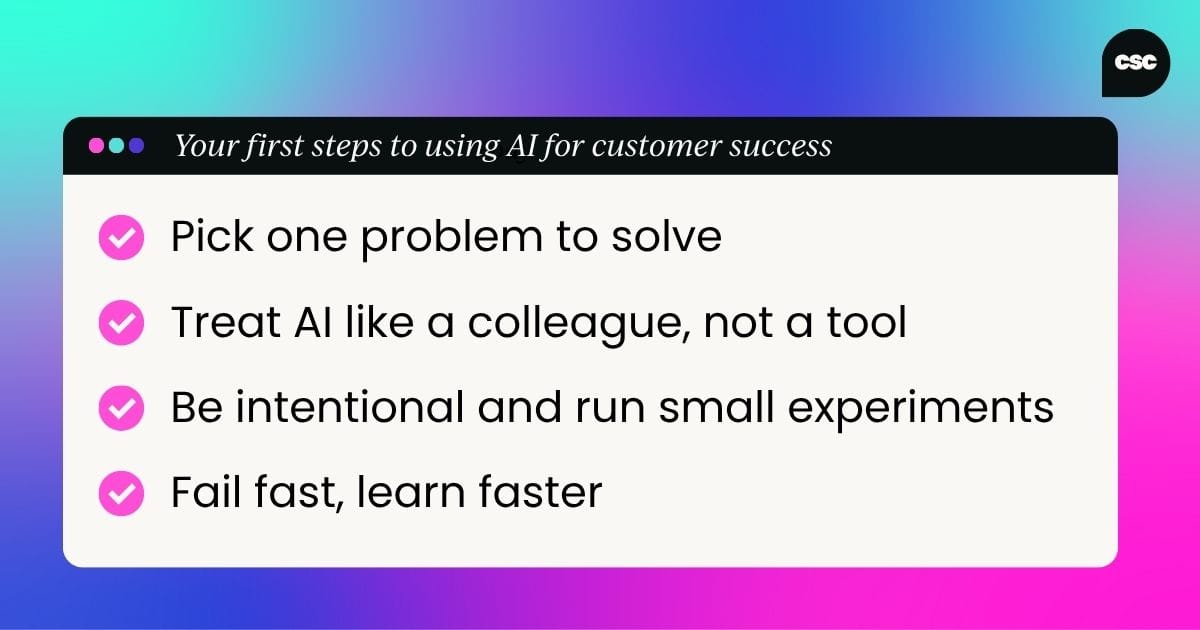
Pick one problem to solve
Don't try to overhaul everything. Just find one friction point in your day and see if AI can help. Is writing a weekly progress report annoying? Start there.
Treat AI as a colleague
Don't use tools like ChatGPT as just a search engine. AI currently has an IQ of around 150 in every single topic known to mankind. Treat it like an expert-level colleague you can have a conversation with. If you don’t understand something, ask it to clarify or explain what it means for your role.
Be intentional and fail fast
Run small experiments. If they don't work, stop doing them and try something else. Curiosity and intentionality have to go hand-in-hand.
The goal is to use AI to remove the process-based tasks so you can focus on what truly matters: adding strategic value to your clients. The future of customer success is human, and AI is the tool that will help us get there.
This article is based on Adam's appearance on the CS School podcast.


Become a CSC Insider
Thank you for subscribing
Get exclusive insights, frameworks, and strategies from customer success leaders driving real business impact.
An email has been successfully sent to confirm your subscription.
 Follow us on LinkedIn