







AI customer success (CS) tools are nice and shiny things. But here's the uncomfortable truth behind all of that: buying the tool is maybe 10% of the work. And it's the 10% everyone spends their budget on and their energy on.
When a team tells me they want to implement an AI tool, what they've actually signed up for is an operating model change. Underneath all of the bells and whistles, that's a different conversation to be had.
What does operationalizing AI in customer success actually involve?
- Your data has to be usable: AI is only as good as what you feed it. If your data is a mess, you're just automating on top of that mess and making it faster.
- You redesign your workflows rather than bolting tooling onto the side of them: The output has to land in the tools CSMs already live in, at the exact moment they need it, attached to decisions they actually have to make.
- You need the operating cadence around it: Ownership, governance, a feedback loop. This way, things get smarter instead of staler.
Skip those and what you've really bought is a very expensive tool, a dashboard that nobody opens, nobody wants to deal with and no one wants to adopt. The whole game is closing the loop from signal to action. See, that's a people and process problem far more than a technology problem.
Which AI use cases deliver the most value in customer success?
My advice is to start where the pain is highest, and the signals are richest – not where the demo looks the coolest. I’ve often found that the shiniest demos are usually the ones where projects go to die.
First up, I run every candidate use case through three questions:
- Is it repetitive and high volume?
- Is there a clean signal to learn from?
- Is there a real decision at the end that a human has to make?
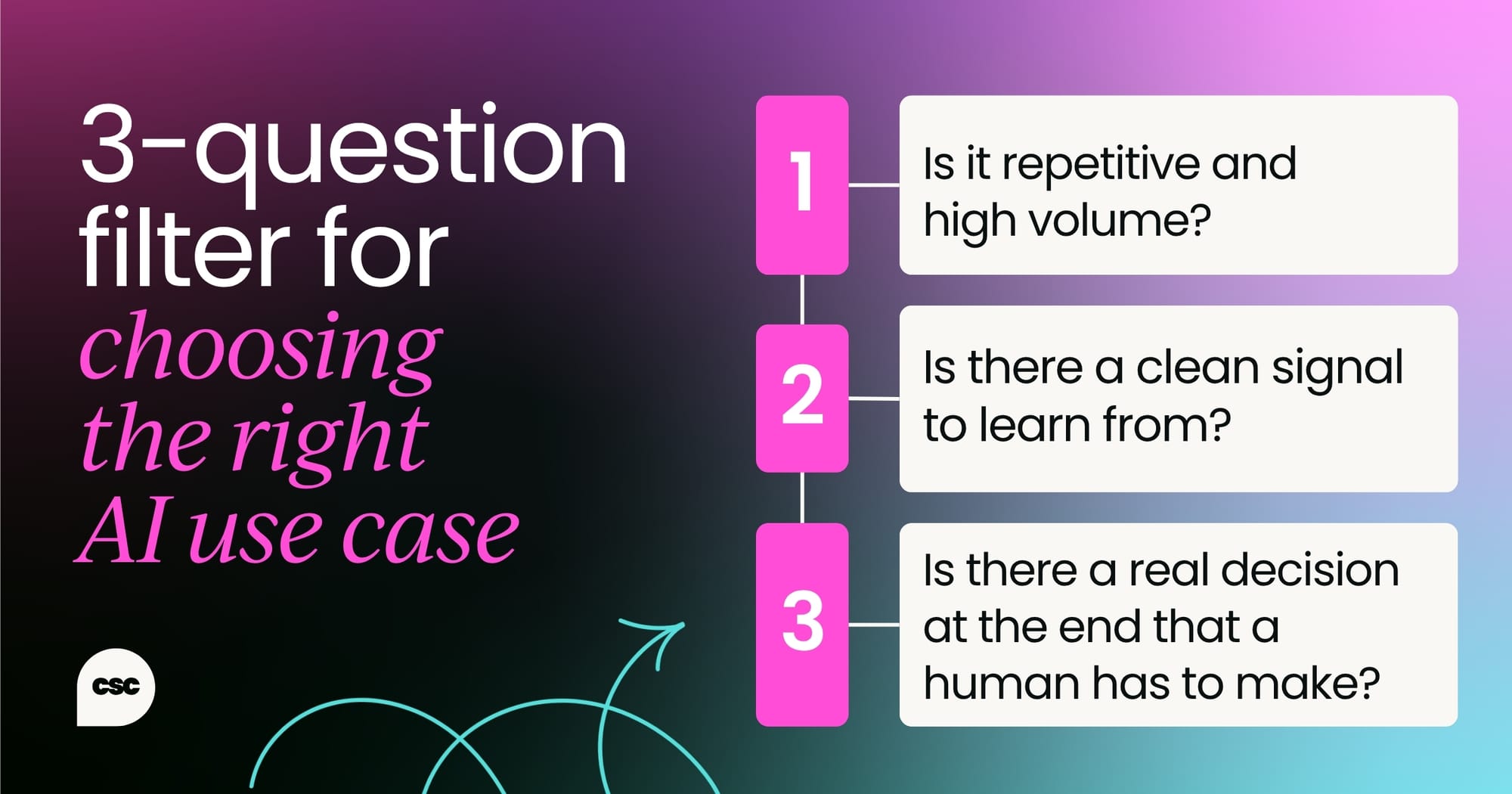
That filter gets you to the money fast. The two places I've seen the biggest return are health scoring and QBR prep.
Customer health scores
Most health scores today are lagging and honestly subjective – a gut feel dressed up as a number. Move to signal-based scoring, pulling in support data, product utilization, and sentiment, and you get an earlier and far more honest read on risk, early enough to actually do something about it.
QBR preparation
QBR and EBR prep is the quiet time thief in every CS org. AI can assemble the account narrative, the usage stories, the risks, and the expansion signals within minutes, instead of a CSM burning through half their day trying to formulate something.
But if you were to twist my arm and make me pick one place to start, it's got to be customer health scoring. Why, you ask? Because it feeds everything else: retention, expansion, and where your best CSMs actually spend their time.
Bain & Company puts numbers on this: a 5% increase in customer retention can lift profits anywhere from 25% to 95%. Small moves in churn move real money. That's why I point AI at retention first.
 Christine Lawther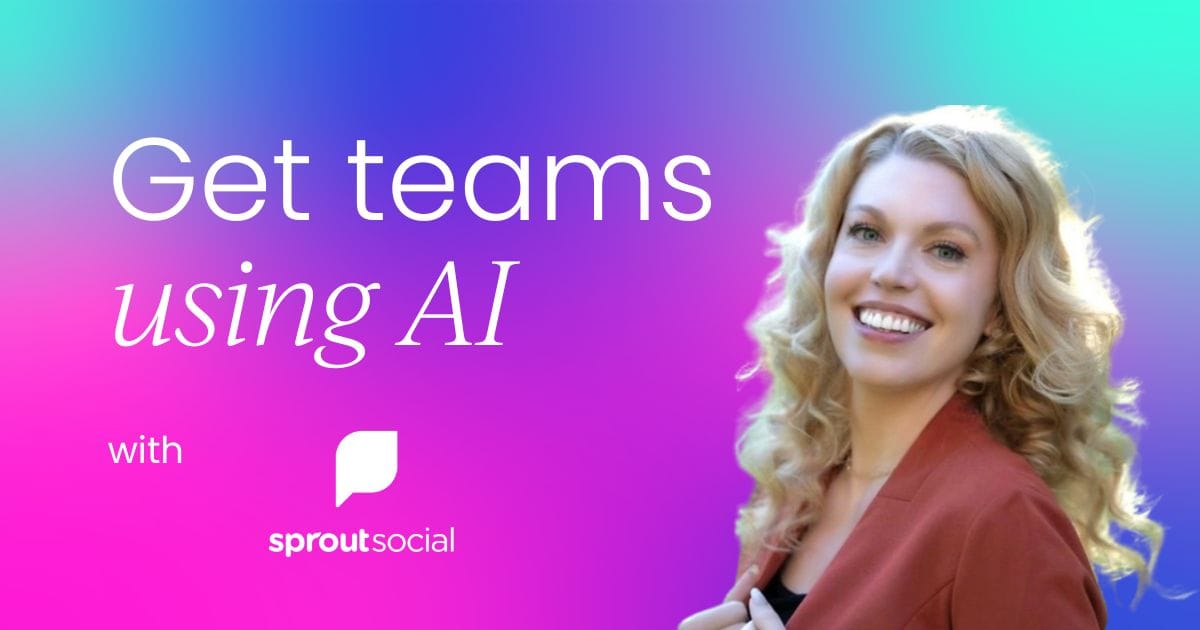
How do you integrate AI into existing customer success workflows?
If you add another step, forget about it. The insight or the recommended action has to show up in the system record they already use at the exact moment they need it. Not in yet another tab they have to remember to check.
I tie every recommendation to what I call a next best action – not just a score, but “Do this for this account today."
I bring the frontline in early as co-designers. If your CSMs don't trust it, they'll just quietly ignore it. The adoption dies in silence and you've got a tool just floating out there, wasting money. Start narrow: one workflow, one pod, prove it, then expand. I use the “KISS approach” – keep it simple, stupid.
You don't build AI that replaces your people. You build AI that makes your people look brilliant. The first time a CSM watches it hand them a save they would have missed, you don't have to sell adoption anymore. It sells itself.
What does AI governance look like in customer success?
AI governance, or lack thereof, is the part that will end your program if you get it wrong.
Ownership has to be explicit
Somebody owns the AI tool in the CS org the same way somebody owns the CRM. If it belongs to no one, it just drifts. I stand up small governance groups with CS, data security, and legal – with real cadences, not one-time sign-offs you frame and forget.
Data privacy
You have to know exactly what data the model touches, where it lives, and what it allows you to do with it. I've spent a lot of my career in defense, federal, healthcare, life sciences, and financial services, where zero-trust and compliance aren't just a checkbox – they're the whole game. I design for data boundaries and least-privilege access from day one.
On humans in the loop, my line is simple, and I don't move it. Let AI triage, score, summarize, and prepare. Let it do the mundane things. But keep a person on the send button for the moments that matter, because that's what drives the relationship.
The goal is augmentation with accountability. Write that down before you scale, not after something has blown up.
How do you measure the ROI of AI in customer success?
The top ways to measure your AI’s ROI are by looking at efficiency and business outcomes. My advice is it’s a huge mistake to stop at the first one.
Efficiency is the easy sell – time given back per CSM on QBR prep, onboarding, routine queries. That capacity is real and it funds the program. But the prize is the outcomes.
- On adoption: are people actually using it and acting on it?
- On efficiency: cycle time, cost to serve.
- On retention: GRR and NRR, and are you catching at-risk accounts earlier than you used to?
- On risk: are you killing the surprises – the churn nobody saw coming? On growth: are you surfacing expansion you were flat-out missing?
The business case comes together the moment you can say, "We gave back this much capacity, we caught risk this many weeks earlier, and we moved NRR by X points." I always drive it back to net revenue retention, because that's the number your board actually feels – and it connects the cost of the AI straight to dollars retained and expanded.
Do one thing before you turn anything on: capture the baseline. If you can't show anything before, you'll never get credit for it after.

Why do AI projects in customer success fail?
The most common failure I see is what I call the ROI-to-adoption gap. The tech works in the demo, the business case sings on the slide – it looks great, it's beautiful – and then nobody uses it.
It's usually one of three things:
- It was bolted on rather than built into the workflow.
- The frontline was never in the room, so they don't trust it.
- You started on dirty, thin data, and after the first couple of wrong calls the team quietly writes it off and you rarely win that trust back.
People also try to boil the ocean – transforming the whole CS motion at once instead of proving one use case that earns the right to the next one. My favorite tell: if people are copying data back out into their own spreadsheets, your workflow integration already failed. They just haven't said it out loud.
Gartner projects that at least 30% of gen AI projects get abandoned after the proof of concept. The reasons they named – poor data quality, weak risk controls, escalating costs, unclear business value – are exactly the warning signs I watch for. You see those four? You're heading to the scrap heap as far as I'm concerned.
 Kay Mukherjee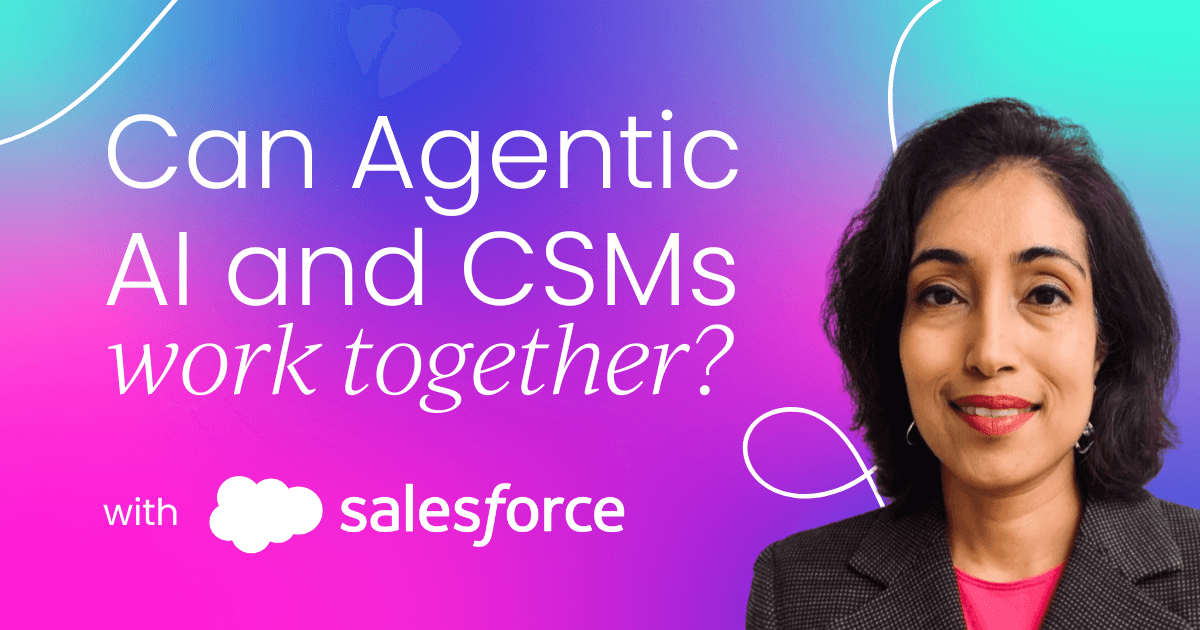
What's the one thing CS leaders should do before rolling out AI?
Outcomes. Outcomes. Outcomes. Not the model.
The leaders who win with this don't ask, "What can AI do?" – that question has a thousand answers and none of them are yours. They ask: “Where is my team losing time? Where is my team losing customers?” Then they point AI at exactly that, with the frontline in the room, starting with one specific use case and one clear outcome.
Treat it as an operating model change. Do that and adoption stops being a fight, because your team feels it making their day lighter and their numbers better. That's the whole game, and that's the difference between the teams getting real returns and everyone else still waiting for them.
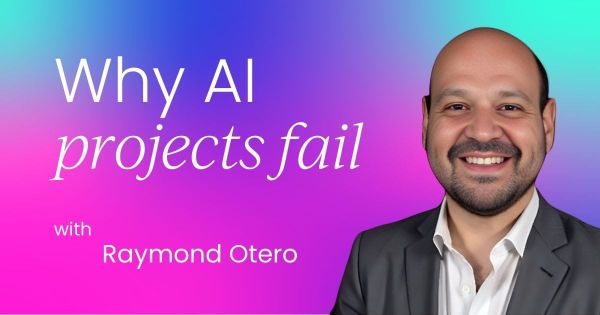
This article draws on a fireside chat Raymond Otero's participated in for the AI for Customer Success certification, where he divulges how to embed AI into customer success operations.
Want to put this into practice?
The AI for Customer Success Certification goes deeper on everything Raymond covers here – built by CS leaders from Cisco and Microsoft who are applying AI across the full customer lifecycle right now.


Become a CSC Insider
Thank you for subscribing
Get exclusive insights, frameworks, and strategies from customer success leaders driving real business impact.
An email has been successfully sent to confirm your subscription.
 Follow us on LinkedIn



Start the conversation
Become a member of Product Marketing Alliance to start commenting.
Sign up now