










In 2026, Chief Customer Officers (CCOs) are at a difficult intersection, caught between two realities.
On one side are revenue expectations – retention, expansion, and predictable growth. On the other side are the human realities required to deliver those outcomes: emotional labor, constant problem-solving, and the pressure of being the frontline between customers and the business.
Burnout sits squarely in the middle of that tension. And yet in many organizations, burnout is still treated as a wellness or an HR issue instead of a business one.
That framing misses the real problem. Burnout is measurable. It’s expensive. And it directly impacts revenue.
For CCOs, the responsibility is clear: connect the dots between human sustainability and business performance.
Translate burnout into financial terms
The conversation about burnout should start in a place executives understand: the business case.
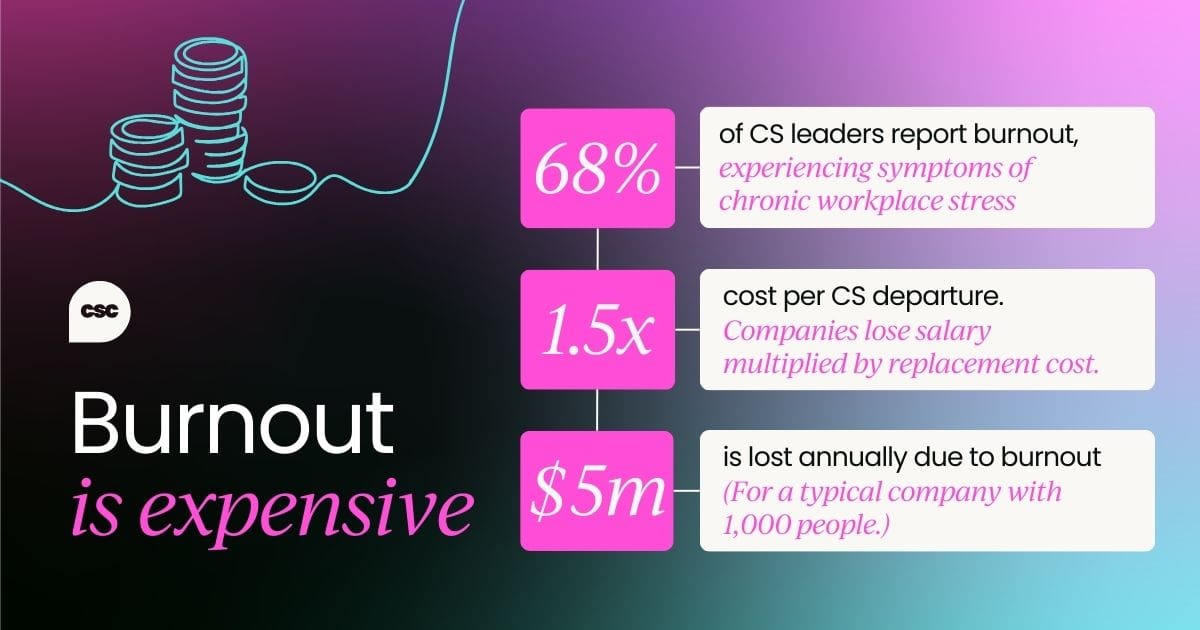
Burnout is measurable – and the numbers are significant. For a typical organization with 1,000 employees, burnout can cost roughly $5 million per year. And that cost doesn’t come solely from employee turnover.
The hidden operational costs of employee burnout
It appears across the organization in ways that are harder to see but just as damaging:
- Disengagement
- Slower problem-solving
- Increased escalations
- Reduced productivity
- Declining customer experience
Customers can feel the fatigue behind every interaction.
Even at an individual level, the financial impact becomes clear. Research shows burnout can cost between $4,000 and $21,000 per employee annually in lost productivity alone. When turnover is factored in, the numbers climb quickly.
Now consider what that looks like at the team level. In a customer success team with 20 CSMs, even the most conservative estimate of $4,000 per person represents $80,000 in annual risk – and that’s before accounting for customer risk, churn, or downstream revenue impacts.
The real cost of replacing a Customer Success Manager
Replacing an employee typically costs six to nine months of salary once recruitment, onboarding, and lost productivity are considered. For a CSM earning $80,000, that’s roughly $40,000 to $60,000 per departure.
These aren’t abstract numbers. They represent real operational leakage.
Now, think about your strongest CSM leaving. You probably already know exactly who that person is – the one you’ve quietly thought, “If they ever left, I’m not sure what we’d do...”
The cost isn’t just the salary. It’s the six months of lost momentum, retraining, and rebuilding the customer relationships that person had developed. This is why the framing matters.
When burnout is positioned as a wellness issue, it often falls to the bottom of the priority list. But when it’s framed as a financial leak, the people holding the purse strings tend to listen.
And that’s where the role of the Chief Customer Officer becomes critical. Burnout drives churn. And churn is revenue erosion.
If an unexpected $5 million in customer churn appeared overnight, you can be every organization in the world would investigate immediately. Yet many companies tolerate internal systems that quietly create the same level of loss. I want to reiterate: connecting those dots is part of the CCO role.
 Jenelle Friday
Why Customer Success Managers are susceptible to burnout
Burnout tends to surface earlier in customer success (CS) than in many other functions. That’s because CS sits where empathy meets economics.
Every conversation requires emotional labor. Every renewal becomes a public measurement of performance. Every interaction carries the pressure of representing the company while protecting the customer relationship.
CSMs are often asked to operate inside contradictions:
- Be strategic, but also empathetic
- Be proactive, but respond instantly when something breaks
- Be data-driven, but remain deeply human
Over time, that emotional multitasking compounds.
Leadership’s job isn’t necessarily to make the role easier. In many cases, that isn’t possible. The job is to make the work sustainable. That starts with clarifying expectations – helping teams understand what “enough” looks like and when to push harder versus when to step back.
 Jade Warne
The early warning signals leaders often miss
One of the biggest challenges with burnout is that leaders tend to recognize it all too late.
Many discover the problem only when a team member requests a short meeting and announces they’re leaving. (I’m sure you’ve experienced the dreaded “Hey, do you have 15 minutes?” direct message.)
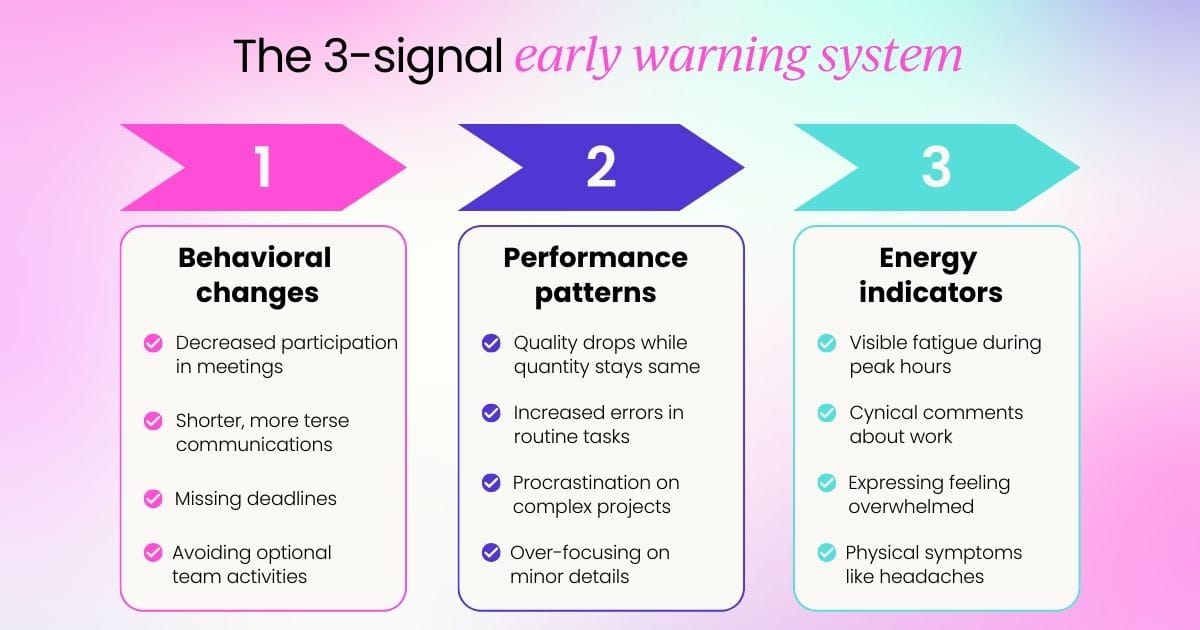
In reality, burnout usually appears earlier through a pattern of signals.
Behavioral signals
The first sign is often behavioral. You may notice shorter replies, reduced participation in optional team activities, or subtle withdrawal from conversations.
Performance signals
Next comes a shift in performance. Work quality may dip. Team members may start focusing on smaller details rather than tackling larger priorities.
Energy signals
Finally, the emotional impact becomes visible. Employees begin to look drained, cynical, or disengaged.
There’s a fourth factor worth calling out: negativity spreads quickly. One cynical comment from an exhausted team member can lower the energy across an entire team. Recognizing these signals early allows CCOs to intervene before burnout becomes irreversible.
Customer leaders carry a unique burden
CCOs often become the emotional shock absorbers of the organization. They absorb pressure from customers, from their teams, and from executive leadership – often without a safety net of their own.
Because CCOs are wired to solve problems, they frequently internalize every churn risk, missed goal, or late-night escalation. But protecting personal capacity isn’t a weakness. It’s a safety blanket and a strategic decision. Plus, it sets the example for how your teams should operate.
Principle 1: Burnout mirrors leadership behavior
One uncomfortable truth about burnout is that it often mirrors leadership behavior. The signals leaders send define the boundaries teams believe are real.
How leadership behavior influences burnout in customer success teams
For example, sending Slack messages at 11 PM may seem harmless. As a CCO, you're expected to reply to messages from your CEO at all hours of the evening. But you shouldn't mimic that behavior with your team. To your team receiving those messages, it often communicates something different.
It suggests that constant availability is expected. Leaders can reshape those signals through simple actions:
- Using delayed send for late messages
- Scheduling time for focused thinking
- Leaving the office at a reasonable hour
Even small behaviors influence culture. I once found out that one of my team members in a previous role wouldn’t leave our office until I had left because they didn’t want to appear less committed.
Leadership behavior matters more than leaders often realize.
Principle 2: Reward clarity and impact, not chaos and volume
Somewhere along the way, many organizations started rewarding activity instead of impact.
I recently spoke with a leader who still monitors how many emails their teams send, the number of calls their teams take, and how many minutes they're using Zoom. I would argue that those are the wrong things to measure because constant activity doesn’t equal meaningful outcomes.
High-performing CS teams shift the focus toward value creation. Frameworks such as OKRs can help create that clarity. When implemented correctly, they encourage ambition while maintaining sustainability.
One important principle is recognizing that 70% achievement of an ambitious goal is not failure.
If teams consistently hit 100%, it often means the targets were never ambitious enough in the first place.
The goal is progress with intention – not chaos disguised as productivity.
 Dan Farley
Principle 3: Psychological safety drives performance
Google’s Project Aristotle explored what makes teams effective. The strongest predictor of performance wasn’t compensation, skill, or process. It was psychological safety.
Teams perform best when individuals feel safe speaking up, admitting mistakes, and offering feedback without fear of punishment. The absence of that safety often drives silent burnout.
Leaders can strengthen psychological safety by:
- Regularly asking their teams for feedback
- Openly admitting their own mistakes
- Approaching problems with curiosity rather than blame
Even changing the language from “Why did this happen?” to “Help me understand what happened” can transform a conversation.
Burnout is often a systems problem
Organizations often try to solve burnout through mindset shifts. But resilience alone can’t fix broken systems.
If customer success teams require constant heroics to keep the machine running, the infrastructure itself needs attention.
Three practical changes can help.
- Automate repetitive work: Automation can remove routine tasks such as reporting, health scoring, and renewal tracking. This frees teams to focus on empathy and strategic work.
- Align OKRs to outcomes: CS teams should be measured on results rather than activity levels.
- Celebrate strategic “no”: When someone declines low-impact work to protect higher-value priorities, that behavior should be recognized – not discouraged.

Sustainable culture begins with small choices
Creating sustainable organizations rarely requires sweeping change overnight. More often, it begins with small leadership decisions. Chief Customer Officers can start with three simple actions.
- Audit: Identify where energy is leaking. Which meetings, reports, or rituals consume time without delivering real value?
- Adjust: Introduce visible changes such as meeting-free blocks or healthier communication boundaries. That means no late-night Slack or Teams messages!
- Amplify: Publicly celebrate sustainable success. When you see people in your team taking on a process and making it simpler, really celebrate that success because those are the behaviors you want to amplify.
Simplifying the system
One useful experiment when joining a new organization is to question existing processes. Many companies operate with recurring meetings, reports, or rituals that no longer serve a clear purpose.
Temporarily stopping some of these activities can quickly reveal which ones actually matter – and which ones exist simply because they always have. The result is often a simpler system that supports both performance and sustainability.
FAQs about customer success burnout
Conversations about burnout often surface the same questions from customer leaders. Two challenges come up repeatedly: how to quantify burnout for executives, and how to manage team wellbeing when leadership expectations remain unrealistic.
When your CFO doesn’t see the burnout
One challenge many CS leaders face is demonstrating burnout in financial terms.
Consider the scenario where pricing increases, or company policy puts CSMs in difficult conversations with customers every day. Over time, those interactions can take a significant emotional toll. Leaders may start seeing the warning signs — long-term leave, exhaustion, or declining morale – but struggle to convince their CFO that the issue requires structural change.
In situations like this, the key is to connect burnout to the metrics leadership already cares about.
One approach is to map the customer value cycle and show how engaged teams drive stronger net revenue retention.
When CSMs are able to operate proactively – focusing on customer value rather than constant firefighting – they influence renewal outcomes and expansion opportunities.
The goal is to shift the conversation from “employee wellbeing” to “revenue impact.”
If burnout is reducing proactive work, weakening customer relationships, or increasing churn risk, those outcomes should be modeled and presented in the same way any revenue risk would be.
Ultimately, executives respond to the language they already use to run the business.
 Deepak Sharma
When leadership expectations are unrealistic
Another question many CS leaders wrestle with is what to do when burnout originates higher up in the organization.
CCOs often act as a buffer between executive expectations and frontline teams. That means protecting the team from unsustainable pressure while still delivering results. If leadership decisions are creating unsustainable workloads, the responsibility becomes showing how those decisions affect customer experience, retention, and revenue.
But there is also a difficult truth that experienced leaders eventually confront: not every culture is changeable from the middle.
Sometimes, the most productive path is influencing the system. Other times, it requires recognizing when the organization is unwilling to change.
CCOs have limited control over executive behavior, but they do have responsibility for protecting their teams and clearly communicating the consequences of unsustainable practices.
Is burnout actually increasing?
Burnout often feels more visible today than it did in the past. But that doesn’t necessarily mean it’s more common.
In many cases, what has changed is the willingness to talk about it.
Leadership cultures have evolved to allow more open conversations about mental health, workload, and emotional labor. That shift is positive, especially in customer-facing roles where emotional pressure is a core part of the job.
The challenge now is ensuring those conversations lead to structural change.

Leadership defines the culture
Burnout is not inevitable. But it rarely resolves itself.
Chief Customer Officers shape the culture through the expectations they set, the systems they build, and the behaviors they model.
When leaders redefine ambition, build psychological safety, and simplify the work itself, they create an environment where teams can perform without sacrificing sustainability.
And in customer success, those outcomes are inseparable. Because protecting the people delivering the customer experience ultimately protects the revenue behind it.
This article has been adapted from a talk called “Anti-burnout leadership: Building ambitious CS teams that still sleep at night” given by Maranda at Chief Customer Officer Summit London 2025.
Continue the conversation with CCOs in Austin
On June 26 in Austin, the Chief Customer Officer Summit will bring together senior CS leaders for a full day of candid conversations, practical insights, and meaningful connections.
Join 100+ customer success leaders to exchange ideas, pressure-test your strategy, and learn how high-performing teams are tackling the biggest challenges in retention, expansion, and churn.
You’ll walk away with:
- Fresh industry insights from leading CS practitioners
- Practical strategies you can implement immediately
- A stronger network of peers who understand your challenges
- New perspectives on scaling customer success in today’s market
Skip years of trial-and-error by learning directly from the people building and scaling today’s most effective CS organizations.


Become a CSC Insider
Thank you for subscribing
Get exclusive insights, frameworks, and strategies from customer success leaders driving real business impact.
An email has been successfully sent to confirm your subscription.
 Follow us on LinkedIn