












As painful as it is, some of your customers leave simply because they don’t vibe with you. They either don’t like your product, your brand, customer service, or, in some cases – and quite tragically – all three. But not every customer you lose does so of their own accord. Some customers leave because their card expired, or an invoice sat in the wrong inbox. Whatever the scenario, their direct debit bounced and nobody in your org followed it up.
That second group never meant to go, which is why losing them is oh-so painful.
Funnily enough, this article started as a question from a member in our Slack community, and it's one we hear all the time: when a customer churns because their payment failed, whose problem is that, and what can customer success (CS) actually do about it?
The short answer is that it sits awkwardly between teams, depending on your company’s maturity. Billing owns the payment. Finance owns collections. CS owns the relationship and, more and more often, the retention number.
In our 2026 State of Customer Success Report that surveyed 200+ CS professionals, 80.4% of respondents said CS is a key driver of revenue through retention and expansion. An even deeper dive into the data reveals that churn rate is the second-most common KPI CS teams are measured on, at 46.2%. So when a failed payment turns into a lost account, it usually lands on a CS scorecard… even if CS never saw it coming.
Here's how to stop that happening, drawing on the report data and on practitioners who've shared their approach on the stages at our global Customer Success Summits. Let’s crack this problem together, shall we?

What counts as involuntary churn?
Before you fix it, agree on what it is. The term gets used for two quite different things.
"Involuntary churn" is when a customer is lost without choosing to leave, usually because a payment failed: an expired card, a declined transaction, a bounced direct debit, or an unpaid invoice. It’s also known as “passive churn.” The customer hasn’t decided to sever the subscription or relationship; it was accidental.
Franca-Sofia Fehrenbach, when she was Head of Customer Success at PlanRadar, told our Customer Success Summit audience in London, back in December 2023, that her team splits churn into two, and pays CSMs on the part they can influence:
"We classify churn into involuntary and voluntary churn... We’re incentivizing my team based on the revenue we expect them to lose, but they don't lose. So you have a $1M portfolio based on the forecasting; we expect you to lose $100K of that, but thankfully, you only managed to lose $50K, so we incentivize you on that."
In Franca-Sofia's framing, involuntary churn meant customers who'd gone bankrupt. In subscription billing, it more often means expired cards. It’s worth pausing on this here because that distinction does matter to this conversation. You might have a customer whose business is being liquidated; this is firmly out of your control.
But a debit card that expired last Tuesday isn't. If you group both of these scenarios under the same "involuntary" bracket, you'll never really know how much of your churn could have been recovered.
Why failed payments are a CS problem (even when CS doesn't own billing)
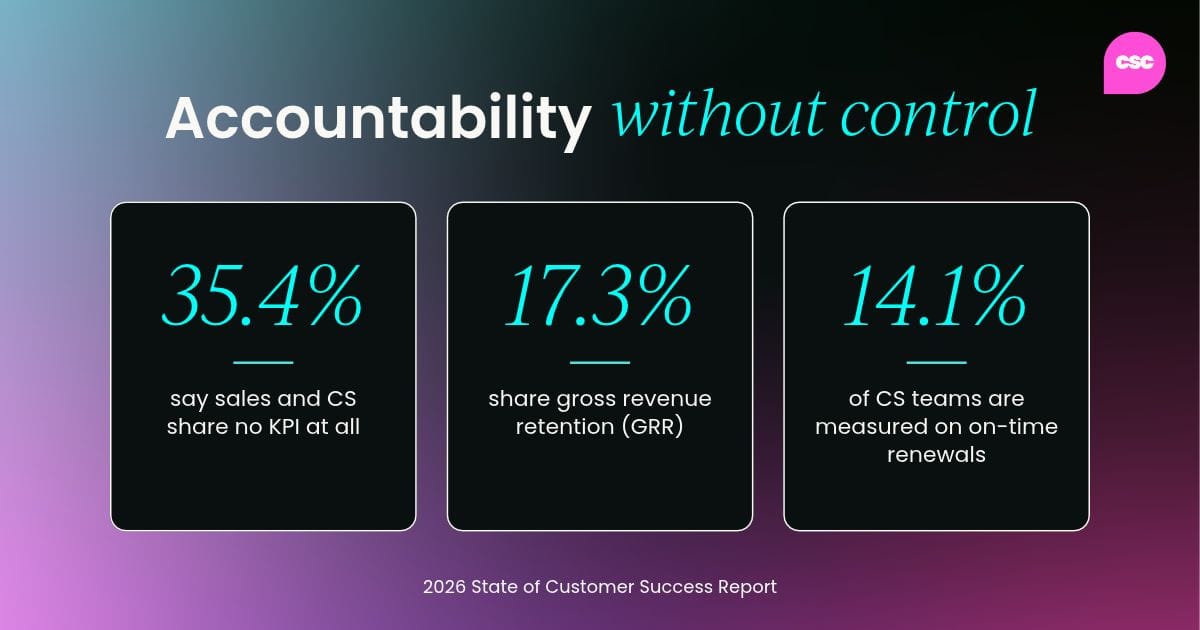
The 2026 State of Customer Success Report describes a pattern it calls "accountability without control."
CS teams are picking up revenue responsibility in fragmented ways, often without the authority to match. As the report put it, “pricing decisions sit with finance, product quality issues sit with engineering and contract terms sit with sales.”
And when we consider payment collection – well, that fits that pattern neatly. CS is measured on churn, but the dunning emails and retry logic usually belong to someone else. Take vCom Solutions, for example: at our Customer Success Summit New York back in 2024, its VP of Customer Success, Kirsten DiChiappari, revealed that their finance team chases customers who forget to pay invoices on time.
But here’s where it gets interesting: 35.4% of respondents say sales and CS share no KPI at all, the most common answer to that question. Gross revenue retention (GRR), the metric failed payments hit most directly, is shared by a tiny 17.3%. And only 14.1% of CS teams are measured on on-time renewals.
Meanwhile, churn management as a core CS responsibility has slipped to 57.1%, down 14.2% year on year. If fewer CS teams see churn as theirs to manage, the quiet, administrative kind is the easiest to fall through the cracks.
Treat payment behavior as a health signal
A failed or late payment is often the first visible sign that something else has changed.
Jaime Moquin, SVP of Customer Success at Element451, a company that sells to higher education institutions, said that financial factors top the list of churn reasons there:
"Our number one churn reason is financial, something that I can't control. I can't control that an institution is closing... [We're] also starting to pay attention to that if they're late with their invoices."
Jaime’s advice for CS teams that can't see billing data is to ask for it:
“Go to your colleagues [in finance] and say, ‘I need to know. Maybe you don’t want to share the details, but I need to know if somebody’s not paying their bill.’ Because that also explains why they’re blowing you off on everything else.”
Others watch the same signals. Rachel McKassib Castaneda, a director on Cvent's global risk and retention team, said paid and unpaid invoices sit alongside adoption, engagement, and support cases in the signals her team tracks. Kirsten DiChiappari put the question to our New York audience directly:
"Are we looking at whether they are late payers, short payers, non-payers? Are they in our platform? Are they using our platform?"
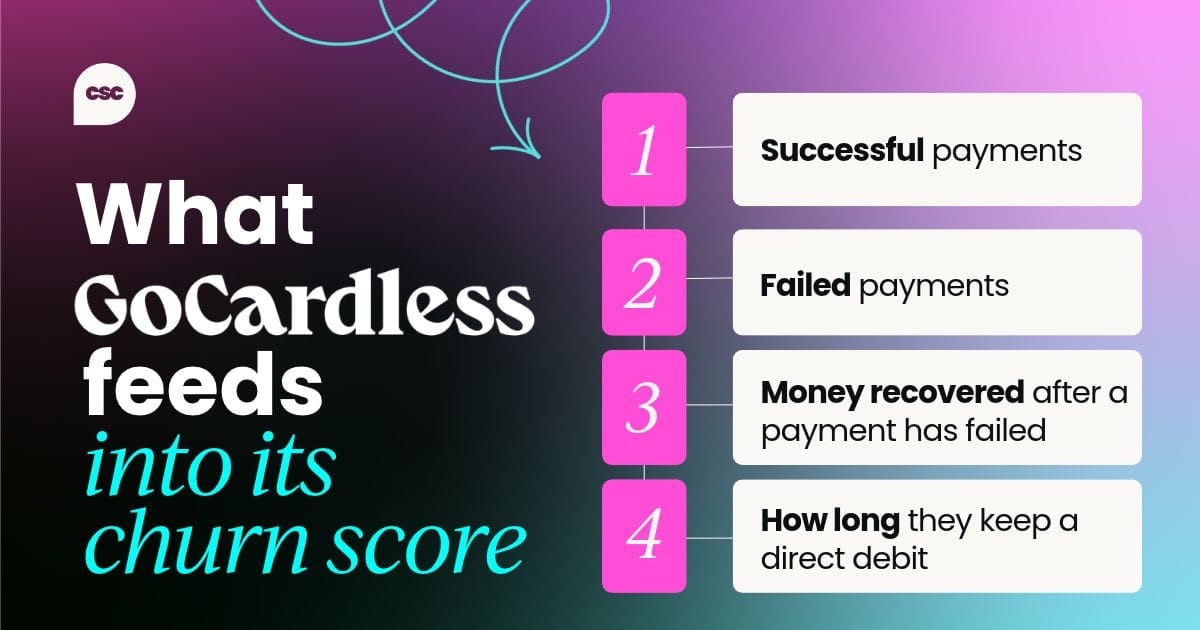
At GoCardless, payment history goes straight into the churn model. Nicola Pellatt, Head of Customer Success, Scale, Operations and Enablement, explained that the company's data science team built a churn score from 40–50 data points, including payment and mandate history:
"As a payment processor, we obviously look at successful payments, failed payments, if you then recover that money after a payment has failed... how long they keep a direct debit with you, all kinds of things like that."
You don't need a data science team to start. Even a simple flag for failed payments or overdue invoices gives CSMs a reason to call before the account quietly lapses.
Build a failed payment process with your finance team
The teams that handle this well agree in advance who does what when a payment fails.
At Cascade, that means a standing meeting. Lauren Salanitra, Manager of Customer Success, described building escalation channels with a "very process-driven finance team" for customers who may not renew, then reviewing them together every week:
"It's really the CS leader's responsibility – in this case myself and our VP of CS – to meet with our Head of Finance weekly to go through any requests that have gone through those channels, any larger customers that we feel are at risk of not renewing in the timeframe they would have hoped."
For some companies, the line between retention and collections blurs entirely. One audience member at an event described how their team was set up to save at-risk accounts, after being asked to work on settlement and releases, renegotiations and collections.
Your version doesn't need to go that far. But it should answer a few questions in writing:
- Who sees a failed payment first, and how quickly does CS hear about it?
- When does CS step in? After the second failed retry, or only above a certain ARR?
- What can CS offer without escalating? A new payment date, a switch from card to invoice, a short grace period?
Automate failed payment recovery, keep humans for the risky accounts
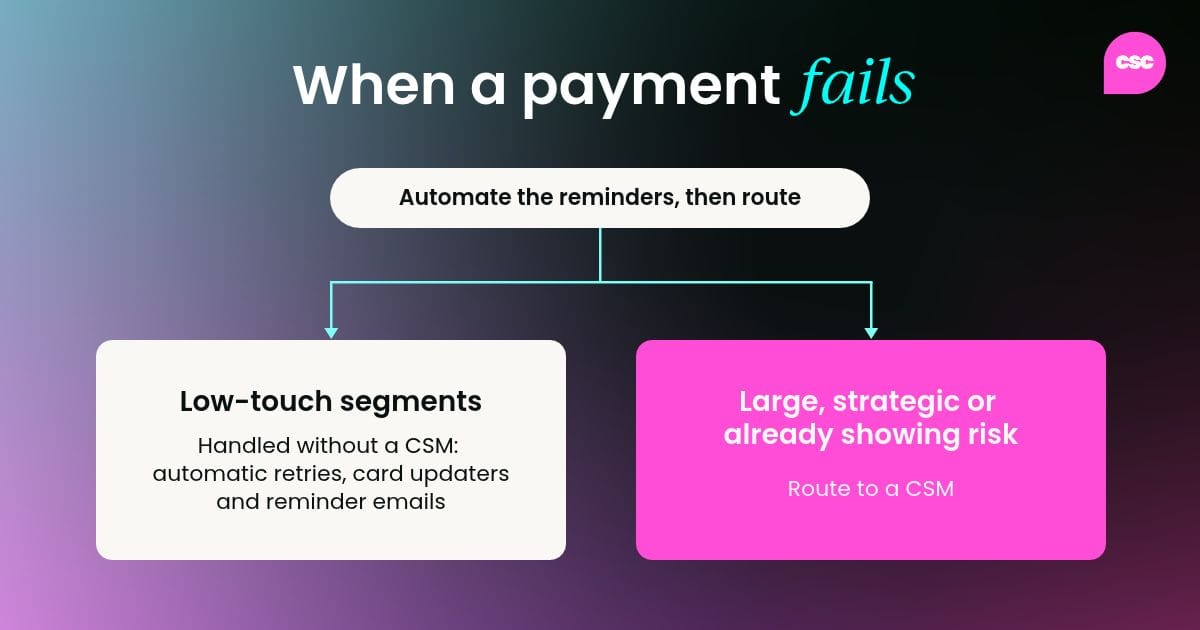
For low-touch segments, most failed payments should be handled without a CSM: automatic retries, card updater services, and clear, friendly reminder emails that make it easy to pay.
Our 2026 report suggests most CS teams aren't quite there yet. Only 12.2% say AI plays a workflow automation role (nudges, routing, triggers) in their CS strategy, yet 45.7% plan to invest in workflow automation. Failed payment recovery is an obvious candidate: high volume, rules-based and measurable.
Automate the reminders, then route to a CSM when the account is large, strategic, already showing risk, or when automation has run its course.
One warning: automation built on messy data just makes the mess faster. As Raymond Otero, Customer Success & Experience Executive, put it in the report:
"You cannot AI your way out of a data problem. You can only automate it."
If your billing system and your CRM disagree about who the billing contact is, no amount of automated dunning will reach the right inbox.

Don't let the payment be your first warning
Failed payments are easier to recover when the customer still values what they're paying for. A customer who forgot to update their card will fix it in minutes. A customer who's been drifting for months may treat the failed payment as a convenient exit.
That's where adoption comes back in, and the report flags a problem: 23.9% of respondents don't track or focus on adoption at all, up 9.9% in 2025. If you can't see usage dropping, the payment failure might be the first signal you get.
Raymond offers a simple test for any renewal:
"If the customer had to make the purchase decision again next year, would they willingly renew it based on the value received?"
If the answer is yes, a failed payment is a logistics problem. If it's no, the payment was never really the issue.
5 steps to cut involuntary churn
- Split your churn reasons into chose to leave, business closed, and payment failed.
- Get billing data into your health score, including retries and overdue invoices.
- Write the handoff down with finance.
- Automate the long tail and route high-value or at-risk accounts to a person.
- Watch adoption, so the failed payment is never your first warning.
Involuntary churn is some of the most preventable revenue loss a CS team will ever deal with. It just needs someone to decide it's their problem.


Become a CSC Insider
Thank you for subscribing
Get exclusive insights, frameworks, and strategies from customer success leaders driving real business impact.
An email has been successfully sent to confirm your subscription.
 Follow us on LinkedIn




Start the conversation
Become a member of Product Marketing Alliance to start commenting.
Sign up now