







I’ve worked in the industry for 25 years, and for the last 15 I’ve held various roles in customer success (CS). The labels changed along the way – customer support, customer success, customer experience – but the job stayed the same: working on the front line with the customer. I’ve been my company’s ambassador at the client’s site and my customer’s voice inside my company. I’ve been appreciated by both sides, and I’ve been kicked by both sides.
If you’re customer-facing, you’ll know that two-way pressure all too well. Your company wants to know where its next piece of business is coming from, why your CSAT is dropping, or why your NPS isn’t where it should be. Your customer wants to know why they’re paying you so much and where the value is. It’s a battle, day in, day out.
For the last year and a half, whatever topic I’m asked to speak on, the conversation ends up at AI. Customer success is no exception.
What’s driving the change in customer success roles
I believe every role is changing. We don’t work to five-year or decade-long plans anymore. It’s quarterly or annual now, and every planning cycle brings changes to roles. So rather than name the roles changing fastest, I’d rather look at what’s driving the change across all of them.
The first driver is that customers want strategic representation rather than reactive support. If you’re managing a customer support team, you’re doing what you’re supposed to do, but that’s an operational, reactive mindset. Customers are asking for a proactive, strategic one. Break and fix, we can do. If you don’t, somebody else will. What matters is the strategy you bring to the table. Roadmaps, strategy and scalability are what’s shaping CS roles today.
The second is that every customer wants more for every dollar they spend.
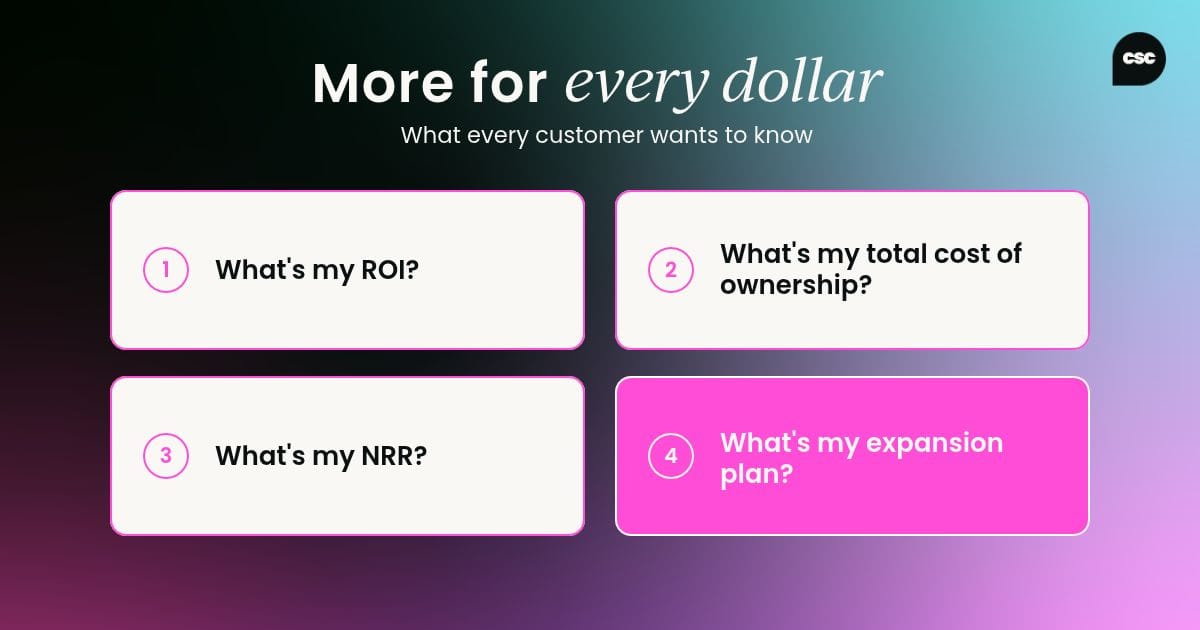
What’s my ROI? What’s my total cost of ownership? What’s my NRR? What’s my expansion plan? Customers are always looking at the value you bring them.
AI is going to help us build those strategic roadmaps. I don’t mean asking ChatGPT for a few slides. I mean using it to automate tasks, automate your churn metrics, and build agents that support your more strategic relationships. That offloads work and gives you more capacity to create value for your customers.
What CS ops should own in an AI-powered future?
Customer success operations (CS Ops) is becoming increasingly strategic. The biggest challenge in CS has always been a lack of clarity around roles, the tools people use and the metrics they follow.
No tool on the market gives you a one-size-fits-all solution. You’ll always need to customize for what each customer is looking for, and that brings us to working backward. It’s right there in the name: customer success. Start from what your customer is looking for, and customize your tools, metrics and approach around it.
Working backward doesn’t mean only delivering what’s in the proposal.
Customers usually arrive with a high-level idea of what they want, and you build on top of it. There’s nothing wrong with pushing back and saying, "You may want this as well." Sometimes the customer doesn’t know what they want – the unknown unknowns.
That’s where you act as their subject matter expert. You’ve seen far more outside their world than they have, so you can propose something new. Start from their baseline, take them where you feel they deserve to be, and keep improving. It’s never a one-time activity.
Why everything depends on your data
AI gives you the ability to build custom solutions for each customer, and it opens up automation opportunities. But the baseline for every AI initiative is how good your data is. Make sure you have the right requirements in place, worked backward from the metrics your customer cares about, and the data to support them. If you don’t have the right data and governance, it’s garbage in, garbage out, and the metrics you give your customer won’t be useful at all.
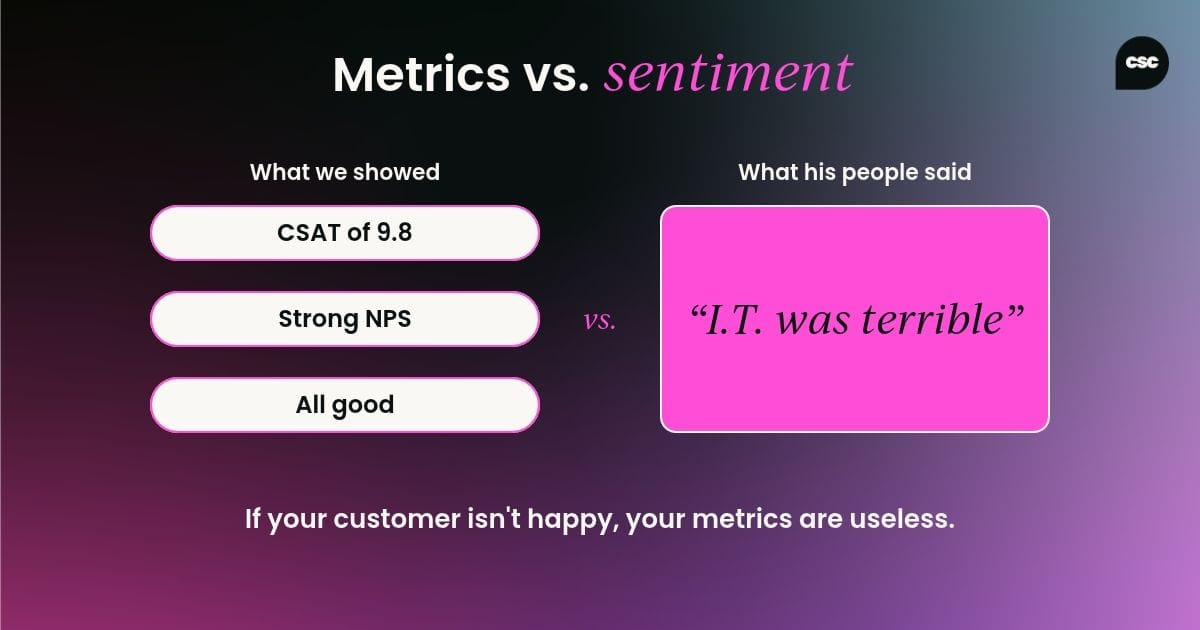
We were once managing IT support – L1, L2 and L3 – for a manufacturing company, and we’d show their CIO our metrics: 95% here, a CSAT of 9.8 there, strong NPS. All good. But he wanted to know about customer sentiment and his users’ experience. And the feedback he was getting from his people was that IT was terrible.
If your customer isn’t happy, your metrics are useless. Bringing that sentiment into your metrics is the key, and AI can help. Here’s where else I see AI helping CS ops:
- Strategy and tooling: Creating agents, customized use cases and self-service AI bots for your customers.
- Intelligent automation: Maintenance, reporting, metrics, routing, triage and dynamic segmentation.
- Compliance: If you support clients whose grants or funding depend on state, government or regulatory compliance, AI can help.
- Experimentation and optimization: A/B tests and experiments that bring value to your client proactively. You can say, "If you follow this practice for six months, it could cut your effort from 10,000 hours to 8,000." Use SMART goals to put a number on the savings.
How to prepare your team to work with AI
Most people I speak to use AI in their day job in some form. Some use corporate AI tools; some use a personal account for work.
One of my team members once copied a 500-page policy document into ChatGPT and asked for a summary. It included critical email addresses and contact details. He had his output within two hours. He also triggered an org-wide email from our CIO. The email was polished. What the CIO said to me one-on-one was a lot shorter: absolutely not.
AI can help us, but it’s a double-edged sword. It comes down to how you use it: setting boundaries, controlling the rules, and deciding what it’s exposed to and what it learns from. Your boundaries and knowledge base should be clearly defined. Once that governance is in place, it’s very helpful. Reading a policy document that long would take me around a week. AI can give me a crisp two- or three-page summary in five or 10 minutes. But it has to be done in a compliant way.
I’d still avoid using AI with any sensitive data, or data you’re not authorized to use. If you work in banking, government or healthcare, that’s a big no right now.
Logging into ChatGPT or Perplexity is the first level. The next is customizing it. In IT, I want my agent’s knowledge base to be my IT repository: known issues, dos and don’ts, SOPs and MOPs. In legal or compliance, it’s those documents. The same governance applies to customer success.
When I build an agent for a customer, I tell them: your data, your agent, your control. Nothing goes outside your boundary. That’s easier said than done. I then have to train them and their admins to make sure those checks are actually implemented, and that they’re more than a line on a checklist.
Embedding AI into your workflows is trial and error. Keep fine-tuning until you get the responses you’re looking for. Eventually, you’ll have something that suits your customers, and you can reuse the format for others.
 Grace Gupta
Using AI as a copilot, with a human in the middle
Think of AI as a copilot – not Microsoft’s Copilot, but something that helps you while you stay in the driver’s seat. It frees up capacity on repetitive tasks. You can create workflows, prompts, agents and automations. If you don’t have the capacity or the skills, learn them, or bring in someone who already has them.
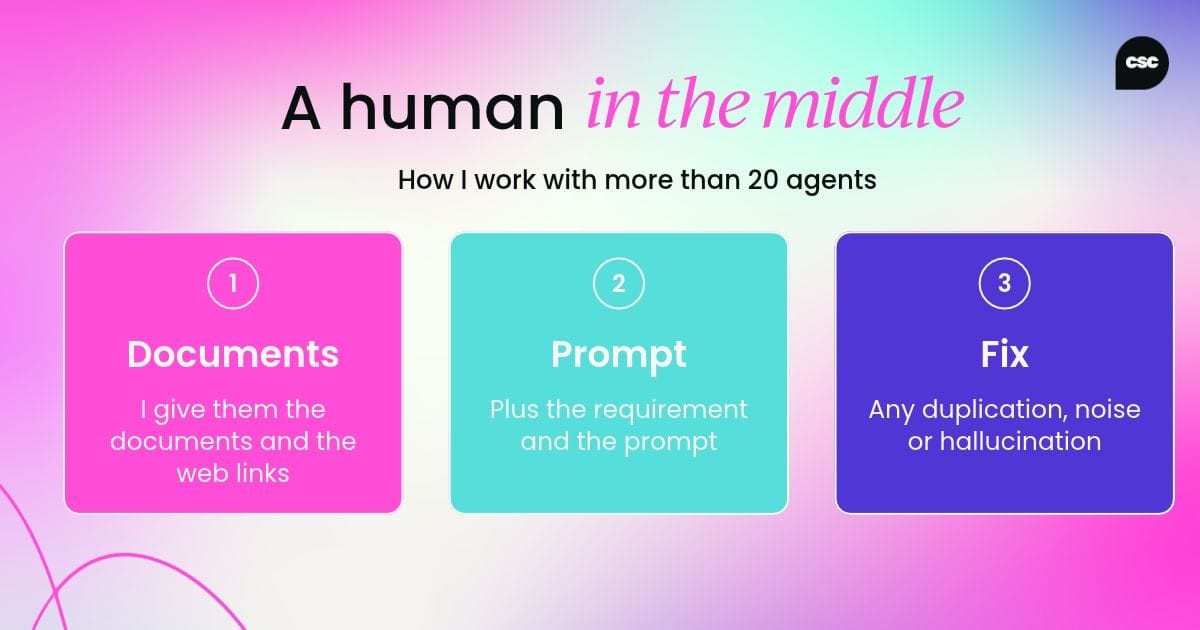
In my day job, I have more than 20 agents for various roles, and I keep a human in the middle. I could let them crawl our intranet for whatever documents they want, but I don’t. I give them the documents, the web links, the requirements and the prompt. Then if I see any duplication, noise or hallucination, I fix it.
Personally, I use AI for writer’s block. When I’m staring at a blank page, I’ll ask for 20 topics or 20 slides on a subject, then populate and fine-tune them. Sometimes AI can be dumb, and the responses are vague, but you still have a head start. I also use it for innovation ideas: pick a vertical like healthcare, ask where there’s a gap for a startup or product, and ask which competing products already exist in or near that market.
Does AI certification matter for CS teams?
Training your team in AI literacy is key, and it doesn’t have to cost anything. Almost every platform offers free AI courses now: LinkedIn Learning, PMI (which I’m part of), the Scrum bodies, and often your own company’s internal learning. I wouldn’t send people down a rabbit hole of coding or no-code courses in the name of AI, though. Start with first-level awareness, governance and responsible AI.
On certification, I value knowledge more than a certificate. A certification is a plus – a first-glance sign that someone has done the learning and knows what they’re doing. But I don’t make it a requirement. It’s good to have. The awareness and knowledge are what count.

How to break down silos between CS, CX and support
I’ve done the same role under all three labels. One day my leadership decided "customer support" sounded too operational. We were enablers for our clients, a strategic alliance, so let’s call it "customer success." Or we’re improving their experience, so let’s call it customer experience. There’s more clarity between these roles now, but they still sometimes work in silos.
What all three have in common is the customer. And with customers, I always go back to what they’re paying for and what their ROI is. Whatever your label, at the end of the day you’re an enabler for their business. That doesn’t always mean something big.
One CIO I worked with said that if your business needs a mouse and IT support gives them one on time, that’s good customer support. Sometimes that matters more than fixing a crashed database. A database restoration might take five or six days, maybe $20,000 of effort. Handing someone a mouse might be the better experience, because it unblocks them. Picture a nurse who can’t do her job because her mouse isn’t working. Give her a new one, and she can get back to work. Small wins can bring a better experience too.
Ownership is key. There’s no room for the blame game: "Not my responsibility. Not my area." You’re wearing two hats, representing your company and your customer, so make sure your roles share a unified journey and complement each other. Cross-functional squads and governance help you support each other. Outside teams see you as one.
Then there’s feedback. I don’t want one CSAT survey for everything. If I’m focusing on a user group, I want feedback that captures their sentiment. Ask, "Did you get timely support?" and you have to define timely. One day? One month? One year? Forever? Your NPS or CSAT score might show one thing while your users aren’t happy, so build that sentiment into your surveys.

4 non-negotiables for a future-ready CS org
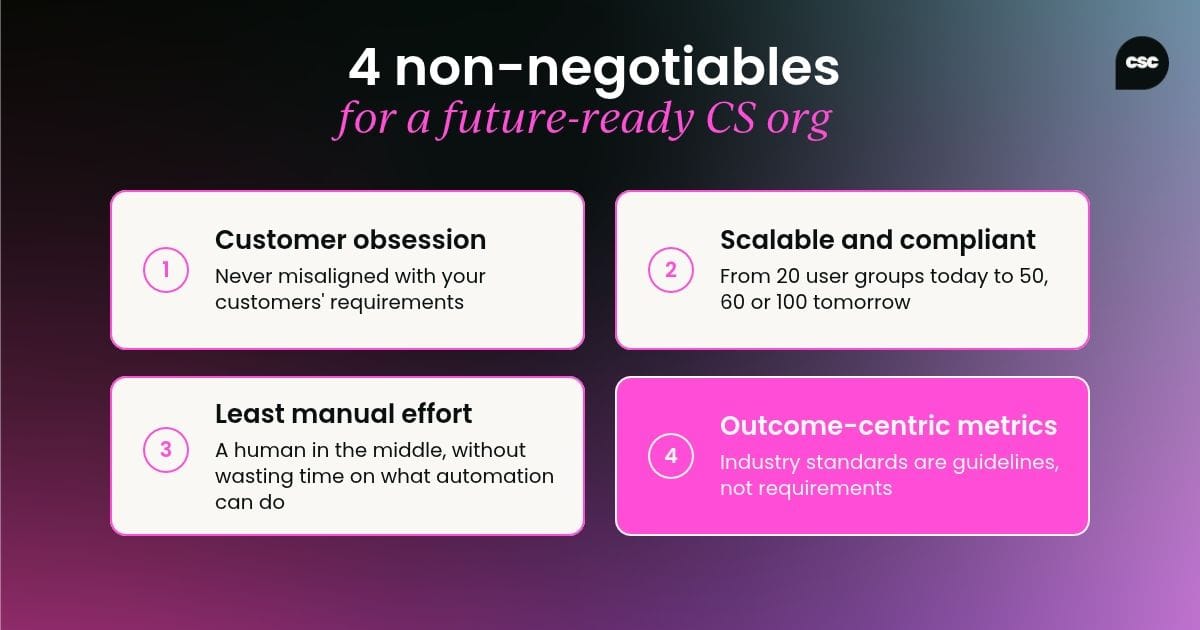
If I were designing a future-ready CS org from scratch, these would be my non-negotiables:
- Customer obsession: Whatever direction it takes, it should never be misaligned with your customers’ requirements.
- Scalable and compliant: You might support 20 user groups today, then 50, 60 or 100 tomorrow. Your processes need to scale with them.
- Least manual effort: There should be a human in the middle, but nobody should waste time on anything automation can do. I don’t want to automate everything, and I don’t want to do everything manually. There’s a middle ground.
- Outcome-centric culture and metrics: Define your metrics by your customers’ requirements. Industry standards are guidelines, not requirements. If Gartner says 900 out of 1,000 customers said something, that’s useful, but my customer might be number 901. Compliance is different. When a regulation like HIPAA sets a rule, you don’t have a choice.
And at the center of all of it, there should be the customer.
Is AI making us dumb?
I’m sometimes asked whether AI is making us dumb. My father could do fractional multiplication tables in his head, and my grandfather used an even more complex system. From my grandfather’s perspective, my father was dumb. From my father’s, I’m dumb. And from mine, my son struggles with simple subtraction.
How many of us still drive a manual car, or use a paper map? Most of us can’t imagine driving without GPS now. What used to be a requirement isn’t anymore. I see AI the same way: as an enabler that gives you the time and capacity to do something new.
This article has been adapted from a talk Vinod gave at Customer Success Summit Washington in January 2026.
Happened to miss the real thing? If you’d like to watch his full talk OnDemand, you can do so with a Pro+ membership – and catch up on hundreds of hours of exclusive thought leadership content bursting with strategies and solutions for your customer success function.


Become a CSC Insider
Thank you for subscribing
Get exclusive insights, frameworks, and strategies from customer success leaders driving real business impact.
An email has been successfully sent to confirm your subscription.
 Follow us on LinkedIn



Start the conversation
Become a member of Product Marketing Alliance to start commenting.
Sign up now