








Landing your next customer success (CS) role, or climbing the ladder in your current company, requires more than just showing up and hoping for the best.
After leading CS teams as a two-time Chief Customer Officer and interviewing hundreds of Customer Success Managers (CSMs), I've seen what separates candidates who get offers from those who don't. And spoiler alert: it's not just about your experience.
In this article, I'm sharing the exact frameworks and strategies I use (and teach) for mastering CS interviews, finding the right mentors and sponsors, and taking control of your career trajectory.
These are battle-tested approaches that have helped countless CS professionals land their dream roles and accelerate their growth.
What hiring managers really want to know
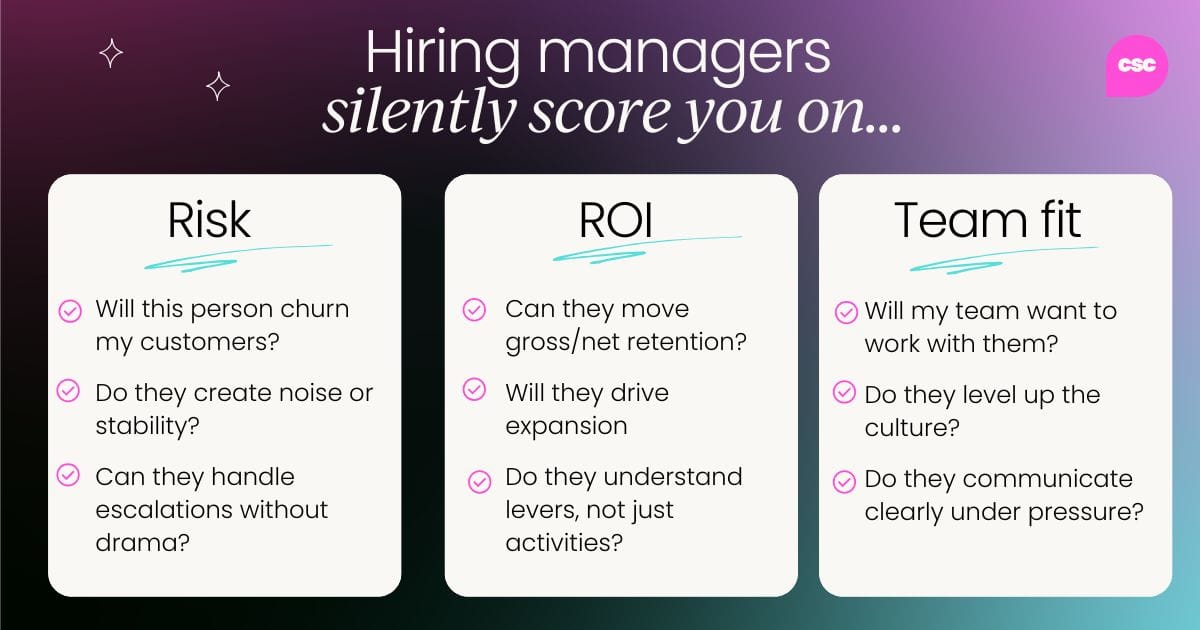
Let's start with a truth bomb: when I interview CSMs, I'm assessing three things above all else: risk, return on investment (ROI), and team fit. Every question I ask ladders up to one of these areas; understanding this changes how you should approach every interview.
Think like an interviewer
When you're sitting across from a hiring manager (or on a tile on a Zoom call, as it so often is these days), they're running calculations in their head. Will this person help me hit my retention targets? Can they reduce churn in our enterprise segment? Will they mesh with our existing team dynamics?
Your job is to make those calculations easy. You need to translate your CS work into business impact that directly connects to their challenges. This means moving beyond "I managed 50 accounts" to "I improved gross retention by 8% through strategic account segmentation and proactive health monitoring."
I interview between four and five CSMs every single week. The candidates who stand out are those who've clearly done their homework, and not just on our company, but on our specific CS challenges. They speak our language, understand our metrics, and can articulate how their experience maps to our needs.
The SOAR+ framework for answering interview questions
You might have heard of STAR (Situation, Task, Action, Result), a very common technique for answering behavioral interview questions.
Personally, I prefer “SOAR+,” which stands for Situation, Obstacle, Action, Result, plus the business impact or lesson learned (+). I find this framework helps you create modular stories that showcase your strategic thinking and execution abilities.
Here's how it breaks down:
- Situation: Set the context in one or two sentences. What was the business challenge or opportunity?
- Obstacle: What made this particularly challenging? This shows you understand complexity and can navigate difficulties.
- Action: What specific steps did you take? Be precise about your role versus the team's contribution.
- Result: What happened? Use concrete metrics whenever possible.
- Plus (Business impact/lesson): What was the broader implication? What did you learn that you've applied since?
The key is keeping each story to 20–40 seconds. I can't stress this enough – practice these stories until they're crisp and natural. In my experience, when candidates ramble through their examples, it tells me they might struggle to communicate effectively with customers.
Building your proof stack
Before any interview, prepare examples that demonstrate:
- Gross and net retention improvements: Have specific percentages and dollar amounts ready
- Net ARR expansion: Show you understand the growth side of CS
- Cross-functional collaboration: Make it clear that you know CS doesn't happen in a vacuum
- Strategic thinking: Try to give examples of playbooks you've created, experiments you've run, or processes you've improved
SOAR+ in practice
Say you're asked about a challenging renewal. You can use SOAR+ to steer your answer. Here's an example:
- Situation: "I inherited an enterprise account worth $1.2M that was flagged as high churn risk."
- Obstacle: "The customer had experienced a fragmented onboarding that led to 120-day time-to-value instead of our target 45 days."
- Action: "I developed a re-implementation pilot combining scaled success plays with executive sponsor engagement, meeting weekly with their VP of Operations."
- Result: "We retained the full contract value and secured a 15% expansion."
- Plus: "This experience taught me the critical importance of multi-threading to executive sponsors early. I now build executive engagement into all my enterprise account plans from day one."
 Gözde Görce
In the Customer Labs workshop I ran for Customer Success Collective, one CS leader from the education space shared a perfect SOAR+ example:
Situation:
“We were running a training for an enterprise client where two senior stakeholders wanted completely different outcomes — one wanted us to focus on sales methodologies and coaching, the other wanted marketing tactics and how to use market research.”
Obstacle:
“We effectively had two ‘masters’. If we tried to please both without thinking it through, we risked delivering a session that didn’t resonate with the actual team in the room.”
Action:
“We blended both requests into the core agenda, but on the day we stayed highly adaptive – tuning the depth, examples, and emphasis based on the team’s ability, interest areas, and live feedback.”
Result:
“We finished with an NPS of 8.4 and are now in discussions with the same enterprise client about additional trainings.”
Plus:
The lesson? Early stakeholder alignment matters, but so does real-time adaptability. In CS, you’re often balancing competing priorities; showing you can do that in a structured way is interview gold.
 Grace Gupta
Questions that make you memorable
When it's your turn to ask questions, this is your chance to stand out. Skip the generic, "What does success look like in this role?" Instead, tailor your questions to your interviewer:
For the hiring manager or CCO
- "What are the primary levers you're focused on for improving net retention this year?"
- "How do you measure customer health, and what early warning signals have proven most predictive?"
- "What's the biggest gap in your current CS motion that this role will help address?"
For product team members
- "Can you share a recent roadmap change that came directly from customer feedback?"
- "How do you balance feature requests from CS versus other sources?"
- "What usage patterns differentiate your most successful customers?"
For sales partners
- "How do you currently handle renewal and expansion ownership?"
- "Where do you see the most friction in the sales-to-CS handoff?"
- "What information from CS would make your renewal conversations more effective?"
These questions show you understand the interconnected nature of CS and that you're already thinking about how to add value.
My favorite interview questions I ask CSM candidates
Since I'm sharing secrets today, here are the questions I ask most often and what I'm really looking for:
1. "Walk me through the experiences that best prepared you for this role."
I'm not asking for your life story. I want to see if you can connect the dots between what you've done and what we need. The best candidates pick 2-3 specific experiences and clearly articulate the connection.
2. "If we're sitting here a year from now, what are we celebrating?"
This is my absolute favorite question. It tells me so much about what you value, how goal-oriented you are, and whether you've truly envisioned yourself in this role. The best answers are specific, measurable, and aligned with business outcomes.
3. "Tell me about a time when something went wrong with a customer. What happened?"
Everyone will ask some version of this. Have your example ready, but focus on what you learned and changed as a result. Perhaps you missed a renewal signal and now track leading indicators differently. Or, maybe you learned the importance of executive alignment. The lesson matters more than the mistake.
 Customer Success Collective
Finding mentors and sponsors who actually move the needle
This is one of my favorite quotes:
“Some of the most important decisions about your career will be made when you’re not in the room.”
It’s a powerful thing to sit with. It raises the question: how can you influence what’s being said, or the decisions being made about your career, when you’re not there? That’s where mentors and sponsors come in.
Understanding the mentor-sponsor distinction
There's a clear difference between mentors and sponsors, which matters to your quest to find one. Mentors guide your skill development. They help you navigate challenges, develop capabilities, and make better decisions. They invest their time and expertise.
Sponsors advocate for your advancement. They spend their social capital to get your name in rooms you can't access. They champion you for opportunities and make introductions that change your trajectory.
You need both, but you approach them differently.
The 6 signals of a great CS mentor
Not all mentors are created equal. Look for these characteristics:
- They've operationalized what you're trying to build: If you want to scale CS operations, find someone who's actually done it at your target company size
- They're candid with care: Sugar-coating doesn't help you grow. The best mentors give direct, actionable feedback
- They teach mechanisms, not heroics: Anyone can tell war stories. Great mentors share repeatable frameworks and processes
- They're access-minded: They make introductions, invite you to shadow calls, and expand your network
- They commit to a reliable cadence: Even if it's just monthly, consistency matters more than frequency
- They share your values: Growth mindset, customer-centricity, and authentic leadership should align
Making mentorship actually work
Here's where most people drop the ball: they treat mentorship like it's the mentor's job to drive. Wrong. As the mentee, you own this process entirely.
When I mentor people, I’m very explicit: you do the heavy lifting. You book the time, send the agenda, follow up on action items, and come back with progress. My job is to bring experience, patterns, and honest feedback – not to chase you. The mentees who treat it this way grow noticeably faster.
Make it ridiculously easy for someone to mentor you. Come prepared with specific questions, challenges, or decisions you're facing. Share context efficiently. And always, always follow through on their advice and report back on results.
My personal mentorship story
Early in my career at MCI (later Verizon), I had something I didn't realize was special – female leaders all the way up my reporting chain. My manager, Senior Manager, Director, VP – even our division president. This wasn't just representation; it was accessible mentorship at every level.
But the moment that changed my trajectory came from a male sponsor. At an awards dinner where I knew nobody, he took me around the room, introducing me to executives and sharing specific examples of my work. "This is Elizabeth – she handled that complex escalation with our largest enterprise account last quarter."
Those introductions opened doors I didn't even know existed. Projects, visibility, opportunities – all because someone with influence decided to spend their social capital on me.
Another pivotal moment: A manager asked if I'd considered applying for a supervisor position. It had literally never crossed my mind. But I applied, got it, and discovered my lifelong passion for leadership. Sometimes, mentors and sponsors see potential in us before we see it ourselves.
 BJ Shannon
Taking ownership
Now for the part you've been waiting for – how to actually take control of your CS career instead of hoping someone else does it for you.
In the workshop this article is based on, one attendee put it perfectly. They said:
“Honestly, I've just been poached into every role I've had. Great leaders have moved me into great positions, but I’ve never really owned my career.”
A lot of heads were nodding. Being in demand is wonderful, but it can mask the fact that you’re not actually steering. Ownership is deciding what you want next and designing your environment to move you there on purpose.
Here's the harsh truth: No one will ever care more about your career than you do. If you're waiting for your manager to bring up career development, you're already behind. Own it.
Making yourself indispensable
The best career opportunities come to those who make themselves useful – dare I say, indispensable. But there's a right and wrong way to do this.
The right way:
You identify a real business problem that affects your work. You align with your manager on its priority. You collaborate cross-functionally to solve it. You measure and communicate the impact.
For example, a CSM in this workshop shared how they were hired specifically to evaluate their company’s onboarding. Seven different departments were onboarding customers in silos, with no shared view of timelines, ownership, or risk.
Instead of quietly complaining about the chaos, they:
- Mapped the existing process across all seven departments
- Identified bottlenecks and duplicated effort
- Worked with each team to agree on a new shared framework and accountability model
- Built in contingency plans for when milestones slipped
The result was seriously impressive: a 13% increase in product adoption and an uplift in NPS. The bigger win, though, was the credibility they built as someone who could align teams around a shared outcome. That’s exactly the kind of story that derisks you in the eyes of a hiring manager.
The wrong way:
You notice something broken and charge ahead fixing it solo, only to discover someone else was already on it, or it wasn't actually a priority, or you missed crucial context about why things were that way.
I've seen eager CSMs jump into "fixing" processes before they've even learned their core role. Take note of improvement opportunities, absolutely. But master your job first, then expand your impact.
The 6-part recipe for career experiments
Think of these as small bets that compound over time. Each experiment should be:
- Quick to execute: Two weeks or less to see initial results
- Clearly measurable: Define success metrics upfront
- Aligned to business outcomes: Connect to retention, expansion, or efficiency
- Collaborative: Involve at least one other team or stakeholder
- Documented: Track what you did, what happened, and what you learned
- Repeatable or scalable: The impact should extend beyond the initial experiment
Here's an example experiment one of my CSMs ran:
Hypothesis: Customers who complete our advanced features training within 60 days have 20% higher retention
Action: Create an automated email campaign for customers at day 45 who haven't completed training
Timeline: Two-week setup, four-week measurement period
Success threshold: 15% increase in training completion rate
The real beauty of experiments is that even failures teach you something valuable. So, let loose and document everything!
Building your assets library
This is your secret weapon for interviews, performance reviews, and sponsorship conversations. Update it monthly (set a calendar reminder) with:
- Specific wins with metrics attached
- Experiments run and lessons learned
- Customer quotes and success stories
- Process improvements implemented
- Cross-functional projects led
- Skills developed or certifications earned
Keep it somewhere accessible – whether that’s a Google Doc, Notion, it doesn’t matter, so long as you keep it updated. When interview time comes, you'll thank yourself for having concrete examples ready.
The format doesn't matter as much as the discipline. Some CS professionals I know maintain full portfolios with dashboards and presentation decks. Others keep simple bullet-point lists. Find what works for you, but do it consistently.

This article is based on a live workshop Elizabeth gave called "Elevate your CSM career" at Customer Labs in October 2025.
Upcoming Customer Labs workshops
Ready to level up your customer success skills? Our workshops run twice a quarter on Wednesdays, bringing you expert-led, hands-on learning experiences designed to solve real CS challenges.
- Build high-performing customer success teams with Dominique Duquennoy (November 19)
Each workshop offers exclusive frameworks, actionable strategies, and collaborative learning opportunities to help you drive retention, enhance satisfaction, and align customer success with your business goals.
Don't get FOMO
Register now to join industry leaders from companies like Microsoft, Akeneo, and Blackline in these transformative sessions. Take what you learn back to your team and create bespoke programs that drive measurable success together.


Become a CSC Insider
Thank you for subscribing
Get exclusive insights, frameworks, and strategies from customer success leaders driving real business impact.
An email has been successfully sent to confirm your subscription.
 Follow us on LinkedIn