






Customer engagement and collaboration between marketing and customer success have never been more critical – or more challenging – than today.
As organizations face increasing pressure to deliver seamless, customer-centric experiences, it’s no longer enough to work in silos or rely on traditional approaches. Marketing, sales, and customer success must align around a shared purpose to truly meet customer needs and drive sustainable growth.
I’ve spent years leading global engagement at Philips Healthcare, so I understand the complexities of transforming a legacy organization into one that prioritizes the customer at every stage of their journey.
In this article, I’ll share insights from Philips’ journey toward audience-centric marketing, including the strategies we used to overcome obstacles, foster collaboration, and deliver measurable impact.
We’ll explore:
- The internal and external challenges that necessitated change,
- The four pillars of Philips’ audience-centric transformation,
- How we bridged gaps between marketing, sales, and customer success, and
- Practical frameworks and questions to assess customer centricity in your organization.
 Karim Hambach
Understand the customer journey
You’re probably familiar with the concept of the customer decision journey. It’s not the newest model out there, but it’s still an important framework for understanding the customer’s experience.
When I talk about “fixing the basics,” this is one of the areas where we need to start. If you examine the customer decision journey, there’s a portion—on the left or right, depending on the diagram—that represents what happens to customers after they buy. This is where customer success teams shine. But there’s a bigger opportunity that I think we’re overlooking.
Extending customer success across the journey
The opportunity lies in bringing customer success principles into the earlier stages of the customer decision journey, even before someone becomes a customer. This includes the inquiry stage, when a potential customer is exploring their options, or when they transition into a lead in the marketing funnel.
It’s not easy, but I believe it’s essential for breaking through silos and ensuring a cohesive customer experience.
At the end of the day, the customer journey is one, unified process. Yet in most organizations, we’re divided into marketing, customer success, sales, and services, each focusing on our own “slice” of the journey. That fragmented perspective is a problem.
Collaboration across these functions isn’t just about getting along or liking each other—it’s about aligning around a shared mission, purpose, and strategy to better serve the customer.
One of my favorite metaphors is that the customer is like an elephant. Depending on the team, we see only a part of them. To marketing, the customer might look like a rope; to sales, maybe a spear; to customer success, perhaps a wall. Each team focuses on their specific interaction with the customer, but the reality is that the customer is a whole entity, not just the sum of these parts.
This fragmented view creates challenges, both practical and technological.
At Philips, we had a legacy of over 30 years with multiple systems that didn’t always communicate well. This made achieving a true 360-degree view of the customer nearly impossible. And yet, that single view is critical for delivering a seamless experience before, during, and after purchase.
Putting the customer at the center
Fixing the basics means understanding that we serve one customer, not just the segment or stage that fits our function.
It’s our collective responsibility as an organization to collaborate and align for the customer’s benefit. A happy customer is not only more likely to return but also contributes directly to the company’s success.
This isn’t about idealistic notions of “peace and love”—it’s about operational efficiency and alignment. We need to identify and address the barriers within our companies that prevent us from putting the customer at the center of our processes. Because when we do, it’s not just the customer who wins; the business thrives as well.
 Karim Hambach
The transformation at Philips: Moving toward audience-centric marketing
Let me share some insights from my time at Philips, where I served as the Global Head of Engagement for its healthcare division.
Philips, as you may know, is a storied company with over 130 years of history, €18+ billion in revenue, and around 70,000 employees. Originally a lighting company, Philips transitioned over the years to become a consumer electronics leader—selling everything from TVs to kitchen appliances.
However, about a decade ago, the board of management made a bold decision: Philips would pivot to focus on healthcare.
Today, healthcare is not only the company’s largest division but also its fastest-growing area. This transformation brought about its own challenges, especially as we had to align with some key trends both within and beyond the healthcare industry.
Responding to customer and industry trends
One of the most significant changes we faced was the changing customer landscape.
Digital transformation was reshaping customer expectations everywhere. People—not just patients—wanted to take ownership of their health, leveraging technology to stay well. This shift was driven by the rise of interconnected digital platforms, the importance of AI in precision healthcare, early diagnosis, and the interoperability of systems.
On a macro level, healthcare providers were consolidating. In the U.S., we saw the emergence of integrated delivery networks (IDNs), while Europe adopted hub-and-spoke models. This consolidation simplified some aspects of decision-making but also made it far more complex.
For instance, the number of people involved in purchasing decisions increased dramatically, reflecting the intricate dynamics of B2B buying.
Challenges within Philips’ marketing organization
As a healthcare organization, Philips wasn’t equipped to address these changes with its existing setup.
At the time, we operated across 17 business units, each tackling customer needs in its own way. This fragmentation led to significant internal challenges, particularly within marketing:
- Strategic misalignment
We weren’t telling a consistent story to our customers. Pre and post-sales teams, enterprise marketing, product marketing, and communications often had conflicting goals and messages. This lack of alignment made it difficult to create a unified experience for customers.
- Inefficiencies and waste
Without proper coordination, we ended up bombarding customers with too many emails—sometimes multiple campaigns targeting the same audience. Our healthcare marketing budgets were lean, and spreading resources across 300+ campaigns made our efforts both thin and ineffective.
- Inconsistent metrics
When we asked different markets how their campaigns performed, the results were impossible to compare. Each geography used its own measurement methods, leading to a chaotic “fruit salad” of metrics. While everyone claimed success, we had no reliable way to evaluate performance or learn from it.
- Low conversion rates
Perhaps the most telling symptom of our inefficiencies was our low conversion rate. The process of turning marketing leads into sales opportunities wasn’t working.
A mandate for transformation
Faced with mounting challenges both internally and externally, we knew we needed a significant shift. We gathered data, analyzed the issues, and presented our findings to the CEO and board of management. Recognizing the urgency, they gave us the green light—and the mandate—to lead a transformation.
The goal was clear: move from a product-centric approach, where individual business units pushed their offerings, to an audience-centric model. This transformation would prioritize the customer journey and ensure our marketing efforts were aligned, efficient, and impactful.
The journey wasn’t easy, but the shift to an audience-first mindset was critical for enabling Philips Healthcare to meet the demands of a changing market and better serve its customers.
 Franca-Sofia Fehrenbach
Building the foundation for audience-centric marketing
To address the challenges at Philips and achieve a true audience-centric transformation, we focused on four key pillars. These pillars provided the framework to transition from a fragmented, product-centric approach to one that prioritized the customer’s needs and journey.
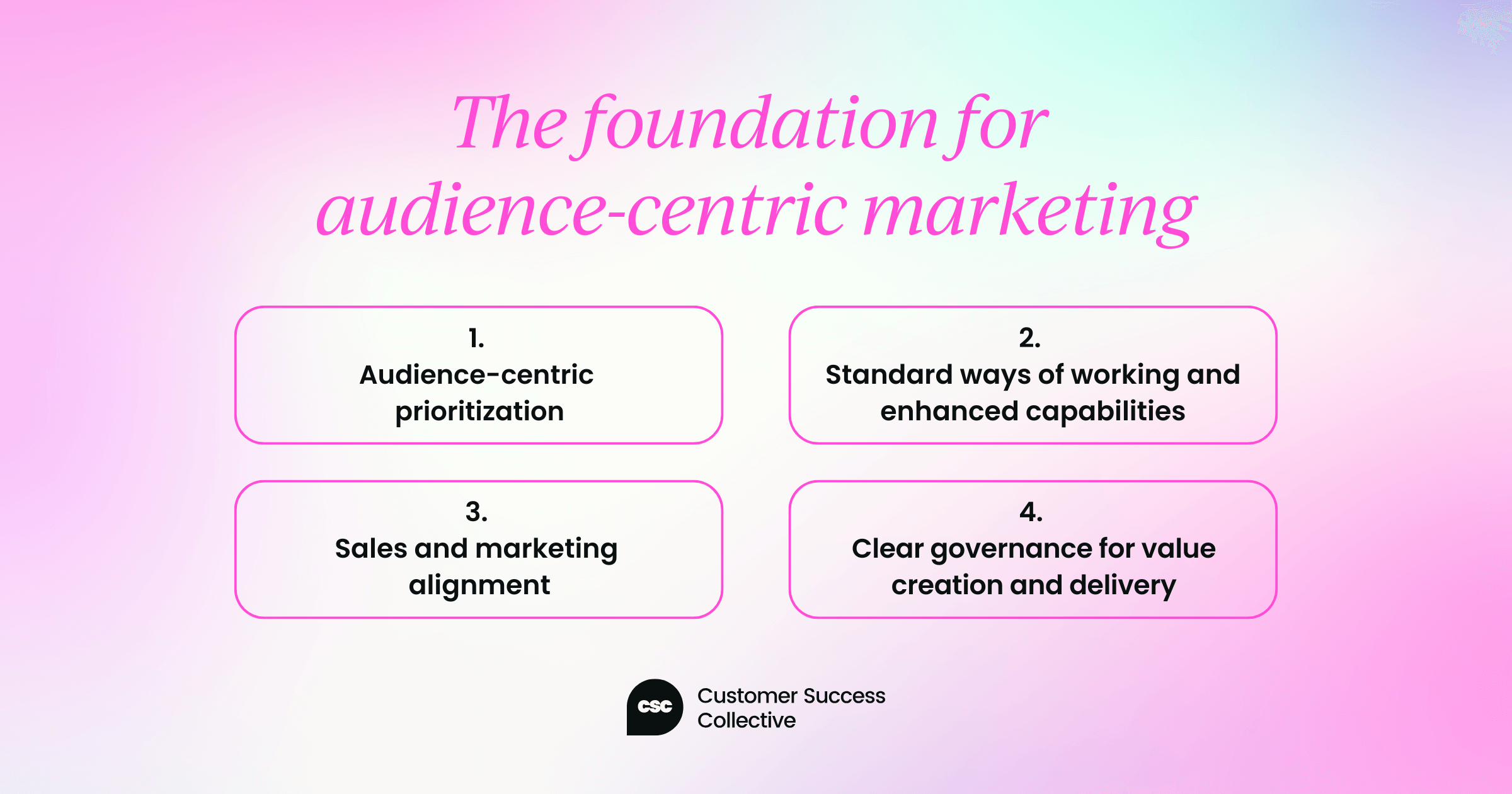
1. Audience-centric prioritization
The first question we tackled was: What does it actually mean to be audience-centric? It’s a term that sounds great in theory, and you’ll find countless articles on it if you search online. But we needed to define what it meant specifically for Philips.
In healthcare, being audience-centric meant identifying the distinct groups involved in purchasing decisions.
For example, in radiology, the audience wasn’t just the radiologist—it also included department heads, nurses, hospital executives, and, in some cases, policymakers like the Ministry of Health.
Across all of our healthcare segments, we initially identified 20 audiences, but soon realized this was unmanageable with our current resources. We prioritized and narrowed it down to 10 core audiences.
This forced us to make tough choices. While some stakeholders weren’t thrilled, prioritization was critical to ensuring we could support each audience effectively. Once the audiences were identified, we analyzed their needs and asked: How can our products, services, and solutions address their pain points?
This flipped our marketing approach. Instead of starting with, “What products do we want to promote?” we asked, “What do our audiences need, and how can we help?”
2. Standard ways of working and enhanced capabilities
A major barrier to efficiency and improvement was the lack of standardization. Everyone worked differently—different timelines, different processes, even different definitions of what a campaign was. This made collaboration and capability-building nearly impossible.
We standardized marketing processes across the organization, aligning functions and geographies. For example, we synchronized campaign planning timelines so that teams weren’t working in silos or at cross-purposes. This allowed us to plan long-term campaigns—18 to 36 months—that spanned the entire customer journey, rather than short-term, ad hoc efforts.
We also redefined “campaign.” Previously, people referred to everything from a LinkedIn post to a trade show as a campaign. We shifted to defining campaigns as comprehensive initiatives targeting a specific audience across multiple customer decision journey phases, from awareness to loyalty.
3. Sales and marketing alignment
In a B2B environment, especially in healthcare, collaboration between sales and marketing is essential. We’re not selling simple consumer goods; many of our products—like CT scanners—can cost millions of euros. These decisions require input from sales teams, account managers, customer success teams, and service teams.
To align sales and marketing, we mapped the entire customer decision journey and ensured both functions were synchronized in terms of timing, strategy, and even terminology. For example, we agreed on shared goals and KPIs, like customer lifetime value (CLTV), so that success was measured consistently across functions.
This alignment also required governance. We established clear RACI (responsible, accountable, consulted, informed) models to define roles and responsibilities. In a democratic, matrix organization like Philips, this was crucial for ensuring accountability and avoiding decision paralysis.
4. Clear governance for value creation and delivery
Governance became the backbone of our transformation. With 3,500 healthcare marketers and 500 service and sales enablement professionals, moving the organization required coordination at every level.
We introduced a formal handshake process for collaboration. For example, if a team created content for a campaign, they had to “handshake” with the receiving team to confirm its use. This included signing off on budget allocation and reporting back on results. By formalizing these steps, we fostered greater accountability and trust.
Governance also helped us address inefficiencies in the use of data, insights, and shared measures of success. Shared metrics like CLTV encouraged cross-functional collaboration and ensured that every team was working toward the same objectives.
Audience-based thinking in practice
The transition to audience-centric marketing wasn’t without its challenges.
For example, in defining personas, we had to balance granularity with practicality. While radiologists in Tokyo and North America have differences, we applied the 80/20 rule to focus on shared characteristics and needs.
We also refined how we engaged different personas across the customer decision journey. For instance, during the awareness phase for oncology solutions, the Ministry of Health might be a key persona.
But during the consideration or evaluation phase, the focus shifts to department heads and purchasing teams. This level of detail required us to simplify complex frameworks into something operationally feasible.
The role of collaboration
Collaboration between marketing and sales wasn’t just a buzzword—it was an operational necessity. We co-created strategies for each segment, ensuring that disagreements were addressed before campaigns launched. This extended to customer success as well.
For example, we jointly ran programs during the loyalty phase, ensuring a seamless experience for customers post-purchase.
Nomenclature also played a critical role. Philips had grown both organically and through acquisitions, resulting in different teams using different terminology. Standardizing our language ensured that we presented a unified story to customers, regardless of which team they interacted with.
Accountability and shared success
One of the most impactful changes was introducing shared accountability for success. Whether it was through shared metrics like CLTV or formalized handshakes, every team had a role in driving results. This built trust, improved coordination, and ultimately made our organization more effective.
Through these efforts, we didn’t just transform marketing at Philips—we created a model of collaboration that could serve as a foundation for other functions, including customer success. By focusing on shared purpose, strategy, and measures of success, we positioned ourselves to deliver better outcomes for both our customers and our business.
The Philips transformation: lessons learned and reflections
The transformation at Philips was a significant journey—one that lasted about four years, depending on how you count it. The first two years were particularly challenging.
Despite having a mandate from the top, we faced immense pressure to demonstrate impact while still in the process of “building the plane mid-flight.” There were plenty of blood, sweat, and tears along the way, but also meaningful successes that made the effort worthwhile.
Building momentum through collaboration
One of the keys to success in any transformation is finding early adopters—those who are not only willing to embrace change but have the credibility and influence to bring others along.
As the saying goes, when driving change, about 30% of people will support you, 20% may resist, and the remaining 50% are undecided and need guidance.
For us, the early adopters were invaluable. They weren’t the ones dismissing headquarters with, “You don’t understand; it won’t work here.” Instead, they had experience, a willingness to collaborate, and a desire to create something better together.
Partnering with these individuals helped us build momentum and ensure that the transformation wasn’t just a top-down directive but a shared effort.
Moving from strategy to action
I’ve always been passionate about translating strategy into action. Coming from the mountains in northern Italy, near the Swiss border, I’ve developed a love for practicality.
Strategy is important, but its value lies in execution. It’s frustrating to hear organizations talk endlessly about customer centricity when so few truly embody it.
Customer centricity requires tough decisions, often ones that may not be popular. Leadership must not only support these decisions but actively champion them. This means having someone in the organization—a chief marketing officer, a chief customer success officer, or equivalent—who is empowered to advocate for the customer at the highest levels.
 Joseph Latteri
Key questions for assessing customer centricity
Through my experiences, I’ve developed a framework for evaluating whether an organization is truly set up for customer-centricity:
- Do you have shared customer decision journey mapping and nomenclature?
One of the first challenges we faced at Philips was the lack of a shared language around the customer decision journey. Different teams even called the customer decision journey phases by different names, creating confusion and inefficiencies. Breaking this barrier is critical to fostering collaboration across functions like marketing, sales, and customer success.
- Is there a chief marketing officer or chief customer officer, and who do they report to?
While customer centricity should be everyone’s responsibility, it often ends up being nobody’s responsibility unless someone is explicitly accountable for it. This person needs to have a direct line to the CEO to ensure that customer priorities are integrated into the organization’s strategy.
- During company meetings, how often is the word ‘customer’ mentioned?
A simple but revealing exercise is to listen for how often leadership references the customer during key events like town halls or press briefings. If the customer isn’t front and center in leadership’s messaging, achieving true customer centricity will be an uphill battle.
Collaboration and accountability
At Philips, we learned that collaboration must be backed by strong processes and governance.
Standardized frameworks like RACI (Responsible, Accountable, Consulted, Informed) were instrumental in defining roles and ensuring accountability. For example, we introduced a formal handshake process where teams had to sign off on their commitments, including budget allocation and reporting back on results.
This formalization fostered trust and ensured that collaboration wasn’t just lip service but a practical, measurable effort. It also helped bridge gaps between marketing, sales, and customer success, allowing us to co-create strategies and campaigns that resonated with our audiences across the customer decision journey.
A journey worth pursuing
Customer centricity is a journey, not a destination. While it’s easy to talk about being customer-focused, it’s much harder to put it into practice. Achieving true customer centricity requires professional collaboration, backed by standardized processes and a commitment to accountability.
Looking back on the Philips transformation, I remain deeply passionate about the potential for organizations to grow and thrive by prioritizing the customer. Whether you’re part of a new, nimble company or an established global organization, the principles of collaboration, standardization, and shared purpose can help pave the way to success.
It’s not an easy road, but it’s one that’s worth traveling.


Become a CSC Insider
Thank you for subscribing
Get exclusive insights, frameworks, and strategies from customer success leaders driving real business impact.
An email has been successfully sent to confirm your subscription.
 Follow us on LinkedIn