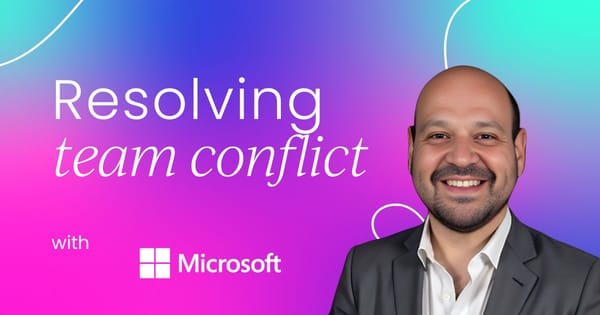











Every customer success leader eventually faces it, the moment when tension ripples through the team, when collaboration feels forced, and when what used to be a healthy debate turns into a distraction. Conflict, in this line of work, is not the exception... it's part of the job.
Customer success teams operate in complex, high-stakes environments. They’re balancing customer expectations, internal goals, and constant change. Each person brings a different background, communication style, and sense of urgency. When things get tough, friction surfaces. But when handled correctly, conflict can be one of the most powerful catalysts for growth, trust and performance.
In my own leadership journey, I’ve learned that the goal is not to eliminate conflict but to refine how the team navigates it. Here are the lessons and approaches that have shaped my view of resolving conflict within customer success organizations.
Understand the real source of conflict
The surface story is rarely the real story. When team members clash, it almost never starts because of personality differences or disagreements about process. More often, the conflict is rooted in misalignment, misalignment of expectations, ownership, or values.
Structure creates conflict, not personality
I remember one situation from my time leading a regional team of folks, from engineers to architects and support.
Two site leads were in constant disagreement over how to support a shared strategic deployment across two key sites in Latin America. One focused on protecting the relationship and ensuring smooth communication, while the other was intent on driving expansion.
Both were right in their own way, but their priorities collided because no one had clearly defined success for that stakeholder.
Once we aligned around a shared goal, one playbook, one customer plan, one message, the tension eased almost immediately. Neither person had to change their personality; they just needed clarity.
The lesson was simple: conflicts rarely start with people, they start with structure. Before assuming it is a relationship issue, check whether your system is forcing people into competition when it should be enabling collaboration.
Address it early, not after it becomes culture
When you sense conflict, act quickly. Silence gives it room to grow. Early in my career, I made the mistake of assuming time would smooth things out. It rarely does. Instead, tension festers and spreads quietly, shaping team norms in ways that are hard to reverse.
I once ignored a disagreement between two senior team members because their results were strong. Six months later, the entire team was divided into “sides.” Productivity had dropped, and collaboration was fractured. Fixing it required months of rebuilding trust that could have been saved with one honest conversation early on.
Now, when I see early signs of strain, tone in meetings, missed handoffs and side conversations, I address it directly. I start by listening to both sides separately, then bring the group together once I understand the perspectives. The conversation is never about blame; it is about clarity, empathy, and moving forward.
Leaders who address conflict early show their teams that candor and accountability are part of the culture. It is not about policing behavior; it is about protecting momentum.
Separate intent from impact
In customer success, you lead people who care deeply about customers and outcomes. And sometimes, that passion manifests as intensity. The trick is to separate intent from impact.
I once had a top performer whose communication style was very direct. Some peers viewed it as aggressive, but her intent was always to protect the customer’s experience. When feedback came her way, she was shocked. “I was just being efficient,” she said.
That moment reinforced the importance of coaching both perspectives. To her, I explained how her delivery impacted team dynamics. To the others, I highlighted her intentions. When both sides could see the full picture, they found balance.
People rarely wake up intending to cause friction. Our job is to help them see how their actions land, and how to adjust without losing authenticity.
Use feedback as a bridge, not a weapon
Feedback is one of the most powerful tools for resolving conflict, but only when delivered with precision and care. Over time, I have come to rely on a simple three-part model: context, behavior, and impact.
“During our customer meeting yesterday” (context), “you spoke over a teammate several times” (behavior), “which made it difficult for the customer to follow the flow of the discussion” (impact).
This method is factual, neutral, and focused on improvement. It takes emotion out of the delivery but keeps empathy in the message. I have taught this approach to every team I have led, and it fundamentally changes how people give and receive feedback.
When you build a shared language around feedback, you reduce defensiveness. People stop waiting for leadership to step in and start resolving issues with one another directly. That kind of maturity is a hallmark of a strong CS culture.
Encourage healthy debate
One of the biggest misconceptions in leadership is that harmony equals health. I disagree. A team that never debates is not a team that is aligned; it is a team that is disengaged.
Customer success is inherently cross-functional. You have people with different views – technical specialists, relationship managers, data analysts, and renewal owners – all seeing the customer journey from their own angle. Productivity should be the mark of disagreement. How can you turn this clash into something positive?
At a leadership gathering several years ago, I had two managers in a heated discussion about how to handle enterprise renewals. One wanted tighter governance, the other wanted flexibility. But instead of stepping in to end it – which is the knee-jerk reaction for any kind of conflict – I reframed it; I asked each to argue the opposite position for 10 minutes. The conversation transformed. They found middle ground and later co-designed a model that became our new standard.
I’m a firm believer that healthy conflict actually builds better strategy, but the key is to keep the debate focused on ideas, not individuals.
 Danielle Martin
Coach through conflict, do not dictate
When leaders handle conflict by simply issuing directives, they might solve the short-term issue but miss the long-term growth opportunity. Coaching through conflict builds resilience.
I often start by asking questions that shift the focus from positions to principles:
- “What outcome are you both trying to achieve?”
- “What would success look like for the customer?”
- “Where might assumptions be getting in the way?”
You see, these questions guide people back to shared purpose, encouraging accountability rather than dependency. The goal isn't to win an argument, but to rediscover alignment.
And this is the best part: when your team learns to resolve issues on their own, you’re no longer the referee, but the enabler of a newfound maturity.
Recognize the emotional layer
Despite my earlier point about conflict being about structure, not personality, it's no good pretending conflict is purely operational. It's not some mechanical thing that logic alone can resolve. You’re dealing with real people, with real emotions.
Customer success professionals spend their days navigating pressure, demanding customers, changing priorities, and constant visibility. Even small misunderstandings can trigger strong reactions when someone is already stretched thin.
I make it a point to understand where my team is emotionally, not just operationally. If someone starts responding sharply or withdrawing from discussions, that’s a signal. It may not be defiance; it may be fatigue or burnout.
I had a team member who was usually very collaborative, but suddenly they became defensive in every meeting. It was a real head-scratcher; totally unlike them. Not wanting things to get out of hand, I had a one-on-one conversation with them and learned they were struggling with a particularly difficult customer and felt they were letting the team down. We reassigned part of their workload, clarified expectations, and gave them space to reset. Within two weeks, their entire attitude shifted.
It’s important to pause here and remind ourselves that empathy isn't about being gentle. It's a deliberate approach. Noticing the emotions involved in a conflict helps stop minor issues from growing into major ones.
 Jenelle Friday
Set the tone: Model the behavior you expect
Your team is always watching how you handle tension, taking their cues from you. If you want them to handle conflict with composure and respect, you need to show them what that looks like under pressure.
I once had two teams blaming each other after a customer escalation that went awry. Sure, it would have been easy enough to assign responsibility to both parties – wash my hands of it, so to speak.
Instead, I took a different route; I called a joint meeting and started by taking ownership of the lack of clarity that had led to the breakdown, and – I kid you not – the entire tone of the meeting immediately changed. Both sides immediately followed suit, acknowledging where they could have communicated better, and within an hour, we had a joint recovery plan and a stronger working relationship than before.
Don’t forget your role in shaping team culture; your example becomes their gold standard. If you lead with transparency and accountability, they will too.
Turn conflict into a learning loop
It's tempting to move on quickly after a difficult moment – to just be glad it's over. But that's a missed opportunity. Conflict can either divide or develop a team. The difference lies in what happens afterward.
After any major disagreement or issue, I make time for reflection. What triggered it? What signals did we miss? What can we adjust in our structure, process, or culture to prevent it in the future?
This approach turns every conflict into data, a feedback loop that strengthens the organization. I know that might sound clinical, like I'm reducing human emotions to spreadsheet rows. But it's the opposite. When you treat conflict as information rather than failure, you take away its power to divide. But over time, it transforms tension from something people fear into something they can navigate confidently.
Teams that can debate, resolve, and move forward quickly are the ones that innovate faster and deliver more consistent customer outcomes.
 Virginia Bloom
Final thoughts
Conflict within CS teams is not necessarily a sign of dysfunction – so don’t panic and run for the hills if two of your team members start disagreeing. It’s a signal that people care deeply about doing what is right for the customer and the company. The real question isn't whether conflict will happen, it's how you, as a leader, choose to respond.
When handled with empathy, clarity, and fairness, conflict becomes a driver of trust. It sharpens focus, builds emotional intelligence, and strengthens team identity.
The most effective CS teams channel tension to enhance collaboration rather than to undermine colleagues. Leadership in this space requires patience, perspective, and courage. When you create a culture where conflict leads to understanding, not division, you unlock the kind of psychological safety that turns good teams into great ones.


Become a CSC Insider
Thank you for subscribing
Get exclusive insights, frameworks, and strategies from customer success leaders driving real business impact.
An email has been successfully sent to confirm your subscription.
 Follow us on LinkedIn