





What if growing your customer base didn't mean growing your team at the same rate? For most CS leaders, the instinct when volume increases is to hire, but that model breaks down fast.
Costs spike, Customer Success Managers (CSMs) burn out, and strategic work gets swallowed by reactive firefighting.
Having scaled revenue from zero to $300M at one organization, $10M to $40M at another, and $5M to $20M at a third, the lessons from each phase point to the same conclusion: scalability isn't a hiring problem. It's a systems problem.
This article covers five core strategies for building a CS operation that can handle serious growth, why churn is never just a CS problem, and why treating it as one is one of the most damaging mistakes a CS leader can make.
Busy isn't the same as productive
The first thing to diagnose is whether your team is being active or actually effective. In most CS orgs, everyone's slammed: manual check-ins, ticket responses, internal meetings, ad hoc reporting, one-off requests. Ask any CSM, and they'll tell you they couldn't possibly take on more.
But being busy isn't the same as being productive.
The real question is whether that work is driving outcomes. Are all those emails actually increasing product adoption? Are the calls moving customers forward, or just answering questions? It's worth setting up a clear rubric so your team is measuring outcomes – activation, adoption, expansion – rather than just counting calls and response times.
Segment your customer base
Here's a pattern that holds across almost every SaaS business: sort your customers by ARR and you'll find that:
- The top 10% account for roughly 25–30% of revenue
- The next 15% add another 33–40%
- Together, just 25% of your customers are generating the vast majority of your revenue
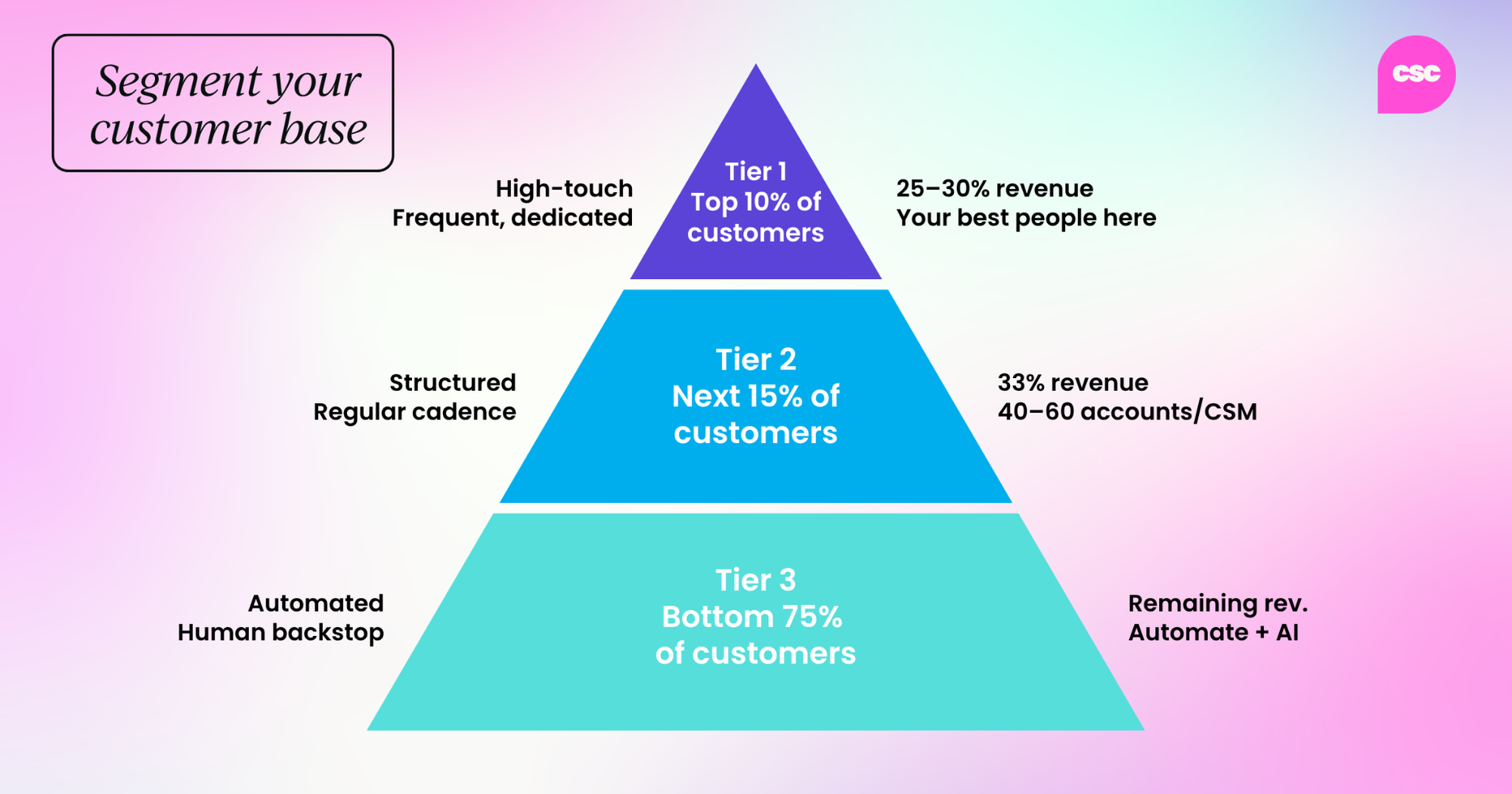
Losing any one of your top-tier accounts will show up in your churn numbers immediately. That has real implications for how your team spends its time.


Become a CSC Insider
Thank you for subscribing
Get exclusive insights, frameworks, and strategies from customer success leaders driving real business impact.
An email has been successfully sent to confirm your subscription.
 Follow us on LinkedIn