












Customer support often flies under the radar until something breaks.
When queues are long or customers are frustrated, support suddenly takes center stage. But when everything’s running smoothly, we’re invisible by design: quietly removing obstacles, resolving issues, and keeping the business moving.
The truth is, support teams hold a gold mine of insights about your product, your customers, and your company. Yet too often, that expertise goes untapped.
At a time when efficiency is everything and AI is transforming how we work, there's a unique opportunity to reimagine the role of support. By unlocking the skills within our teams, embracing technology, and forging cross-functional connections, we can elevate support from a reactive function to a strategic powerhouse.
This is how we shift the narrative and uncover the hidden gems within customer support.
Move from reactive to strategic
So, how do we unlock the full potential of the support team and create a greater impact?
- Identify and recognize the expertise and insights that already exist within your team.
- Supercharge support with technology to create space for higher-value work.
- Leverage our unique proximity to customers to amplify the customer voice inside the business.
- Understand company strategy: what’s driving decisions, what obstacles leadership is facing, and where support can play a role.
- Advocate and connect across departments, weaving support expertise into product development, marketing messaging, and strategic planning.
These are the hidden gems of customer support, and when we take the time to unlock them, we can truly change the way support is perceived and valued across the business.
Discover the personas within your team
One of the first steps to unlocking the full potential of your support team is identifying the skill sets and unique personas that already exist within it. Support professionals show up in many different ways, and it’s important to recognize and value those strengths.
Let me introduce you to a few of the personas I see most often.
The educator
These are the folks who can take complex concepts and break them down for customers in ways that just make sense. They’re often the ones with the highest customer satisfaction ratings. They thrive on making things clear and accessible.
The detective
These team members never shy away from tough tickets. They dive headfirst into complex issues, chasing root causes and solving tricky problems. Often, these are your more technical folks, the ones working on bugs, incident management, and process optimization.
The innovator
Innovators are constantly learning and experimenting. They don’t stop at surface-level solutions; they go deeper, trying new things and refining processes. You might see them leading workshops, digging into quality assurance, or proposing improvements.
The connector
These are your natural relationship-builders. They translate customer feedback into meaningful internal dialogue, and they bridge teams. You’ll often find them playing the role of feedback liaison, cross-functional collaborator, or community advocate. Their strength lies in communication and empathy.
The hidden influencer
Throughout my career, I’ve sat on both sides of the pre- and post-sales divide. No matter where I sit, I find myself constantly thinking about how to influence revenue. And behind all of these personas, there’s an influencer.
Support professionals have the power to shape customer behavior. They help drive activation, improve adoption, and even influence expansion and retention. In many ways, they’re an extension of your sales development team – surfacing leads and opportunities – and of your customer success team – educating and guiding customers toward value.
These personas aren’t exhaustive, and they definitely aren’t mutually exclusive. One person can embody several at once. When you take a step back and look at this cast of characters, you realize just how far from “just a cog” your support team really is.
Listen to unlock insight
Another critical part of unlocking potential is understanding the insights and feedback your team is already holding. And to do that, you have to make time for genuine conversations. You have to listen.
It sounds simple, but it’s easy to overlook in the daily grind. Make the effort to connect with your team. Ask about what they’re experiencing, not just with customers, but internally. What’s frustrating them? What ideas do they have? Where are the friction points?
When I started at Typeform, we were drowning in tickets. No matter how much effort the team put in, the queue wouldn’t go down. And there was a narrative floating around about why, but it just didn’t add up.
So, I sat down with every single person in the department. One-on-one. I let them talk it out. And slowly, the real picture came into focus.
There were so many factors at play. The team was working hard, but they were feeling stuck. People who were transitioning into new roles couldn’t even get out of the queue to start onboarding. They were frustrated. They weren’t growing. And some had even started saying things like, “I don’t think anyone’s listening. I’m just going to stop talking.”
That is devastating to hear.
The worst thing that can happen in your company is for support and success teams to go silent. Because when they do, you lose the voice of your customer.
Advocate, connect, grow
It’s absolutely essential to understand what motivates your team. Who are they talking to? Who are they not talking to? What’s getting in their way? And as a leader, you need to take a hard look at yourself: Are you advocating for your team? Are you making space for their voices and leveraging their expertise?
At Typeform, one thing we’ve introduced is a growth hub, a simple, ad hoc tool where individuals and managers can log skills, interests, areas of expertise, and even current projects.
It’s not fancy, but it works. I can go in, search for a specific strength or interest, and quickly find the right person for a new initiative or mentorship opportunity. It’s helped us identify hidden talent and surface new ways to collaborate.
When you take the time to observe your team’s strengths and really listen to their feedback, you gain insights that impact far more than just support metrics. You get a clearer view of the motivations, frustrations, and opportunities that shape your customer experience, and you create pathways for your team to contribute meaningfully to product development and business growth.
Create space through technology
Understanding our team is one thing, but how do we actually give them the time and space to execute on their strengths?
No surprise here: one of the most effective ways is through technology. At this point, most of us are experimenting with AI in some form. And let’s be honest, our inboxes are flooded with messages from products promising to reduce time to response and lower overhead.
But while AI tooling holds a lot of promise, it also brings a fair amount of uncertainty. Many of us have heard the quiet rumblings from team members wondering what this all means for their roles. It might not be said outright at first, but eventually those questions start surfacing: What does AI mean for me? Will I be replaced?
The truth is, AI isn’t our competitor. It’s a capacity expander. If we use it effectively, it gives us the space to go deeper – to bring more of our human expertise, critical thinking, and empathy into every customer interaction.
Merging tech with the human touch
Technology doesn’t replace the human element, it enhances it.
Take deflection, for example. By using AI to answer transactional or repetitive questions through self-serve resources, we free up our team to focus on complex, high-impact tickets. That opens the door for us to go beyond problem-solving. We can consult, offer recommendations, and truly elevate the customer experience.
At Typeform, we use tools to extract feature requests and feedback directly from tickets. Instead of manually reviewing thousands of interactions, we work from a curated list.
Our support team can add qualitative commentary that makes it easier for cross-functional partners to understand customer sentiment and trends. That’s how we help amplify the voice of the customer.
Leverage frontline insights for impact
So we’ve mapped out our team’s skill sets, listened to their feedback, and brought in technology to support their growth. Now comes the next step: leveraging our firsthand customer experience to drive even broader impact.
Support is in a unique position to see exactly where customers are hitting friction. We can inform where a product enhancement, marketing campaign, educational resource (or even just a better bot or human handoff) can make a real difference.
Most of my career has been in product-led growth environments, where customers often enter through a freemium model and then scale into paid plans.
In these models, customer touchpoints are limited, so every interaction counts. That means every conversation with a customer is an opportunity to uncover insights, identify blockers, and help them move seamlessly through the experience.
No one has more exposure to the full customer journey than the support team. We’re handling hundreds of interactions every day. We know what’s resonating. We know what’s frustrating. And we can clearly communicate that back to the business with empathy and context.
Helping the company feel the customer
One of the most powerful things support can do is help the company feel what the customer is experiencing. We've all been in those moments where a customer issue gets "resolved" with a fix that clearly misses the mark. You can feel it the second you read the resolution: This is not what the customer was asking for.
Support is the team that can bridge that gap. We can go back to product and say, “Here’s what they actually meant. Let me walk you through it.” And on the flip side, we’re also the team that can celebrate when improvements hit the mark. We get to see the delight firsthand. That feedback is just as important to share – it builds momentum, drives morale, and helps refine the product even further.
We also have a keen sense of the data we need to serve customers better. What do we need to triage faster? What information helps us diagnose and solve problems more efficiently? That’s another reason support is a critical gut check for the company.
Recognize that support is your organization’s reality check
Your research or data teams might define your ICP, outline use cases, or map out the customer journey. But support is the team that can validate whether that journey is actually unfolding the way you think it is.
We’re on the front lines. We see how things play out in the wild.
One thing we’ve implemented at Typeform is a monthly cross-functional session that includes voices from every go-to-market team. Each group shares key insights – from internal workflows to customer interactions. Support has a big presence in these meetings. We often see consistent themes month after month, and we make sure those are heard, loud and clear.
We don’t just describe the issues; we show real customer stories. And that creates a meaningful opportunity for product and other teams to respond thoughtfully and with urgency.
By continuously sharing what we’re hearing and what we’re seeing, we ensure that support is more than a ticket-solving function. We become a trusted source of truth – and a strategic voice in the company’s ongoing development.
Aligning with company strategy
So we’ve identified the strengths on our team. We’ve listened to their feedback. We’ve used technology to give them breathing room. And we’ve tapped into our customer experience to inform broader strategy. Now it’s time to make sure we have a clear line of sight into the goals and needs of the company.
This means understanding your company’s strategy – what it's trying to accomplish, where the gaps are, and how support can align to help fill them. Sounds straightforward, but here’s the hard truth: support often gets left out of the room when strategic planning happens.
Sure, we all have our service stats. But how many of us are actually included in annual planning sessions? Some are. But many aren’t.
Support has value to contribute – strategically. We need to be involved early, so we can align our work and amplify our impact. That starts by deeply understanding both our internal and external stakeholders – their goals, their pressure points, and how we can help.
For example, think about QA. That team is often under-resourced. But who better to help test a product than support? We know exactly how customers will push the product’s boundaries. We know the shortcuts, the hacks, the odd behavior patterns.
At Typeform, support acts as early testers, and I’ve seen this done well at other companies, too – especially when individual agents have an interest in product or engineering.
Or take roadmap planning. Support should absolutely be at the table for those discussions. We know which long-standing issues need prioritization. We can speak to the volume, the intensity, and the customer impact of those pain points. That’s crucial input for prioritizing what to build and when.
Becoming a strategic hub
To do this effectively, we need to build strong cross-functional workflows. That means having clear points of contact across teams – product, engineering, QA, sales, customer success, incident response, feedback triage, and more.
Support shouldn’t be operating on the sidelines. We should be integrated into the flow of work across the company.
When that happens, something powerful emerges: support stops being seen as a reactive cog and starts being recognized as a strategic customer team hub. We become the team that feeds critical data, insight, and experience into every corner of the business.
And let’s be clear, regardless of whether "sales" is in our job title, we are all revenue drivers. A bad support experience means customers won’t land, won’t expand, and won’t stay. Our work is essential to the company’s success.
The evolution of the customer support role – in action
So now we’ve come full circle. Let’s recap:
- We know our team and the expertise they bring.
- We’ve listened to their feedback.
- We’re using technology to free up their time and capacity.We know our customers and what they’re experiencing.
- We understand our company and where it’s headed.
Now it’s time to connect the dots. If we go back to our earlier characters – the educator, the detective, the innovator, the connector, and the influencer – what kinds of roles might they grow into?
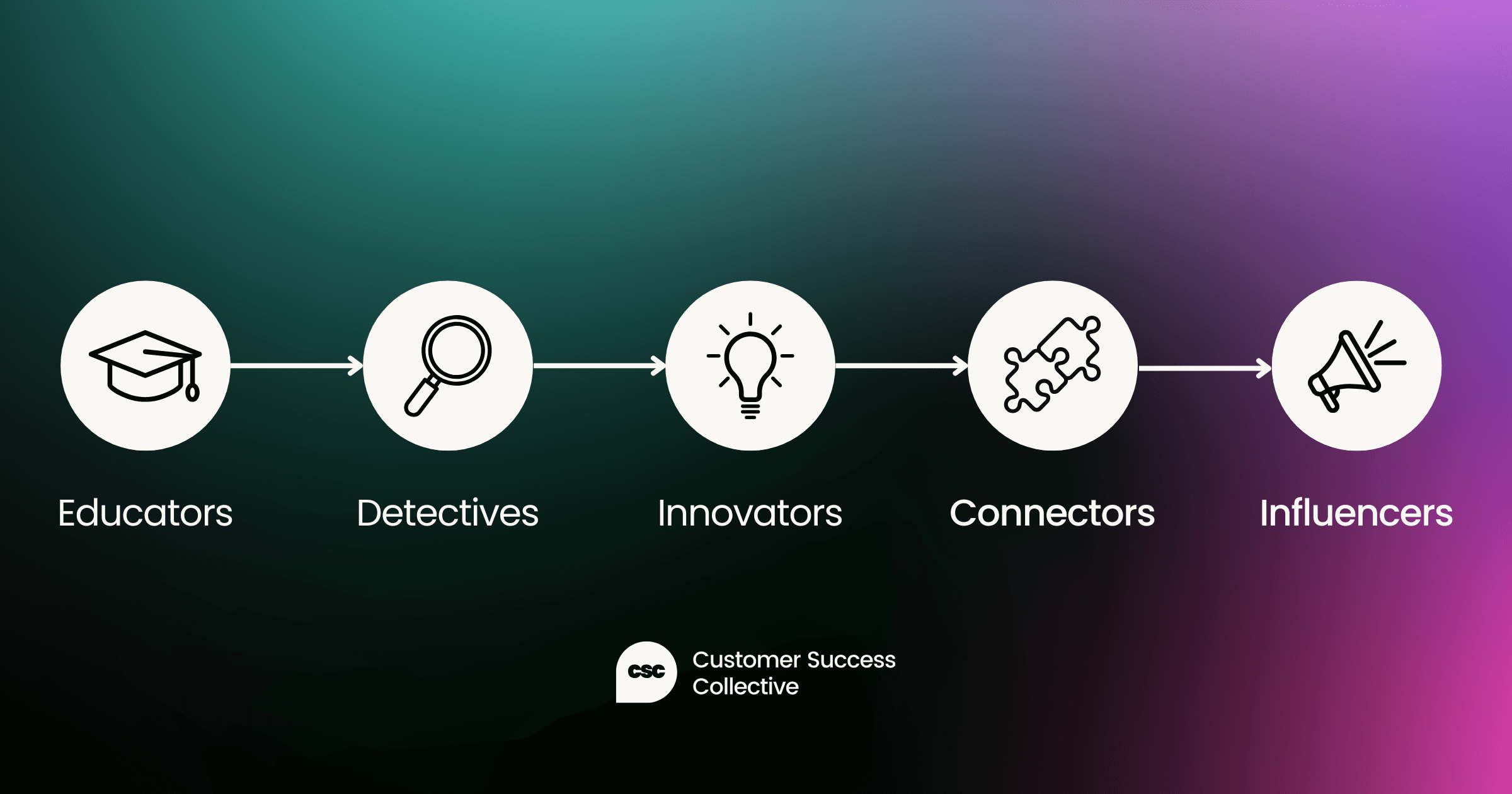
- Educators can lead customer journey mapping, host trainings, moderate webinars, or step into community and education roles.
- Detectives can conduct risk assessments, drive Help Center audits, run troubleshooting office hours, or evolve into solutions engineers.
- Innovators are ideal for QA, usage reviews, and account workshops – paving a path to professional services.
- Connectors can handle escalations, gather customer stories, weigh in on pricing strategies, and serve as voice-of-the-customer leads or escalation managers.
- Influencers are built for scale programs – think digital customer success, implementation support, or referral enablement.
These personas can evolve into full-fledged roles with clear development pathways. But how do we build toward that across the organization?
At the company level
- Support inputs for roadmap prioritization and health scoring.
- Cross-functional collaboration on Q&As, escalations, and shared insights.
- Experiments: Pilot new programs (like digital CSM or onboarding support) using support resources.
- Strategic development: Contribute to customer profile refinement and company L&D initiatives.
At the team level
- Run special projects (e.g., AI bot refinement, customer recommendations, cross-department training).
- Build out specialized skill tracks (e.g., tech support, billing, security, consults).
- Promote mentorship and peer development to elevate the entire team.
At the client level
- Add consultative layers to support – go beyond the ticket to offer account recommendations.
- Embed support in scale programs, like co-hosting webinars or leading tune-up sessions.
- Facilitate customer interviews, feedback sessions, and education outreach.
This is how we break the mold. This is how we stop being a back-office function and start being a business driver.
From hidden gem to strategic powerhouse
We started with that hardworking team – the one full of expertise and insights – operating quietly in the background, looking around to see if anyone had noticed.
And we’ve moved toward something far more powerful: a team that contributes directly to strategic company development, influences customer behavior, and supports cross-functional initiatives.
We’ve unlocked potential by:
- Identifying our team’s unique expertise and perspectives
- Leveraging technology to expand our bandwidth
- Sharing our frontline knowledge of the customer experience
- Understanding and aligning with company goals
- Connecting across departments to create opportunities
And in doing so, we’re driving real impact while still working efficiently and effectively.
The ripple effect of customer support’s evolution
Support is no longer just a reactive cost center — it’s a lean, expert-driven growth engine. With legacy knowledge, frontline insight, and cross-functional agility, this team drives impact across the business.
Internally, morale and performance rise when support professionals are empowered to grow and lead. Line managers and team leads shift from queue management to talent development, and that momentum spreads.
Externally, customers feel the difference. Support is now integrated across the entire journey, offering insights that shape product, education, and marketing.
This isn’t a team hoping not to be replaced by AI – it’s the team powering transformation.
They are the experts. The connectors. The strategic voice of the customer.
It’s time to stop treating support as a fallback function and start recognizing it for what it is: the untapped jewel of your company.


Become a CSC Insider
Thank you for subscribing
Get exclusive insights, frameworks, and strategies from customer success leaders driving real business impact.
An email has been successfully sent to confirm your subscription.
 Follow us on LinkedIn



Start the conversation
Become a member of Product Marketing Alliance to start commenting.
Sign up now