











Did you hear that? That’s the sound of a quiet shift happening in boardrooms everywhere. Once, the loudest voices came from sales, finance, or product teams. Today, customer success (CS) is earning its place not because it demands attention, but because it brings something every board and C-suite now craves: foresight.
I’ve spent nearly three decades across cloud, customer experience (CX), and enterprise leadership, and I've watched customer success evolve from a support function to a strategic growth driver. But the reality is that many organizations hit the same wall: they don't know how to translate that potential into boardroom influence.
If we, as CS leaders, want to shape decisions at the top, we need to move beyond retention and satisfaction metrics. We must speak the language of business, anticipate outcomes, and connect our insights to the company’s core strategy.
Here’s what I've learned and what I recommend to every CS leader who wants to earn influence where it matters most.
Translate customer success into C-suite language
Early in my career, I presented a quarterly update filled with the typical CS metrics: NPS, adoption rates, and support resolution times. I was proud of the results. But our executive leadership? Not so much. Don’t get me wrong, it wasn’t because our numbers were poor; they just couldn’t connect these metrics to the company’s financial narrative.
But that was a turning point for me because I realised that my then-company’s board did not speak in customer success metrics. NPS meant nothing to them. Of course, they understood the principles of what a net promoter score was, but it didn’t matter to them. Now, outcomes? Outcomes they understood. Revenue, margin, risk, and growth velocity. This is a language they could get behind.
So, the moral of the story is this: if you want to drive decisions at that level, start translating. Here are a few ways to start translating in your own day-to-day:
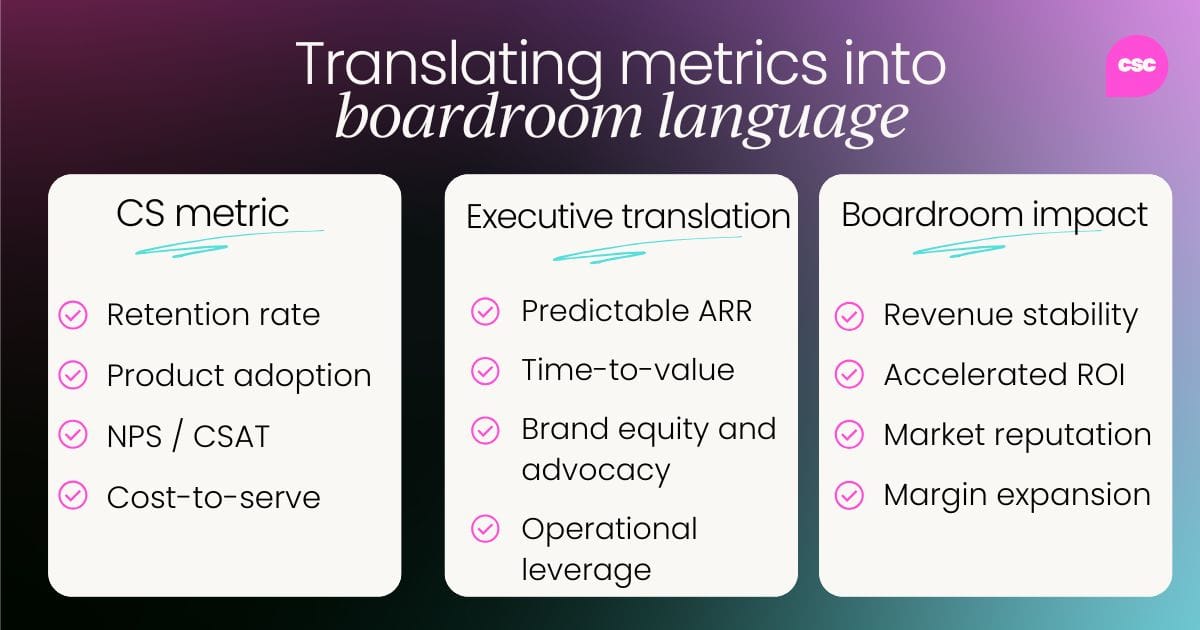
Translating customer retention
Customer retention becomes predictable annual recurring revenue. Tie your renewal rate directly to revenue forecasting. When you can show that a three-point lift in retention equates to millions in recurring revenue, you aren't just managing churn anymore. You're influencing investor confidence.
Translating adoption
When talking about adoption, re-frame it around time-to-value. Don't talk about adoption rates, but rewrite the narrative – every day shaved off deployment accelerates payback, increases product stickiness, and shortens the expansion cycle.
Translating sentiment
Customer sentiment becomes brand equity. Use satisfaction data to quantify the market reputation and advocacy value your company earns through customer loyalty.
Executive leadership don’t want to know what you measure. They want to know why it matters to enterprise value.
Predict, don’t just report
Customer success leaders should be the ones walking into those meetings with forward-looking intelligence. Churn analysis won’t quite cut it – you need to be armed with future risk and opportunity forecasts.
If you have access to engagement data, product usage, or behavioral telemetry, use it to build early-warning and opportunity models, and then present those insights like a portfolio strategist would. Here are a few examples:
- “Based on engagement patterns, these five accounts represent 60 percent of next quarter’s expansion potential.”
- “Our early-warning model shows a retention risk trend among customers with declining feature utilization over thirty days.”
- “Cross-analysis indicates that increased digital adoption correlates with a twenty percent reduction in service cost-to-serve.”
Those at executive-level will never forget the leader who can see around corners. Predictive success modeling is how CS earns that credibility.
Tie success directly to strategic objectives
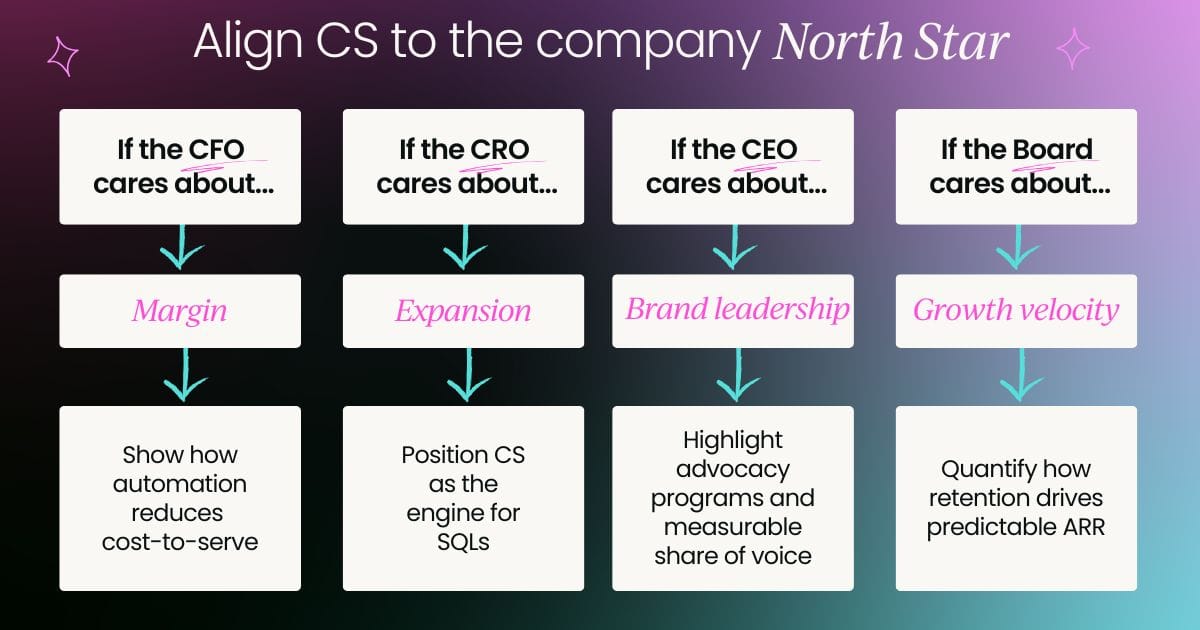
Every board operates with a defined north star. Maybe it’s market share, profitability, or ecosystem expansion. Whatever it is, your influence depends on your ability to align CS to that north star.
If your CFO is focused on margin, highlight how automation in customer engagement reduces cost-to-serve and improves operational leverage. If your CRO is focused on expansion, position CS as the engine for identifying Success Qualified Leads (SQLs) that feed the sales funnel. If your CEO is focused on brand leadership, show how your customer advocacy programs translate into measurable share of voice and trust metrics.
Trust me when I say alignment is an influence. When the board can clearly see that customer success accelerates the company’s primary objectives, your insights stop being optional and become indispensable.
Bring the customer’s voice into the room authentically
One of the most powerful things a CS leader can do is act as the customer’s advocate when the customer isn't present.
And I'm not talking about a half-baked anecdote you've recalled on the spot, but actual evidence-based storytelling.
When I presented to senior executives, I used a simple but powerful approach: pair one real customer story with one measurable business outcome. For example, “A healthcare provider reduced patient onboarding time by 30% through adoption of our platform, which translated to $4M in additional throughput per quarter.”
This approach makes the data human and the story undeniable. It is not just empathy; it is proof of impact.
When the board sees customers as living examples of strategic value rather than abstract users, customer success becomes the connection between vision and execution.
Build cross-functional influence before you need it
A CS leader’s power in the boardroom depends on the strength of their relationships across the organization. Anyone who's been around long enough will tell you that influence isn't something granted, but accumulated.
Which stakeholders should you target?
Start with your CFO. They care about predictability and efficiency, so show how customer data forecasts revenue risk and improves margin. Your next play is to partner with product to quantify the downstream value of new feature adoption. Then, you're to collaborate with sales to align expansion opportunities with success planning.
After following these steps, by the time you present it to the board, your insights should already be woven into the narrative of every major function.
In my own experience, some of the most impactful board conversations happened actually well before the meeting, in quiet one-on-one discussions where data and empathy converged. That is where trust is built, and trust is what gives your insights weight when it is time to decide.
How to lead with insight and humanity
Don’t underestimate the human element of influence
Customer success leaders sit on a mountain of insight, but influence often depends on how that insight is delivered. Dashboards inform; narratives inspire. When you tell a story such as, “Over the past six months, customers adopting our new analytics module realized ROI twice as fast as those who didn’t,” you’re not showing data; rather, you’re showing direction. Numbers earn attention, but narrative is what earns conviction.
The most effective leaders balance precision with empathy. They know that every metric represents a person, a business, or a transformation. “Here’s what the numbers show” should always be followed by “Here’s what it means for the people we serve.”
Use data to tell stories, not just summaries
When you walk into an executive or boardroom, whatever you do, just don’t lead with slides. Instead, lead with a story that illustrates what the data cannot. Trust me when I say another run-of-the-mill slide deck will force the most patient CEO to start thinking about their next meeting. It’s this carefully tailored blend of truth, evidence, and empathy that cuts through noise.
Ultimately, decisions aren’t made on data alone; they’re made on conviction. And conviction is built by leaders who connect business outcomes with human impact.

Connect customer success to capital allocation
Few CS leaders realize just how much of their data influences investment strategy. Or perhaps I should say could, if it’s framed correctly.
Imagine presenting a board analysis that says:
“Our top quartile customers generate eighty percent of expansion revenue and share three common characteristics. They are digitally mature, co-innovating, and have executive sponsorship. Investing in similar customer profiles could yield a twenty-five percent higher lifetime value.”
That isn’t a retention report. What you’ve actually got is far more valuable – an investment thesis.
When customer success teams start shaping how capital is deployed into products, markets, or customer segments, they stop being a downstream function and become a compass for corporate growth.
Don’t wait for the board, bring them to the customer
One of the best recommendations I give to CS leaders is to invite the board into the customer journey.
Host executive roundtables. Arrange customer innovation briefings. Curate sessions where key clients share how your company’s solutions have changed their trajectory.
In my experience, these interactions do far more than any presentation could. When a executive leadership hears directly from a customer about a transformation made possible by your team’s work, it reframes the conversation from customer satisfaction to strategic partnership.
You’re no longer talking about outcomes... you’re showing them.
Elevate customer success to a strategic imperative
This is where we are headed. The future of CS is not about renewals or satisfaction scores. It is about governance and growth strategy.
Boards are already recognizing this. You can see it in how NRR is becoming a top performance metric alongside profitability and market share. Investors and analysts now scrutinize customer retention curves with the same intensity once reserved for sales growth.
This means the CS leader of tomorrow must provide predictive models that feed revenue forecasting, identify growth clusters across the customer base, quantify the business impact of adoption and advocacy programs, and embed customer insights into ESG, innovation, and risk frameworks.
Customer success should no longer be relegated to “post-sales.” It’s the operating system for sustainable growth.
My closing thoughts
My challenge to every CS leader reading this is simple. Don't wait for the board to invite you in. Walk in ready to teach them something about their own business that they did not already know.
When you do that, when you bring clarity, foresight, and truth from the customer frontlines into the executive suite, you aren't just representing CS anymore, but you're helping lead the company forward.


Become a CSC Insider
Thank you for subscribing
Get exclusive insights, frameworks, and strategies from customer success leaders driving real business impact.
An email has been successfully sent to confirm your subscription.
 Follow us on LinkedIn