












Customer success professionals like you create a huge amount of value. You guide customers through complex, high-stakes renewals, protecting revenue and stabilizing accounts. But here’s the question that keeps popping up for CSMs and CS leaders everywhere: Are you being compensated for the value you deliver?
Data from the 2025 Customer Success Salary Report shows us that salaries aren't fixed. They move – sometimes dramatically – based on what you choose to learn, where you choose to work, and how you position yourself. And the data makes it very clear which levers matter most.
Let’s break down the 10 most powerful, data-backed ways to increase your CS salary in 2026, using real insights from the report – not guesswork.
1. Build a meaningful experience arc
One of the strongest stories in this year’s data is the simple fact that experience pays, and it pays well. Not because time alone is valuable, but because customer success is a discipline built on judgment, and judgment only comes from living through enough cycles to recognize patterns before others see them.
And we can see that reflected clearly in the numbers. Someone in their first year earns a median of $57,850, but by year five, that number jumps to $90,000, and by year eight, it reaches $123,250. 10 to 19 years of experience lands around $150,000, and veterans with 20 or more years now sit at an impressive $190,000.
But don’t be fooled into thinking this is linear growth. It’s more of an acceleration – the kind that comes from mastering the subtleties of customer behavior, internal alignment, stakeholder management, renewal psychology, and risk anticipation. It’s not that seasoned CS leaders work harder; it’s that they work from a deeper well of understanding.
And here’s the real nuance: experience only becomes earning power when you actively articulate the value of that experience. Don’t assume your line manager sees how far you’ve come. It's your job to connect your background to the business outcomes you influence today. Experience only becomes currency once you make its impact visible.
2. Invest in product and sales training
You’re doing professional development all wrong if you consider cross-functional training as a “nice to have.” We can see that when CSMs and CS leaders have access to product and sales training, their salaries are considerably higher than those who don’t. In fact, it’s one of the clearest salary differentiators in the entire report.
CS professionals who received both product and sales training earn a median of $112,560, which is 34% more than the $84,000 median for those with no formal training at all.
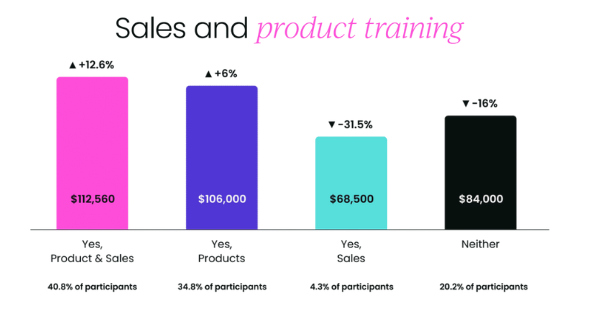
That’s not a coincidence. Customer success has become increasingly commercial and increasingly technical. It’s no longer enough to be great with people – companies now expect CSMs to understand the product deeply, articulate ROI clearly, and navigate renewal and expansion conversations with confidence.
Training is one of the fastest ways to signal that you’re not just plodding along, you’re willing to put in extra work to upskill yourself.
And no, it’s not about cramming more certificates into your LinkedIn profile. It’s important to remember training isn’t about optics, or vanity certifications or badges to promote your "levelling up." It’s about building fluency in the areas that make you more effective in your day-to-day job: product mechanics, revenue levers, negotiation, customer psychology, and storytelling. When you speak the language of value, you become harder to replace and easier to reward.
3. Incorporate AI early (even lightly)
Not wanting to bore you with a sweeping statement like "AI is reshaping customer success," but AI is reshaping customer success… just not the story most people expect.
In 2025, we’re seeing that heavy AI usage doesn’t necessarily equate with the top pay packet – light, exploratory usage does. CS professionals who dabble with AI earn a median of $132,000, compared to $97,875 for heavy users and just $68,519 for those avoiding AI altogether.
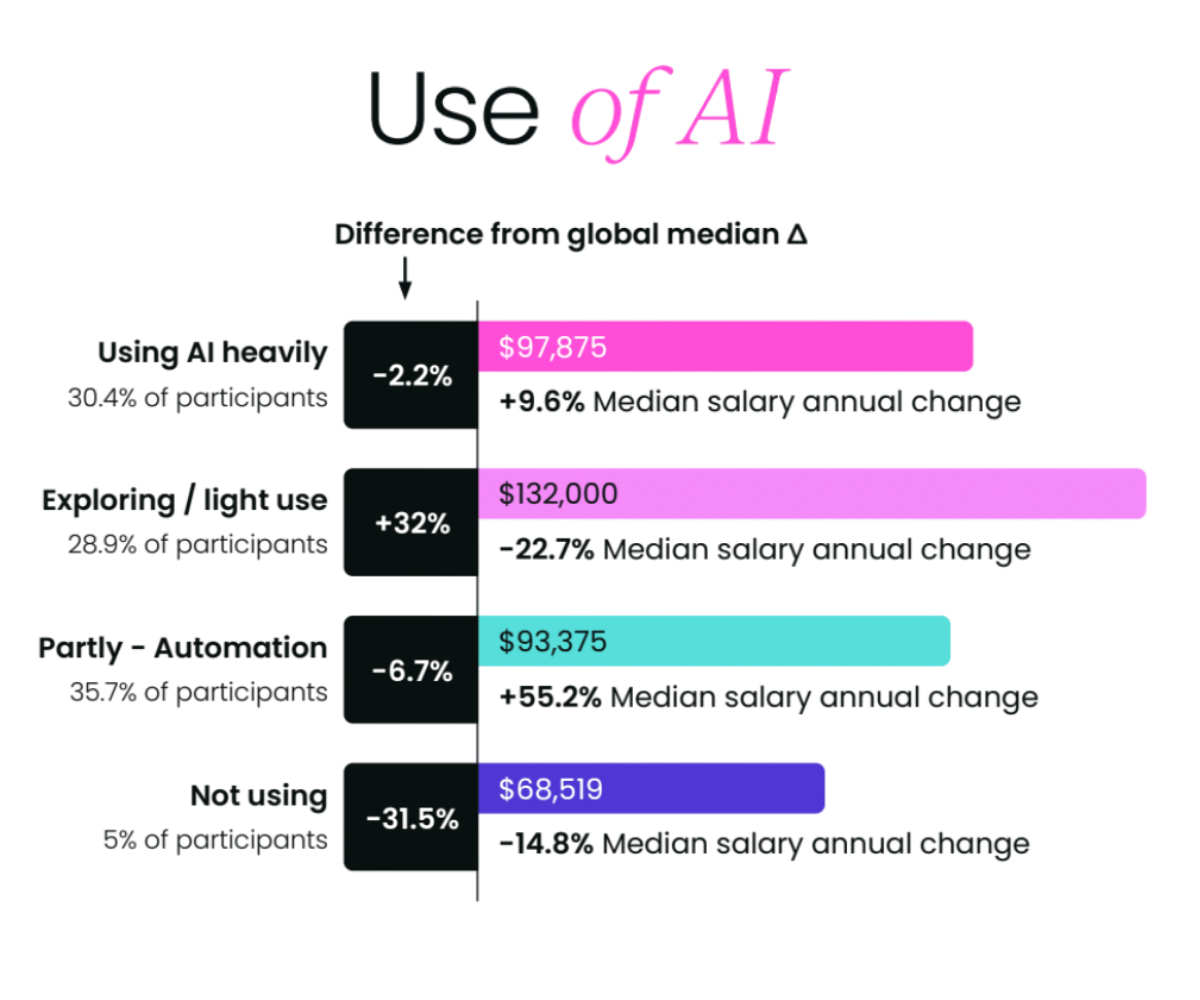
This suggests something important: AI isn’t yet rewarding technical depth. It’s rewarding strategic curiosity.
Light AI users tend to treat AI as a thinking partner rather than a replacement for their work. They use it to prep renewal narratives, summarize complex conversations, extract insights from data, or articulate customer value more clearly. The outcome is a more confident, more efficient, more strategic operator – just the kind companies love promoting.
Hopefully, it’ll reassure a lot of the customer success community that they don’t need to "become an AI expert." You just need to understand how AI sharpens your work and improves your thinking. A few minutes here and there – a summary, a brainstorm, a rewritten email – can meaningfully shift how your expertise is perceived.
4. Specialize in a revenue motion
One of the clearest – and most misunderstood – compensation signals this year is the value of specialization in revenue-driving functions.
You might think that owning renewals, upsells, and cross-sells simultaneously would increase your earning potential. But the opposite is true. The highest-paid CS professionals are those who specialize:
- Cross-sell specialists earn a median of $123,000
- Renewal-focused CS pros earn $117,500
- Those responsible for all expansion motions? $97,500
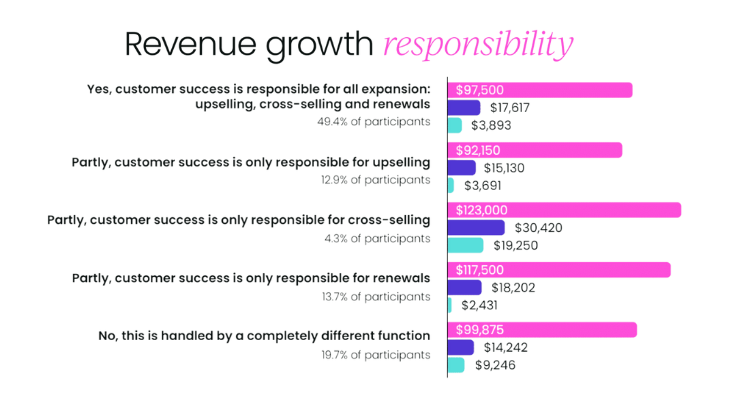
This tells us something important: companies value clarity. And when your remit is too broad, your impact becomes harder to measure – and harder to reward.
Specialists build deeper playbooks, more predictable outcomes, and clearer ROI. They understand the nuances of a particular revenue motion and can improve it in ways generalists can’t. And because their value is easier to quantify, it’s easier to compensate.
If your goal is to increase your salary without changing companies, specialization may be the most powerful lever you have.
5. Move toward enterprise environments
If earning potential is your north star, enterprise companies are hard to ignore. The report shows an unmistakable compensation curve as company size increases:
- Small companies (<50 employees): $77,000
- Mid-sized (201–500 employees): $110,000
- Mid-large (1,001–5,000 employees): $129,000
- Enterprise (10,000+ employees): $200,000
Don’t be fooled into thinking enterprise companies are just bigger versions of smaller companies with a little more red tape. It’s an entirely different ballgame. You’ve got more stakeholders, more complexity, more sophisticated customer expectations, and more political layers.

But it’s not all doom and gloom. With enterprise companies, you also get higher budgets, more structured career paths, and compensation that reflects the scale of responsibility.
Enterprise CS requires composure, executive communication, strategic thinking, and a comfort with ambiguity. If that aligns with your strengths, enterprise is one of the most reliable paths to higher earnings.
The key is showing you’re ready for it: highlighting cross-functional wins, navigating big accounts, influencing product, and driving measurable outcomes across large customer bases.
6. Choose industries that truly value customer success
Customer success isn’t valued equally across industries, and the salary data makes that starkly clear. Some sectors treat CS as essential to long-term revenue – and they pay accordingly:
- Healthcare saw a dramatic surge this year, jumping to a $150,000 median base salary.
- Marketing and advertising reached $114,320, and software remains strong at $110,000.
We see a pattern emerge: retention is mission-critical, switching costs are high, and customer relationships have a significant commercial impact. When CS drives measurable revenue outcomes, salaries rise. When CS is treated as post-sale support, salaries stagnate.
So, if you’re feeling stuck in an industry that undervalues CS, the data suggests it’s not you... it’s your sector. Moving to an industry where CS is central to the business model can transform your earning potential far faster than climbing the ladder where you are.
7. Use geography as a leverage tool
Remote work has changed almost everything about how we hire. But it hasn’t eliminated the impact of geography on compensation. Salaries still correlate heavily with the economic profile of the employer, not necessarily the employee.
- North America leads at $110,00
- Australasia follows at $90,420
- Europe sits far lower at $70,000
Inside the U.S., the Northeast tops the charts with a median of $150,000, followed by the West at $135,000.
But what does this mean for you?
It means you can increase your salary simply by shifting your job search toward companies headquartered in higher-paying regions, even if you never leave your city or your living room. When the employer benchmarks compensation to a stronger market, remote employees benefit from that uplift.
This is one of the quietest but most powerful salary strategies available today: work wherever you want, but get paid according to the economic center of someone else’s HQ.
8. Show up in the community
One of the most quietly influential sections of the salary report is the data around conferences and certifications. Not because attending an event magically raises your salary, but because professionals who invest in themselves consistently earn more.
The numbers are telling. In the U.S., conference attendees report a median salary of $141,250, compared to $124,500 for those who don't attend. Even in Europe, the gap shows up at $74,250 versus $72,000. The difference is subtle, but persistent, and gets stronger the more senior the role.
Certification data tells the same story. Certified CS professionals earn more at nearly every level, and at the executive tier, the difference becomes striking — certified VPs reach a median of $260,500, compared to $225,000 for their non-certified peers.
But the real story here is not the credentials themselves. It’s what the credential represents.
- It signals curiosity
- It signals ambition
- It signals a commitment to mastering your craft
And perhaps most importantly, it puts you in rooms – virtual or physical – where opportunities tend to happen. People who invest in their careers tend to get noticed, and people who get noticed tend to move faster.
In CS, visibility is a currency. And the people who cultivate it consistently earn more.
9. Lead before the title
Leadership in customer success isn’t about managing people. (At least not at first.) It’s about taking responsibility for outcomes, shaping strategy, and elevating how your team operates. And the salary jumps tied to leadership roles are some of the largest in the entire report.
The move from CSM to Senior CSM brings a substantial increase. The leap from Senior CSM to Team Lead or Manager shifts your earning bracket entirely. And once you reach Head of CS, Director, or VP, compensation can skyrocket – with VPs now earning a median of $250,000.
But here’s the nuance the data doesn’t explicitly say but absolutely implies: Most people wait too long to act like leaders. They wait for permission. They wait for validation. They wait for the title.
Leadership, however, is almost always awarded retroactively. You lead first, then the title follows.
That means taking the initiative in cross-functional conversations, improving processes that frustrate everyone, mentoring colleagues who need guidance, reframing customer challenges in a strategic way, or stepping up when the situation feels a little too big for your current job description.
Managers promote the people who make the team better. And the sooner you behave like that person, the sooner your salary moves into leadership ranges.
10. Stay open to new opportunities
The final insight in the report is one of the most revealing: CS professionals who are open to new roles earn more. Those actively looking report a median salary of $100,000, compared to $95,300 for those who are not.
It’s not that job seekers are inherently higher earners, it’s that the professionals who explore the market tend to better understand their worth. They see what other companies pay. They learn how their skills are valued outside their current environment. And because of that, they negotiate more confidently – both internally and externally.
Internal raises are often capped by budget cycles and pay bands. External offers have no such limitations.
Even if you love your role, periodically engaging with the job market is a form of career hygiene. It keeps your expectations grounded in reality, and it ensures you’re not being quietly underpaid simply because you haven’t questioned it in a while.
The most empowered CS professionals don’t job-hop constantly. They simply stay informed – and because of that, their compensation stays aligned with their value.
Your earning potential is not static
The data is clear. Customer success is becoming more strategic, more commercial, and more valued. And with that comes more earning potential, if you know which levers to pull.
None of these 10 strategies require luck. None require “waiting your turn.” They require intention, skill-building, and positioning. And the moment you start treating your compensation as something you can influence – not something you simply accept – you’ll start moving toward the salary your work deserves.


Become a CSC Insider
Thank you for subscribing
Get exclusive insights, frameworks, and strategies from customer success leaders driving real business impact.
An email has been successfully sent to confirm your subscription.
 Follow us on LinkedIn